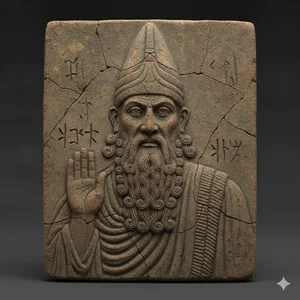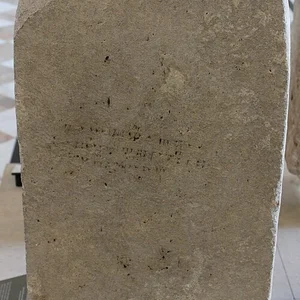

Dagon is a Semitic deity worshipped by the Philistines and Canaanites, associated with fertility and the harvest. His cult is attested throughout the ancient Near East, notably at Ugarit and Gaza. He was later reinterpreted as a demonic figure in Christian literature and in John Milton's Paradise Lost.
Dagon
Dagon
9 min read
Frequently asked questions
Key Facts
- Cult attested as early as the 3rd millennium BCE in Mesopotamia and the Levant
- Chief god of the Philistines, with major temples at Gaza and Ashdod
- Mentioned in the Hebrew Bible (Judges 16; 1 Samuel 5) as a rival to Yahweh
- Worshipped at Ugarit (Ras Shamra) as the father of Baal in cuneiform texts
- Reinterpreted as a demon in John Milton's Paradise Lost (1667)
Works & Achievements
A major Philistine sanctuary dedicated to Dagon in the city of Ashdod, mentioned in the Hebrew Bible and the First Book of Maccabees. It was one of the most important religious centers on the Canaanite coast for several centuries.
A major sanctuary in the Philistine city of Gaza, made famous by the biblical story of Samson bringing down its pillars. It bears witness to the lasting presence of the Dagon cult in the coastal cities of Philistia.
A collection of mythological tablets in the Ugaritic alphabet discovered at Ras Shamra, in which Dagon appears as the father of the god Baal. These texts are the richest source on Canaanite mythology and Dagon's role within the pantheon.
The Akkadian ruler Naram-Sin describes himself in his inscriptions as "beloved of Dagon," attesting to the integration of this Semitic deity into Mesopotamian royal theology and his influence beyond Syria.
The royal tablets of Mari include oracles and prophecies delivered in the name of Dagon, addressed to King Zimri-Lim. These texts are among the oldest known examples of prophecy in the Semitic Near East.
Milton's epic poem includes Dagon among the fallen angels alongside Beelzebub and Moloch, depicting him as a half-human, half-fish deity. Although historically inaccurate, this work profoundly shaped the portrayal of Dagon in Western culture.
Anecdotes
The name Dagon most likely derives from the Semitic word "dagan," meaning "grain" or "wheat." This etymology reveals that Dagon was first and foremost an agricultural deity, protector of harvests in ancient Near Eastern societies that depended entirely on cereal production for their survival.
According to the First Book of Samuel (chapter 5), when the Philistines captured the Hebrew Ark of the Covenant, they placed it in the temple of Dagon at Ashdod. The next morning, the statue of Dagon was found fallen face-down before the Ark. Set upright again, it fell a second time the following day — this time broken: its head and hands lay severed on the temple threshold.
In the mythological texts discovered at Ugarit (present-day Syria), written in the 14th century BCE, Dagon is mentioned as the father of the god Baal, the supreme deity of the Canaanites. This lineage illustrates the fundamental importance of Dagon in the western Semitic pantheon, long before the Philistines.
Medieval scholars, confusing "dag" (the Hebrew word for fish) with the name Dagon, invented the idea that Dagon was a fish-bodied god. This interpretation, entirely unsupported by archaeology, nonetheless influenced centuries of iconography and continues to inspire works of fiction today, including those of H.P. Lovecraft.
The biblical episode of Samson (Judges 16) takes place in the temple of Dagon at Gaza, where thousands of Philistines gather to celebrate a victory. Samson, blinded and in chains, prays to his god and topples the temple's pillars, killing — according to the account — more than three thousand people. This text testifies to the importance of Dagon's temples as political and religious centers of Philistine cities.
Primary Sources
The royal archives of Mari (present-day Tell Hariri, Syria) contain numerous references to Dagon as the tutelary deity of the middle Euphrates, recipient of royal sacrifices and guarantor of diplomatic oaths.
"Baal sends messengers to Mot: Word to Mot, son of El, message from the mighty god Baal." In these tablets, Dagon is invoked as the father of Baal, deity of rain and fertility.
"The Philistines captured the ark of God and brought it from Ebenezer to Ashdod. Then they carried the ark into Dagon's temple and set it beside Dagon."
"The rulers of the Philistines assembled to offer a great sacrifice to Dagon their god and to celebrate. They said: Our god has delivered Samson, our enemy, into our hands."
"Azotus and the neighboring towns were set on fire; their spoils and the temple of Dagon, along with all who had taken refuge there, were burned."
Key Places
One of the five great Philistine city-states, Ashdod was home to the principal temple of Dagon in Philistia. According to the Book of Samuel, the Ark of the Covenant was placed there, and the Maccabean general Jonathan burned the sanctuary to the ground in the 2nd century BCE.
A coastal Philistine city where a great temple of Dagon stood, said in the Bible to be the site of Samson's final act. Gaza was a major commercial and religious center along the Canaanite coastline.
A Late Bronze Age Canaanite city-state where thousands of mythological tablets were discovered in 1929, mentioning Dagon as the father of Baal. Ugarit is the most important archaeological site for understanding Canaanite religion.
A powerful city-state on the middle Euphrates whose royal archives from the 18th century BCE provide some of the earliest recorded evidence of the cult of Dagon, attesting to royal sacrifices and oracles delivered in his name.
One of the earliest great Semitic metropolises, whose archives from the 3rd millennium BCE contain the oldest known attestations of the name Dagon, testifying to the great antiquity of his cult.
Typical Objects

The primary symbol of Dagon, whose name derives from a Semitic word meaning "grain." Offerings of grain were the central ritual gesture of his cult, reflecting his role as protector of harvests.

Dagon's temples housed richly adorned divine statues, as evidenced by the biblical account of the statue at Ashdod that topples before the Ark of the Covenant. These idols stood at the heart of Philistine veneration rituals.

A ritual piece of furniture in stone or wood placed before the divine statue in Canaanite and Philistine temples, upon which food offerings — bread, grain, oil — were laid to nourish the god.

A ceramic or metal vessel used in libation rites — the pouring of oil, wine, or water — in honor of Dagon. These cups, often richly decorated, are regularly found in excavations of Canaanite sites.

Dagon's priests kept administrative and liturgical records on clay tablets inscribed in cuneiform or Ugaritic alphabetic script, such as those discovered at Ugarit and Mari.

A symbolic weapon offered as a votive gift in temples of the ancient Near East, testifying to a king's victory placed under Dagon's protection. Several votive axes dating to the Middle Bronze Age have been found in cultic contexts across Syria-Palestine.
School Curriculum
Vocabulary & Tags
Key Vocabulary
Tags
Daily Life
Morning
At dawn, the priests of Dagon would open the temple doors and ritually "awaken" the divine statue by washing it, anointing it with perfume, and offering the first meal of the day — wheat bread, oil, and fruit. Hymns were sung at sunrise to honor the god's power over the coming harvests.
Afternoon
The afternoon was devoted to temple administration: receiving offerings from worshippers (grain, livestock, oil), maintaining records on clay tablets, and overseeing work on the agricultural lands belonging to the sanctuary. Oracular consultations could also take place, with the priest conveying messages from the god.
Evening
At sunset, a final food offering was presented to the statue of Dagon before the temple doors were closed. During major festivals, communal banquets brought together the city's notables in the temple courtyards, accompanied by music and ritual dances performed in honor of the god.
Food
The diet in Philistine and Canaanite cities was built around the Mediterranean triad: wheat (bread and porridge), olive oil, and wine. Mutton and goat were eaten during sacrifices and festive banquets. Fish, plentiful along the coast, rounded out the diet of coastal communities such as Gaza.
Clothing
Priests officiated in white linen robes — a pure fabric symbolically linked to the sacred throughout the ancient Near East. Worshippers wore tunics of dyed wool, often decorated with geometric embroidery. Women adorned themselves with bronze and gold jewelry — bracelets, necklaces of faience and carnelian beads — for religious ceremonies.
Housing
Temples of Dagon followed a Levantine-Canaanite architectural plan: an outer courtyard accessible to worshippers, a vestibule, and an inner sanctuary (the Holy of Holies) reserved for priests, where the divine statue stood on its pedestal. The priests lived in annexes of the temple complex, surrounded by granaries and craft workshops managed by the religious institution.
Historical Timeline
Period Vocabulary
Visual Style
Esthétique du Proche-Orient ancien au Bronze récent : architecture de pierre massive, statuaire stylisée en or et bois, mélange d'influences égéennes, égyptiennes et levantines sur céramiques et bronzes rituels.
Sound Ambience
Ambiance sonore d'un temple cananéen du Bronze récent : chants liturgiques, percussions rituelles et bruits de la cité philistine mêlés au vent du désert côtier.
Liens externes & ressources
Références
Œuvres
Temple de Dagon à Ashdod
XIIe – IIe siècle av. J.-C.
Temple de Dagon à Gaza
XIIe – Xe siècle av. J.-C.
Cycle mythologique de Baal (tablettes d'Ougarit)
XIVe – XIIIe siècle av. J.-C.
Inscriptions royales de Naram-Sin d'Akkad
v. 2250 av. J.-C.
Archives de Mari — textes prophétiques
XVIIIe siècle av. J.-C.
Paradise Lost de John Milton
1667