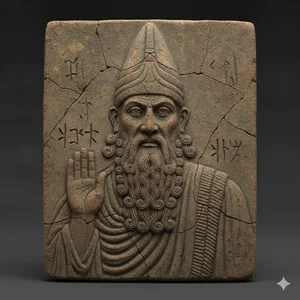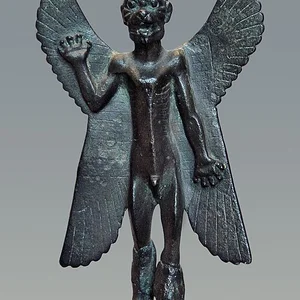

Pazuzu is a Mesopotamian demon of the evil wind, depicted with a canine face, raptor wings, and a hybrid body. Paradoxically, he was invoked as a protector against Lamashtu, the demon of childbirth. His image adorned amulets to protect pregnant women and newborns.
Pazuzu
Pazuzu
7 min read
Frequently asked questions
Key Facts
- Pazuzu is attested primarily in Neo-Assyrian texts and objects from the 1st millennium BCE
- He is described as king of the wind demons of the air, bringer of disease and fever
- Statuettes and amulets bearing his likeness have been found in large numbers at Nineveh and other Assyrian sites
- Paradoxically a protector, he was invoked to ward off Lamashtu, a demoness who threatened pregnant women and children
- He became widely known in modern popular culture through William Friedkin's film The Exorcist (1973)
Works & Achievements
A corpus of cuneiform tablets in three series describing rituals to protect pregnant women and newborns. Pazuzu is systematically invoked as a force opposed to Lamashtu.
A major compilation of nine tablets of exorcisms against witchcraft and demons. It attests to the role of wind spirits, including Pazuzu, in Assyro-Babylonian demonological cosmology.
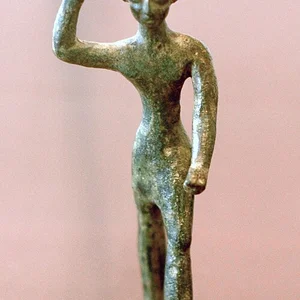
One of the most complete and best-preserved three-dimensional representations of the demon, discovered at Nimrud. It serves as direct evidence of Pazuzu's iconography and ritual use.
A bronze head of Pazuzu with a suspension ring, held at the Louvre Museum. Among the most iconic examples of the type of portable talisman used to protect newborns.
An exceptional collection of cuneiform texts assembled by the Assyrian king Ashurbanipal, including rituals, myths, and incantations. These tablets represent the most important written source on Mesopotamian demonology, including Pazuzu.
Anecdotes
Pazuzu is one of the rare Mesopotamian demons to play a protective role: although he is himself a malevolent spirit of the southwest wind, his image was placed in homes to frighten away Lamashtu, the demoness who preyed on pregnant women and newborns. The Mesopotamians thus used the power of one evil to ward off another.
Archaeologists have unearthed dozens of bronze statuettes depicting Pazuzu, notably at Nimrud and Nineveh. These figurines were often hung above the beds of women about to give birth, acting as invisible guardians. Some bore an Akkadian inscription invoking the demon's name and powers.
The head of Pazuzu was the most widespread talisman: amulets in the shape of a grimacing canine face, pierced with a hole to be worn as a pendant, have been found throughout Mesopotamia. This terrifying face was believed to repel malevolent forces lurking around newborns by its appearance alone.
Pazuzu is described in cuneiform texts as 'the king of the evil wind demons,' son of the underworld god Hanbi. His hybrid body — dog's head, eagle's wings, human torso, scorpion's tail — symbolized his power over multiple realms of the living world, making him fearsome even among other demons.
In the Neo-Assyrian period, exorcists (the āshipu) recited specific incantations calling upon Pazuzu to drive Lamashtu from a household. Ritual texts detail the procedure: craft a figurine of Pazuzu, recite the appropriate formulas, and place the statuette at the entrance of the home to make it a permanent guardian.
Primary Sources
Pazuzu, king of the demons of the evil wind, I invoke you. You who surpass the wind gods in majesty, protect this house and drive away the demoness Lamashtu.
Votive figurine depicting Pazuzu standing, grimacing canine face, wings spread, bearing an Akkadian inscription on the base recalling his protective function.
Bronze head of Pazuzu with suspension ring. Used as an amulet to protect pregnant women and newborns against evil spirits.
The incantations of the Maqlû mention wind demons among the forces the exorcist could call upon to purify a household and drive away harmful spirits.
Description of Pazuzu's attributes: 'His face is that of the desert lion, his claws are those of the eagle, his body bears the scales of the serpent, and his wings cover the sky with the evil wind.'
Key Places
Capital of the Neo-Assyrian Empire and its main religious center, where numerous statuettes and tablets mentioning Pazuzu were discovered. The Library of Ashurbanipal housed the most complete series of exorcism texts.
Assyrian city where archaeologists unearthed several of the finest bronze statuettes of Pazuzu in the 19th century. These objects are now held in the British Museum in London.
Holy city of the Assyrian Empire and its earliest major religious center; numerous apotropaic amulets linked to birth rituals have been excavated here.
Great metropolis of the Mesopotamian world where the ritual tradition against Lamashtu was codified and transmitted. Babylonian texts are the richest written sources on Pazuzu's protective role.
A major religious and intellectual center of ancient Mesopotamia, where libraries of cuneiform tablets preserved numerous ritual texts referencing wind demons and exorcism practices.
Typical Objects

A bronze or clay pendant depicting only the demon's grimacing head, pierced to be worn around the neck. It was the most widespread talisman for protecting pregnant women and newborns against Lamashtu.

A figurine 10 to 25 cm tall depicting Pazuzu standing with wings spread, sometimes bearing a dedicatory inscription. It was placed at the entrance of homes or in bedrooms to serve as a permanent guardian.

A rectangular bronze or fired clay tablet engraved with scenes of combat between Pazuzu and Lamashtu. Hung on a bedroom wall, it served to visualize and reinforce the protection of the benevolent demon.

A clay tablet inscribed in Akkadian containing the ritual formulas to be recited when invoking Pazuzu during difficult childbirth. The exorcist (āšipu) would read it aloud while holding a figurine of the demon.

A ceramic vessel used to burn aromatic resins during invocation rituals. The smoke was believed to attract the attention of protective spirits, including Pazuzu, and to purify the space of malevolent presences.

A red-dyed wool thread tied around the wrists of pregnant women during protective ceremonies. Combined with the invocation of Pazuzu, it formed a symbolic barrier between the mother and demonic forces.
School Curriculum
Vocabulary & Tags
Key Vocabulary
Daily Life
Morning
At sunrise, the exorcist (āšipu) who invokes Pazuzu performs a ritual ablution and recites the first incantations of the day to renew the protection of the household. He inspects the amulets hung by the doors and checks that the statuette of Pazuzu is still in place at the entrance of the home.
Afternoon
The afternoon is devoted to preparing remedies and ritual objects: shaping small clay figurines, blending medicinal herbs, and inscribing formulas onto tablets. If a woman is about to give birth, the exorcist arranges the birthing chamber by placing Pazuzu amulets around the bed.
Evening
At nightfall — the hour when demons are said to be most active — the rituals invoking Pazuzu reach their peak intensity. The exorcist burns incense, recites long series of incantations, and places a figurine of the protective demon beneath the threshold to guard the entrance through the night.
Food
Mesopotamian ritual practitioners followed specific dietary restrictions during ceremonies: abstaining from certain meats and fish considered impure, and consuming barley bread, dates, and emmer wheat beer. Certain herbs with soothing properties were incorporated into ritual preparations.
Clothing
The exorcist who invokes Pazuzu wears white wool garments for purification rituals, or dark tunics during nighttime ceremonies. Red wool cords are tied around the patient to strengthen their protection. Pazuzu amulets are worn directly against the skin as pendants.
Housing
Neo-Assyrian houses built from sun-dried clay bricks are organized around a central courtyard. Birthing chambers are set up in the innermost rooms to shield the mother in labor from evil winds. Niches in the walls hold protective statuettes, and inscribed tablets are buried beneath thresholds to consecrate the space.
Historical Timeline
Period Vocabulary
Visual Style
Style inspiré des bas-reliefs et statuettes en bronze néo-assyriens, avec une iconographie hybride sombre et solennelle évoquant la puissance démoniaque protectrice.
Sound Ambience
Atmosphère nocturne d'une cité néo-assyrienne traversée par les vents du désert, ponctuée des chants d'exorcistes et des crépitements d'encens brûlé lors des rituels de protection.
Liens externes & ressources
Références
Œuvres
Série d'incantations anti-Lamashtu
IIe–Ier millénaire av. J.-C.
Série rituelle Maqlû
VIIe siècle av. J.-C.
Statuette en bronze de Pazuzu (British Museum BM 93079)
Vers 800 av. J.-C.
Plaquette apotropaïque du Louvre (AO 22205)
Ier millénaire av. J.-C.
Tablettes de la bibliothèque d'Assurbanipal (Ninive)
VIIe siècle av. J.-C.