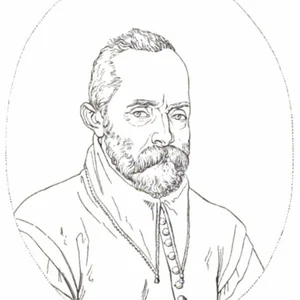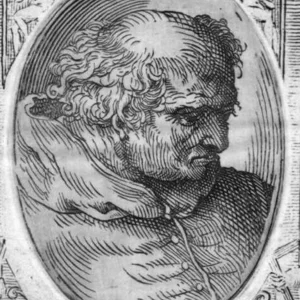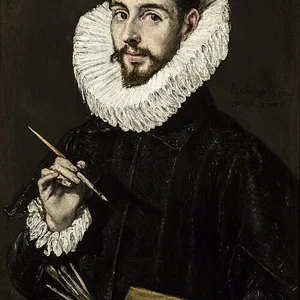

Son and collaborator of El Greco, Jorge Manuel Theotokópoulos (1578–1631) was a painter and architect in Toledo. He carried on his father's Mannerist style while working as a master builder on several projects in the city.
Jorge Manuel Theotokópoulos
Jorge Manuel Theotokópoulos
7 min read
Frequently asked questions
Key Facts
- Born in 1578 in Toledo, legitimate son of El Greco and Jerónima de las Cuevas
- Worked in his father's workshop from adolescence, jointly executing numerous commissions
- After El Greco's death (1614), he inherited the workshop and continued producing works in his father's style
- Also practiced as an architect in Toledo, notably on projects for the cathedral
- Died in 1631, leaving a body of work that is difficult to distinguish from his father's
Works & Achievements
A set of paintings produced for the hospital of Illescas, begun by El Greco with contributions from Jorge Manuel. The affair ended in litigation, as the patrons disputed the price of the work.
A composition repeated by the workshop at the request of multiple patrons. Attribution between El Greco and Jorge Manuel remains debated among art historians, illustrating the close collaboration between the two painters.
As *maestro mayor de obras*, Jorge Manuel oversaw the maintenance and various interventions on the primatial cathedral. This position conferred considerable social prestige and authority upon him within the city.
Following El Greco's death, Jorge Manuel continued to receive commissions. Many of these works held in Spanish collections bear the uncertain attribution "El Greco and workshop," reflecting his fidelity to his father's style.
A painting attributed to Jorge Manuel in several early inventories, attesting to his loyalty to his father's Mannerism: the elongated figures, acid colours, and supernatural light effects characteristic of the Toledan school.
Anecdotes
Jorge Manuel was born in 1578 as the illegitimate son of El Greco and Jerónima de las Cuevas. Although his parents never married, his father formally acknowledged him and brought him into the workshop at a very young age, passing on all the secrets of the craft. This was perfectly acceptable in the artistic circles of Toledo at the time.
An indispensable collaborator to his father, Jorge Manuel worked alongside El Greco on the major commissions in Toledo. After the master's death in April 1614, he was chiefly responsible for the inventory of the workshop, which revealed more than a hundred unfinished paintings, cartoons, and small wax sculptures used as models for painted figures.
Appointed *maestro mayor de obras* for several important buildings in Toledo, including the primatial cathedral, Jorge Manuel pursued a dual career as painter and architect — quite rare for the period. This versatility, inherited from the humanist training of his father's workshop, earned him a social standing far above that of an ordinary craftsman.
The Theotokópoulos workshop was embroiled in a lengthy lawsuit over the altarpiece for the Hospital de la Caridad in Illescas: the friars refused to pay the asking price, claiming the work was overvalued. Jorge Manuel had to manage the legal fallout from this contentious inheritance long after his father's death, illustrating the financial difficulties faced even by the finest artists of the Golden Age.
Primary Sources
The document lists the finished and unfinished paintings, wax sculptures, and tools of the workshop, compiled in the days following the painter's death. It attests to Jorge Manuel's central role in managing his father's estate and the material wealth accumulated by the workshop.
Agreement between El Greco's workshop and the hospital administrators, specifying the dimensions, iconographic programme, and agreed price. This document is at the origin of a celebrated lawsuit over non-payment in which Jorge Manuel was directly involved.
Deliberation of the cathedral chapter confirming the post of master builder to Jorge Manuel Theotokópoulos, with mention of his obligations to oversee construction works and to render annual accounts before the canons.
Record of the death of Domenikos Theotokopoulos known as El Greco, naming Jorge Manuel as heir and executor of the will. The document notes outstanding debts and charges the son with settling them with creditors.
Key Places
Jorge Manuel's birthplace and the setting of his entire career. A former imperial capital and religious city, Toledo was in the seventeenth century one of the most active artistic centers on the Iberian Peninsula.
The largest religious building in Toledo, for which Jorge Manuel served as *maestro mayor de obras*. He oversaw the maintenance and various works on this monumental Gothic complex.
The home and studio where Jorge Manuel lived and worked his entire life alongside his father, and then alone after 1614. Now a museum, this site preserves the memory of the Toledan Mannerist school.
A hospital located some twenty kilometers north of Toledo, for which El Greco's workshop produced a series of paintings that gave rise to a famous lawsuit over non-payment involving Jorge Manuel.
Typical Objects

An oval wooden board on which the painter mixed his pigments ground in linseed oil. Jorge Manuel used the same color range as his father: vermilion, madder lake, lead white, and ochres.

An essential measuring and drafting instrument for Jorge Manuel in his role as maestro mayor. It was used to transfer distances, draw arcs, and verify the proportions of buildings under construction.

A large sculpted and painted ensemble placed behind the altar of a church, and the principal commission for painters in 16th–17th century Spain. Jorge Manuel completed or finished several in Toledo and the surrounding area.

The painter's everyday tools, made from sable or boar hair depending on the technique. The Theotokópoulos workshop kept many types on hand for the transparent glazes (*veladuras*) characteristic of El Greco's style.

The raw materials of painting, purchased from specialist merchants and ground in the workshop. Lapis lazuli, imported from Afghanistan, was reserved for the Virgin's robes; vermilion produced the intense reds characteristic of the workshop.

Tools used by Jorge Manuel in his capacity as architect to check the plumb of walls and the levelness of stone courses — visible symbols of his authority as master builder.
School Curriculum
Vocabulary & Tags
Key Vocabulary
Daily Life
Morning
Jorge Manuel began his day early, making the most of the morning light to paint in the family workshop. He prepared pigments, organized the apprentices, and returned to works in progress — often large altarpieces destined for churches in Toledo and the surrounding area.
Afternoon
In the afternoon, his role as *maestro mayor* took him to the construction sites of the cathedral or other buildings around the city. He checked on the progress of the work, conferred with the stonemasons, and reported back to the cathedral chapter.
Evening
In the evenings, Jorge Manuel devoted himself to administrative matters: drafting contracts, corresponding with patrons, and settling legal disputes inherited from his father's unresolved cases — most notably the Illescas affair.
Food
Like most prosperous Toledan craftsmen, he ate wheat bread, dried legumes, mutton or pork, and drank wine from La Mancha. The many fast days imposed by the Church made dried fish and eggs frequent staples.
Clothing
Jorge Manuel wore the dress of a respectable craftsman-artist: a woolen doublet, breeches, and a black cape — the expected color for men of standing in Toledo. His official duties required him to dress with care for meetings of the cathedral chapter.
Housing
He lived in the house inherited from his father in the Jewish quarter of Toledo, a set of rooms arranged around an inner courtyard typical of Toledan architecture. The workshop occupied the best-lit rooms and also served as a showroom for patrons.
Historical Timeline
Period Vocabulary
Liens externes & ressources
Références
Œuvres
Baptême du Christ (versions d'atelier)
vers 1600-1620
Travaux architecturaux à la cathédrale de Tolède
vers 1620-1630
Compositions religieuses de l'atelier (après 1614)
1614-1631