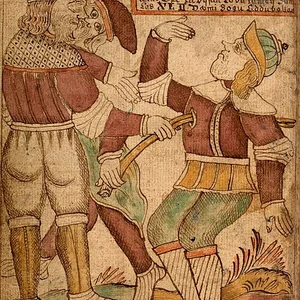

Jörmungand, the Midgard Serpent, is a colossal creature from Norse mythology, son of Loki and the giantess Angrboða. He encircles the world by biting his own tail, a symbol of infinity and chaos. The sworn enemy of Thor, he will slay him at Ragnarök before succumbing to his venom.
Jormungandr
Jörmungand
7 min read
Frequently asked questions
Key Facts
- Son of Loki and Angrboða, brother of Fenrir and Hel
- Odin casts him into the ocean surrounding Midgard, where he grows large enough to encircle the entire world
- Symbol of the Norse Ouroboros: he bites his own tail to hold the world in place
- At Ragnarök, he battles Thor — each will be the cause of the other's death
- Mentioned in the Prose Edda by Snorri Sturluson (13th century) and in the Poetic Edda
Works & Achievements
Written by Snorri Sturluson, this work is the most complete source on Jörmungand, describing his birth, cosmic role, and final battle against Thor at Ragnarök.
Central Eddic poem describing Norse cosmogony and Ragnarök, in which Jörmungand emerges from the waters to take part in the final battle that will destroy the world.
Old Norse poem recounting Thor's adventure of fishing for Jörmungand from the giant Hymir's boat, one of the most popular mythological episodes in Norse tradition.
Elaborate skaldic poem celebrating Thor's exploits, including his battle against Jörmungand during the miraculous fishing trip, attesting to the antiquity of this myth in Viking oral tradition.
Icelandic manuscript containing the Poetic Edda, the only surviving written source of the oldest Norse poems mentioning Jörmungand. Its rediscovery in the 17th century revolutionized knowledge of Norse mythology.
Anecdotes
Jörmungandr is so enormous that it encircles the entirety of Midgard, the world of humans, by biting its own tail. This symbol, called the Ouroboros, represents eternity and the endless cycle of time. The Vikings believed that as long as the serpent held its tail between its teeth, the world remained stable.
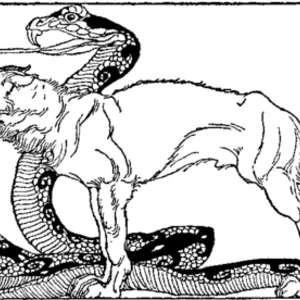
During his journey to the land of the giants, Thor was challenged to lift a cat by King Útgarða-Loki. Despite all his efforts, he could only raise one paw of the animal. The king then revealed that this cat was actually Jörmungandr in disguise: Thor had nearly lifted the Midgard Serpent, a feat that terrified the gods themselves.
At Ragnarök, the final battle that will mark the end of the world in Norse mythology, Thor and Jörmungandr face each other for the last time. Thor manages to kill the serpent with his hammer Mjölnir, but he then succumbs to the deadly venom that the creature spat on him, collapsing after nine steps.
Jörmungandr is one of the three monstrous children of Loki and the giantess Angrboða. His siblings are the wolf Fenrir and Hel, the goddess of the dead. Odin, aware of the danger they posed, threw the serpent into the ocean surrounding Midgard, where it grew until it encircled the entire world.
Scandinavian sailors attributed great storms and tsunamis to the movements of Jörmungandr beneath the sea. When the serpent stirred, the waves raged. This belief reflected the Vikings' fear of an unpredictable and often deadly ocean during their expeditions.
Primary Sources
The serpent Jörmungandr, Odin took it and cast it into the deep sea that encircles all lands. The serpent grew so large that it encircles the whole earth and bites its own tail.
Thor fished for Jörmungandr from the giant Hymir's boat, pulling the line until the serpent burst forth from the waters, before Hymir, seized with fear, cut the line.
The serpent strikes the waves, the eagle screams, the ship of the dead breaks loose; Jörmungandr writhes in its giant fury, the serpent advances over the waters.
Skald describing Thor's battle against Jörmungandr during the miraculous fishing trip, praising the god's strength as he nearly hauled the Great Serpent out of the World Ocean.
Key Places
The vast ocean encircling the world of humans is the domain of Jörmungandr. The serpent is so large that it surrounds all known lands and bites its own tail.
Mythical realm of the giants where Thor was challenged to lift Jörmungandr disguised as a cat. It is in this place of deception and illusion that the gods confront their limits.
Mythical battlefield where the final confrontation between Thor and Jörmungandr will take place. It is there that the two sworn enemies will slay each other, marking the end of the world.
Site of the Icelandic Alþing where skalds and poets recited Norse myths, contributing to the oral transmission of the tales of Jörmungandr before they were written down in the 13th century.
It was in Iceland that Snorri Sturluson wrote down the tales of Jörmungandr in the *Prose Edda* around 1220, preserving Norse cosmology forever.
Liens externes & ressources
Références
Œuvres
Edda en prose — Gylfaginning
vers 1220
Völuspá (La Prophétie de la Voyante) — Edda poétique
vers 1000
Hymiskviða — Edda poétique
XIIe-XIIIe siècle
Þórsdrápa — Eilífr Goðrúnarson
fin du Xe siècle
Codex Regius
vers 1270