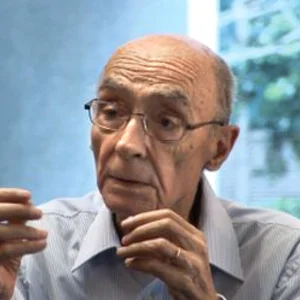

José Saramago is a Portuguese writer and a major figure in 20th-century literature. The author of novels with a powerful imagination and a singular style, he received the Nobel Prize in Literature in 1998, becoming the first Portuguese-language author to do so.
José Saramago(1922 — 2010)
José Saramago
Portugal
6 min read
Frequently asked questions
Famous Quotes
« We are the only animal that can learn, because we are the only animal that can teach.»
« If you can look, see. If you can see, notice.»
Key Facts
- Born in 1922 in Azinhaga, into a family of poor peasants in Portugal
- Publication of Baltasar and Blimunda (Memorial do convento) in 1982, which brought him to wide public attention
- Publication of Blindness (Ensaio sobre a cegueira) in 1995, his most celebrated novel
- Awarded the Nobel Prize in Literature in 1998
- Died in 2010 in Lanzarote, in the Canary Islands, where he had lived in self-imposed exile
Works & Achievements
His very first novel, published at age 24, long remained without a sequel.
A fresco of the peasants of Alentejo where his unique style appears, made of long sentences and dialogues without quotation marks.
Historical novel blending love, the Inquisition, and a flying machine, which revealed him to the world.
Homage to the poet Fernando Pessoa, through one of his famous heteronyms.
A bold and human reinterpretation of the life of Christ, which sparked great controversy.
A parable of an epidemic of blindness that reveals the fragility of civilization; his most famous work.
Story of a civil registry employee fascinated by an unknown woman, a meditation on identity and solitude.
A fable about a country where, suddenly, no one dies anymore, with its absurd and profound consequences.
Anecdotes
The name "Saramago" was not José's real surname: it was a mocking nickname given to his family of poor peasants, referring to a wild edible plant, the wild radish. When his father went to register his birth, the civil registry clerk mistakenly wrote down this nickname. José only discovered this at age 7, when he started school.
His family was too poor to pay for his education: he left high school to learn the trade of locksmith mechanic. He educated himself by reading in the evenings, for free, at a public library in Lisbon. He liked to say that the wisest man he ever knew, his grandfather Jerónimo, could neither read nor write.
Saramago remained an unknown writer for a long time: his first novel was published in 1947, then he fell silent for nearly twenty years. It was only at age 60, in 1982, with *Memorial do Convento*, that he finally achieved success. He proved that one can become a great writer later in life.
In 1992, the Portuguese government withdrew his novel *The Gospel According to Jesus Christ* from a major European literary prize, deeming the book offensive to Catholics. Furious at this censorship, Saramago left Portugal and went into voluntary exile on the volcanic island of Lanzarote in the Canary Islands.
In 1998, he became the first Portuguese-language writer to receive the Nobel Prize in Literature. He learned the news at Frankfurt Airport, just as he was about to board a plane after the Book Fair: he was called back at the last minute to be told of the award.
Primary Sources
The wisest man I ever knew in all my life could neither read nor write.
If you can look, see. If you can see, observe.
I don't think we went blind, I think we are blind; blind people who see, blind people who, seeing, do not see.
We are the memory we have and the responsibility we assume; without memory we do not exist, and without responsibility we perhaps do not deserve to exist.
Key Places
Saramago's birthplace, on the banks of the Tagus River; its peasant world deeply influenced his work.
City where he grew up, educated himself in libraries, and began his career as a journalist and writer.
The immense Mafra Palace-Convent serves as the setting for "Memorial do Convento", his great historical novel.
Volcanic island where he settled in exile from 1993 and where he died in 2010.
Capital where he received the Nobel Prize in Literature in December 1998.
Typical Objects

This humble field plant gave the writer his surname through a mocking nickname. It recalls his peasant origins.

Unlike many writers of his generation, Saramago adopted the computer early on to write his novels, without missing the typewriter.

His round-rimmed glasses and white hair were part of his recognizable image as an attentive old sage.

Symbol of the 1974 Revolution and emblematic flower, the carnation evokes his communist convictions and his attachment to Portugal's regained freedom.

During his exile, Saramago kept a regular journal where he noted his thoughts, readings, and political angers.

His house in Lanzarote housed thousands of books: self-taught, he had made libraries the great project of his life.

Before becoming a writer, young José earned his living as a mechanic locksmith, a manual trade he always took pride in.
School Curriculum
Vocabulary & Tags
Key Vocabulary
Daily Life
Morning
Saramago got up unhurriedly, skimmed through the newspapers, and answered his mail. Then he would sit down at his computer to write, with discipline, about two pages a day, no more, no less, working slowly and carefully.
Afternoon
The afternoon was devoted to reading, research for his books, interviews with journalists, and walking. Later, he also took care of his foundation and defended his political ideas.
Evening
In the evening, he dined and conversed at length with his wife, the Spanish journalist Pilar del Río, who translated his books into Spanish. They discussed current events, politics, and literature.
Food
His cooking was simple and Mediterranean: fish, bread, olive oil, vegetables, and a glass of wine. He remained attached to the modest dishes of his peasant childhood, such as Portuguese bread soups.
Clothing
He dressed soberly and without ostentation: shirts, simple jackets, and his inseparable pair of round glasses. Nothing in his attire betrayed the famous writer.
Housing
He lived at "A Casa," his house in Tías, Lanzarote, dominated by an immense personal library of thousands of books and open to the volcanic landscape. Previously, he had known modest apartments in Lisbon.
Historical Timeline
Period Vocabulary
Visual Style
Une esthétique sobre en noir et blanc, entre réalisme social du XXe siècle et touche de réalisme magique, sur fond de paysages volcaniques et de bibliothèques.
Sound Ambience
Le calme studieux d'un bureau d'écrivain à Lanzarote, mêlé au vent de l'Atlantique et aux échos lointains de la campagne portugaise de son enfance.
Liens externes & ressources
Références
Œuvres
Terra do Pecado
1947
Levantado do Chão (Relevé de terre)
1980
Memorial do Convento (Baltasar et Blimunda)
1982
O Ano da Morte de Ricardo Reis (L'Année de la mort de Ricardo Reis)
1984
O Evangelho segundo Jesus Cristo (L'Évangile selon Jésus-Christ)
1991
Ensaio sobre a Cegueira (L'Aveuglement)
1995
Todos os Nomes (Tous les noms)
1997