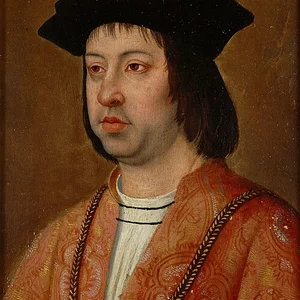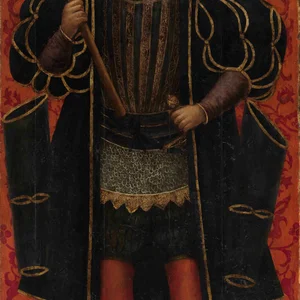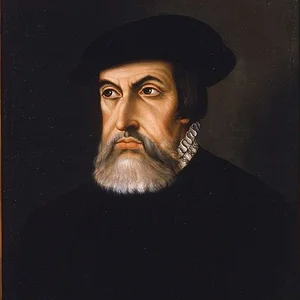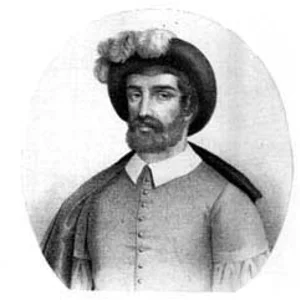

Spanish navigator and sailor (c. 1476–1526), he took command of Magellan's expedition after the latter's death in the Philippines and completed the first circumnavigation of the globe in 1522, returning the Victoria to Seville.
Juan Sebastián Elcano(1486 — 1526)
Juan Sebastián Elcano
Espagne
7 min read
Frequently asked questions
Key Facts
- Born around 1476 in Getaria, in the Spanish Basque Country
- Took part in Magellan's expedition, which set off in 1519 with 5 ships and 270 men
- Took command after Magellan's death in the Philippines in April 1521
- Returned to Seville on 6 September 1522 with 18 survivors aboard the Victoria, completing the first circumnavigation of the world
- Charles V granted him a coat of arms bearing the motto: 'Primus circumdedisti me' (You were the first to sail around me)
Works & Achievements
Commanding the Victoria, Elcano completed the first circumnavigation in history, definitively proving the roundness of the Earth and the existence of a western sea route to the Indies.
An official document addressed to the emperor in which Elcano reported on the voyage, the discoveries, and the deaths. It is one of the earliest firsthand sources on the Magellan-Elcano expedition.
Elcano appeared before the Casa de Contratación in Seville to give an official account of the expedition. His testimony helped establish geographical knowledge of the new maritime routes.
Elcano set out again as second-in-command for a second circumnavigation on the orders of Charles V. He died of scurvy in the Pacific on August 4, 1526, before he could complete the voyage.
Anecdotes
Elcano was one of the mutineers who had risen against Magellan at Port Saint Julian in April 1520. Sentenced to hard labor, he was pardoned by Magellan, who needed experienced sailors to continue the passage through the strait. Without that unexpected pardon, he could never have completed the first circumnavigation of the globe.
When the Victoria entered the port of Seville on September 6, 1522, only 18 men remained of the 270 who had set out three years earlier. The survivors were so exhausted and emaciated that they walked barefoot in procession to the cathedral to give thanks to God for still being alive.
Upon his return, Emperor Charles V granted Elcano a coat of arms depicting a globe surrounded by the Latin motto *Primus circumdedisti me*, meaning “You first circumnavigated me.” It is one of the finest honors ever bestowed upon a navigator in history.
The sailors of the Victoria were astonished to discover, upon arriving in Seville, that they had lost an entire day in their logbook compared to the inhabitants of Spain. By sailing continually westward, they had “gained” time without realizing it — a discovery that would fascinate scientists and philosophers for centuries.
Primary Sources
The captain-general [Magellan] having died, the five ships continued their course under the command of Juan Sebastián del Cano, who took the return route via the Cape of Good Hope and brought the ship Victoria, laden with cloves, back to Seville.
Your Majesty should know that we have accomplished the greatest and most admirable thing ever done since the creation of the world, for we have circumnavigated the entire earth, returning by the way the sun travels.
In reward for his services and the glory he has brought to the crown of Castile by being the first to circumnavigate the world, We grant him as his coat of arms a golden globe bearing the motto Primus circumdedisti me.
Partido de Sanlúcar de Barrameda a veinte de septiembre de mil e quinientos e diez e nueve años, con cinco naos y doscientos e sesenta e cinco hombres...
Key Places
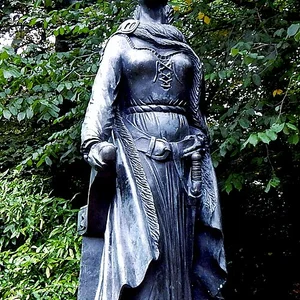
Small Basque port town where Elcano was born around 1476–1487. Today, a statue of him stands facing the Atlantic Ocean and a museum is dedicated to his memory.
The port from which the Magellan–Elcano expedition set sail on 20 September 1519, and where the Victoria returned in triumph on 6 September 1522, after three years of circumnavigating the globe.
The passage between South America and Tierra del Fuego, discovered in 1520, which allowed the expedition to cross from the Atlantic to the Pacific. Elcano took part in this perilous 38-day crossing.
The Philippine island where Magellan was killed on 27 April 1521 during a confrontation with the local chieftain Lapulapu. It was here that Elcano was forced to take command of the expedition.
The spice-producing archipelago that was the expedition's primary destination. It was here that Elcano loaded the hold of the Victoria with cloves before beginning the return voyage to Spain.
Typical Objects

A copper instrument used to measure the altitude of the sun or stars in order to determine latitude at sea. Elcano and his pilots used it daily to navigate through unknown waters.

Essential for holding a course on the open sea, the compass was mounted near the helm. The expedition carried several spare compasses, as they could become demagnetized or break during storms.

A sea chart drawn on vellum, showing coastlines with their ports and wind roses. The expedition's pilots consulted and corrected one as they advanced into uncharted territory.

Used to measure time and calculate the ship's speed with a chip log (a knotted rope). Elcano and his men turned the sandglass every half-hour to maintain the logbook and calculate their position.

A carrack-type vessel of roughly 85 tons, the only one of the expedition's five ships to complete the circumnavigation of the globe. Under Elcano's command, it crossed the Indian Ocean and rounded the Cape of Good Hope to return to Seville.

Precious spices loaded at the Maluku Islands, they represented the economic justification for the entire voyage. The 26 tonnes of cloves brought back by the Victoria more than covered the cost of the whole expedition.
School Curriculum
Vocabulary & Tags
Key Vocabulary
Daily Life
Morning
At dawn, Captain Elcano inspected the state of the ship and consulted his pilots on the course to hold. He observed the position of the sun with the astrolabe to correct the route and recorded the data in the ship's log.
Afternoon
The afternoon was devoted to monitoring the rigging, managing supplies, and resolving conflicts among the crew — about a hundred men of various nationalities crammed into a very confined space. Elcano also had to maintain discipline and motivate sailors exhausted by months at sea.
Evening
In the evening, after the mandatory collective prayer, Elcano studied the charts and conferred with his pilots to prepare for night navigation. The watch was organized in shifts, and the captain could be woken at any hour in case of storm or danger.
Food
On board, sailors lived mainly on sea biscuit (hardtack), salted meat, dried vegetables, and wine. During the longest crossings, supplies ran out: the men ate rats, boiled leather, and even sawdust, which caused scurvy, a disease resulting from a lack of vitamin C.
Clothing
Elcano wore the garb of a 16th-century Spanish naval officer: a wool or linen doublet, breeches, leather boots, and a cloak to protect against wind and moisture. As a Basque captain, he likely wore a sword at his belt, a mark of his rank and authority.
Housing
On the Victoria, Elcano had the aft cabin (poop deck), a tiny space but separate from the rest of the crew. A few personal chests, navigation instruments, charts, and perhaps a prayer book made up the entirety of his furnishings on board.
Historical Timeline
Period Vocabulary
Liens externes & ressources
Références
Œuvres
Premier tour du monde en bateau
1519-1522
Lettre à Charles Quint (rapport de voyage)
1522
Témoignage lors de l'enquête sur l'expédition
1522
Participation à l'expédition Loaísa
1525-1526