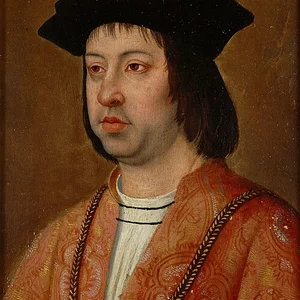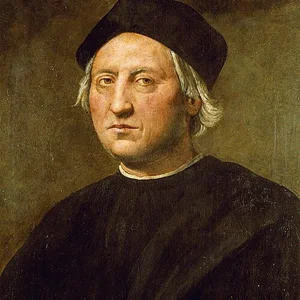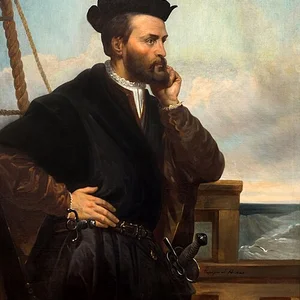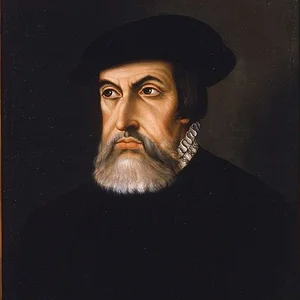

Spanish conquistador (1485–1547) who conquered the Aztec Empire in the early 16th century. Setting out from Cuba in 1519, he led an expedition that culminated in the fall of Tenochtitlan in 1521, marking the beginning of Spanish dominance in Mesoamerica.
Hernán Cortés(1485 — 1547)
Hernán Cortés
Espagne
9 min read
Frequently asked questions
Key Facts
- 1519: Departed from Cuba leading an expedition to explore Mexico
- 1520: Arrived at Tenochtitlan and first met with Montezuma
- 1521: Fall of Tenochtitlan and end of the Aztec Empire following a siege
- 1522: Appointed governor and captain general of New Spain
- 1547: Died in Seville following political marginalization
Works & Achievements
Epistolary accounts addressed to Emperor Charles V in which Cortés precisely describes the conquest of Mexico, the civilizations he encountered, and his military decisions. These letters constitute a primary historical source of the highest importance, blending political justification with exploration narrative.
Cortés founded the city of Villa Rica de la Vera Cruz, the first permanent European settlement on the Mexican continent. This founding act allowed him to establish an independent legal base free from the authority of the Governor of Cuba.
The capture of Tenochtitlan on August 13, 1521 is the defining act of Cortés's life, bringing an end to the Aztec Empire and opening the way for Spanish colonization of all of Mesoamerica. This event durably reshaped the history of Central America.
Cortés oversaw the construction of the new colonial capital on the rubble of the Aztec city, reusing its materials and urban layout. This symbolic and practical decision made Mexico City one of the first great metropolises of the American continent.
Cortés led a grueling overland expedition through the jungles of Central America to suppress the rebellion of Cristóbal de Olid. This arduous journey kept him away from New Spain and weakened his political authority.
Cortés personally financed and led a maritime expedition that reached the Baja California peninsula, which he initially mistook for an island. This exploration contributed to the cartography of the northeastern Pacific.
Anecdotes
Upon his arrival on the Mexican coast in 1519, Cortés made a bold and controversial decision: he ordered most of his ships to be scuttled (sunk) to prevent his men from fleeing or turning back. This dramatic act forced his soldiers to press forward, with no possibility of retreat, against an empire incomparably more populous.
Cortés received unexpected help in the person of Malintzin, known as 'La Malinche', a young Nahuatl woman given as a slave to the Spaniards. Speaking both Nahuatl and Maya, she became his indispensable interpreter and companion, playing a crucial role in all negotiations with indigenous peoples.
In November 1519, Cortés met the Aztec emperor Moctezuma II in Tenochtitlan in a solemn reception. A few days later, he took Moctezuma hostage within his own palace, thereby paralyzing Aztec power from within. This act of extreme audacity allowed him to temporarily control the capital without direct combat.
The 'Noche Triste' of June 30, 1520 saw the Spaniards driven out of Tenochtitlan by an Aztec uprising. Cortés lost nearly two-thirds of his men and much of the accumulated gold. It is reported that he wept beneath a great tree (the ahuehuete of the Noche Triste) as he contemplated the disaster, before regaining his composure and organizing the reconquest.
After the conquest, Cortés undertook the construction of Mexico City directly on the ruins of Tenochtitlan, using the stones of Aztec temples to build the first churches and palaces. This symbolic superimposition was intended to assert Spanish and Christian dominance over indigenous memory.
Primary Sources
And so, Most Powerful Lord, Your Majesty may be certain that this city is the greatest and most beautiful that has ever been seen, and that the things done there are so admirable that they seem almost beyond belief.
When we saw so many cities and villages built on the water, and other great cities on dry land, and that straight and level causeway leading to Mexico, we were amazed and said it resembled the enchanted things spoken of in the book of Amadis.
You shall treat the Indians well, without wronging them or taking their possessions, so that they may live in peace and justice, and that our holy Catholic faith may be spread among them.
Moctezuma came to meet us carried on a richly adorned litter, and as soon as he descended, the great lords supported him by the arms on either side, and he walked beneath a canopy of green feathers with much gold and silver.
Key Places
Birthplace of Hernán Cortés, born into a family of minor nobility (hidalgos). This poor region of Spain drove many ambitious young men to seek their fortune in the New World.
Capital of the Aztec Empire built on an island in Lake Texcoco, with an estimated population of 200,000 inhabitants, larger than most European cities of the time. Cortés conquered it in 1521 and built Mexico City on its ruins.
First Spanish settlement founded by Cortés in 1519 on the Gulf of Mexico coast, the starting point of his conquest into the interior. It was here that he scuttled his ships to cut off any retreat for his men.
Indigenous city-state enemy of the Aztecs that became Cortés's main ally after a period of fighting. This alliance was decisive in the fall of the Aztec Empire, as the Tlaxcalans provided thousands of warriors.
Island from which Cortés organized his expedition in 1519 against the wishes of Governor Diego Velázquez. The Cuban colony served as a logistical base for expeditions toward the American continent.
Town near Seville where Cortés died on December 2, 1547, far from the New Spain he had conquered. He was staying at the villa of the Duke of Medina Sidonia while awaiting his return to the Americas.
Typical Objects

Spanish soldiers wore a combination of chainmail and plate armor with the characteristic ridge-shaped helmet, the morion. Cortés had a full suit of armor that gave him a major defensive advantage against indigenous weapons.

Forged in the renowned workshops of Toledo, these tempered steel swords were of far superior quality to the obsidian weapons of Aztec warriors. They symbolized the military power and nobility of the conquistadors.

Firearms, still rudimentary but effective, struck terror among Mesoamerican peoples who had never seen them before. The noise and smoke of the cannons helped sustain the almost supernatural image of the conquistadors.

Unknown in the Americas before the arrival of Europeans, horses terrified indigenous warriors who sometimes took them for mythical creatures. Cortés had 16 horses when he landed, a decisive military and psychological advantage.

Cortés sent Charles V extraordinary gifts collected in Mesoamerica, including the famous quetzal feather headdress attributed to Moctezuma (now in Vienna). These objects bore witness to the wealth and sophistication of the conquered civilizations.

Cortés would erect crosses and place images of the Virgin Mary in indigenous temples as soon as they were taken possession of. The conversion of populations to Christianity was officially presented as one of the main justifications for the conquest.
School Curriculum
Vocabulary & Tags
Key Vocabulary
Tags
Époque
Daily Life
Morning
Cortés rose early, attending daily mass with his chaplains — the Catholic faith being the official framework of the conquest. He would then hold council with his captains to plan troop movements, negotiate with indigenous allies, or draft reports to send to Spain.
Afternoon
Afternoons were devoted to military or diplomatic activities: inspecting fortifications, holding audiences with indigenous chiefs and their interpreters, or overseeing the construction of the first Spanish towns. In the field, he fought himself on the front lines, which earned him the respect of his soldiers.
Evening
In the evenings, Cortés would dictate or write his reports and letters to Charles V, meticulously detailed. During his years as governor, he received captains and allies for dinner in a setting of relative splendor, seeking to reproduce the dignity of a great European lord.
Food
On the American continent, Cortés and his men quickly adopted local resources: corn tortillas, beans, turkey, cacao, and tropical fruits supplemented Spanish provisions (lard, hardtack, wine). During difficult campaigns in hostile territory, soldiers sometimes suffered from famine and ate whatever they could find.
Clothing
On campaign, Cortés wore typical conquistador armor: chainmail, greaves, a morion helmet, and sometimes a brigandine (a leather jacket reinforced with metal plates). Outside of combat and in his role as governor, he adopted the dress of the Spanish nobility: doublet, hose, cape, and feathered hat — a sign of his status as a hidalgo.
Housing
Before the final conquest, Cortés lived in makeshift camps or took up residence in requisitioned indigenous palaces, notably in Moctezuma's palace in Tenochtitlan. Once governor, he resided in a palace he had built in Cuernavaca (today the Palacio de Cortés), and also owned properties in Spain.
Historical Timeline
Period Vocabulary
Visual Style
Un style visuel contrasté mêlant la rigueur de la Renaissance espagnole et la richesse chromatique de la civilisation aztèque, avec des tonalités chaudes dorées et des paysages tropicaux dramatiques.
Sound Ambience
Un mélange saisissant des sons de la conquête : cliquetis des armures espagnoles, tambours de guerre aztèques, bruits de la jungle tropicale et premiers coups de canon résonnant dans les vallées mésoaméricaines.
Liens externes & ressources
Références
Œuvres
Cartas de Relación (Cinq lettres de relation à Charles Quint)
1519-1526
Fondation de Veracruz
1519
Conquête de l'Empire aztèque et chute de Tenochtitlan
1519-1521
Construction de Mexico-City sur les ruines de Tenochtitlan
à partir de 1521
Expédition au Honduras
1524-1526
Exploration de la Basse-Californie
1535