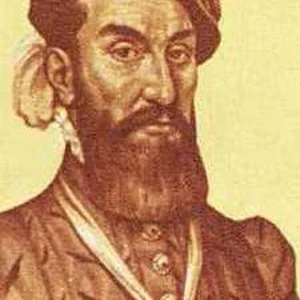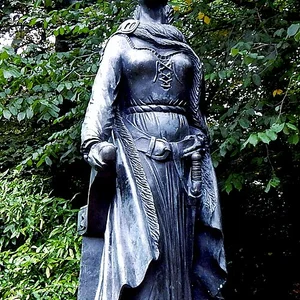

Irish clan chief and navigator of the 16th century, nicknamed the “pirate queen.” At the head of the Ó Máille fleet, she scoured the west coast of Ireland through raiding and tolls, and negotiated in person with Elizabeth I of England.
Grace O'Malley(1539 — 1599)
Grace O'Malley
royaume d'Irlande
7 min read
Frequently asked questions
Key Facts
- Born around 1530 in Connacht (western Ireland), daughter of Eoghan Dubhdara Ó Máille, chief of the seafaring Ó Máille clan.
- Took control of the family fleet and built her power on raids, tolls imposed on ships, and control of the Atlantic coastal routes.
- Resisted the advance of the English governors of the province of Connacht, notably Richard Bingham, who had her sons and her brother imprisoned.
- In 1593, met Queen Elizabeth I at Greenwich Palace to negotiate their release.
- Died around 1603, the very year of Elizabeth I's death.
Works & Achievements
She took command of the family fleet and turned it into a true naval power dominating the west coast of Ireland.
She levied a toll on ships passing through her waters, blending trade, protection, and raids to fund her clan.
She repelled an English siege launched by sea against her castle, demonstrating her military skill and the strength of her stronghold.
Through her marriages into the O'Flaherty and then the Burke families, she extended her influence and secured key coastal territories.
Her diplomatic meeting at Greenwich secured the release of her kin: a rare political triumph for a Gaelic chieftain.
For decades, she preserved the independence of her maritime domain against the Tudor conquest that was dismantling the Irish clans.
Anecdotes
In September 1593, in her sixties, Grace O'Malley crossed the sea to Greenwich Palace to meet Elizabeth I in person. She came to demand the release of her son Tibbot and her half-brother, who had been captured by the English governor. To everyone's surprise, the queen granted her request.
Before this meeting, the English government sent her a list of eighteen written questions, the “Articles of Interrogatory.” The answers she gave, preserved in the English state archives, are among the very few records in which we hear Grace O'Malley speak about herself and her family.
The governor of Connacht, Sir Richard Bingham, despised her: in his letters to the Privy Council, he described her as “the nurse of all rebellions in the province for the past forty years.” This hostile phrase shows just how dangerous the English considered her to be.
In 1574, an English expedition laid siege by sea to her castle at Rockfleet, on Clew Bay. According to the accounts passed down, Grace O'Malley and her men repelled the assault and forced the attackers to retreat to their ships, an event that cemented her reputation as a war leader.
Surprisingly, the Irish annals, which did record the great Gaelic chieftains, barely mention her at all. Almost everything we know about her comes from English administrative documents — that is, from the very people who sought to subdue her.
Primary Sources
To the first question, she answers that her father was named Dubhdara O'Malley, once chieftain of the country called Upper Owle O'Malley, and that he owned many ships and galleys with which he carried on trade and seafaring.
He denounces her as a notable traitress and “the nurse of all rebellions in the province for the past forty years.”
She explains that, stripped of her property and her means of living by the governor, she begs the queen's mercy and the release of her detained kinfolk, offering in return to serve Her Majesty by sea against her enemies.
The queen orders that the petitioner's sons be released and that she be assured enough to live on for the rest of her days, provided that she keeps quiet and loyal.
Key Places
A vast bay dotted with islands, on the coast of County Mayo. It was the heart of the Ó Máille territory, where Grace controlled shipping and levied tolls.
An island guarding the entrance to Clew Bay, home to an Ó Máille castle and a Cistercian abbey. Tradition places the burial site of Grace O'Malley here.
A stone tower-fortress on the shore of Clew Bay. Grace lived here and repelled the English siege of 1574.
Seat of the O'Flaherty clan, in Connemara, where Grace lived after her first marriage. An anchor point of her maritime power south of Clew.
A royal residence on the banks of the Thames where Grace O'Malley met Elizabeth I in 1593. Site of the famous meeting between the “pirate queen” and the Queen of England.
Typical Objects

A fast ship powered by oars and sail, the heart of the Ó Máille fleet. It was used for trade, for transporting warriors, and for raiding along the west coast.

A portable firearm that appeared in the 16th century, used by Irish troops and the English alike. It complemented bladed weapons in fighting on land and during boarding actions.

A long two-handed battle axe (the sparth axe) wielded by the gallowglass, Gaelic mercenary warriors. It was the emblematic weapon of clan armies.

A long linen tunic, often dyed saffron yellow, worn by Irish people of both sexes. The basic garment of the 16th-century Gaelic nobility.

A large cloak of thick fringed wool, worn over the léine to protect against the Atlantic wind and rain. A distinctive mark of Gaelic chieftains.

Compass, lead sounding line, and coastal charts made it possible to steer the galleys through the dangerous channels of Clew Bay. This maritime knowledge was the strength of the Ó Máille.
School Curriculum
Vocabulary & Tags
Key Vocabulary
Daily Life
Morning
At first light, in the cold gloom of her stone tower, Grace would survey the bay and the state of the sea. She organized her clan's day: maintaining the galleys, watching the channels, and receiving the news brought in by fishermen and merchants.
Afternoon
The afternoon was often spent at sea or on the quays: directing the manoeuvres, collecting tolls from passing ships, negotiating trades, or preparing a raid along the coast. On land, she also had to settle quarrels between families and watch over the cattle, the clan's true wealth.
Evening
In the evening, everyone gathered in the great hall around the fire. There they shared a hearty meal, listened to the harpist and the tales of the bards, and discussed alliances, debts, and the English threats hanging over Connacht.
Food
The diet was based on oats (flatbreads and porridge), dairy products (butter, curds, cheeses), and beef during feasts. Fish and seafood from the bay were plentiful; people drank beer, mead, and wine imported through maritime trade.
Clothing
She wore the léine, a long linen tunic dyed with saffron, covered by a thick fringed woollen cloak called the brat, to face the Atlantic climate. Ornate brooches and belts marked her rank as a clan chief.
Housing
She lived in stone tower-houses such as Rockfleet or the one on Clare Island: narrow, tall, defensive buildings standing at the water's edge. People slept on the upper floor, above the storerooms, ready to withstand a siege coming from the sea.
Historical Timeline
Period Vocabulary
Liens externes & ressources
Références
Œuvres
Direction de la flotte des Ó Máille
vers 1560-1599
Système de péages maritimes
XVIe siècle
Défense de Rockfleet
1574
Alliances matrimoniales stratégiques
vers 1546 et 1566
Négociation avec Élisabeth Ire
1593
Maintien d'un pouvoir gaélique autonome
vers 1560-1599