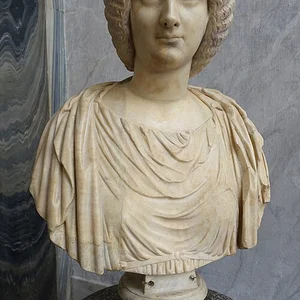

Roman empress of Syrian origin and wife of Septimius Severus, she wielded considerable political influence and gathered around her a circle of philosophers and intellectuals. As the mother of Caracalla and Geta, she embodied female power at the very summit of the Roman Empire.
Julia Domna(165 — 217)
Julia Domna
Rome antique
8 min read
Frequently asked questions
Key Facts
- Born around 160 AD in Emesa (present-day Homs, Syria), into a family of priests of the sun god El-Gabal
- Wife of Emperor Septimius Severus from 187 onwards, she was granted the title of Augusta
- Formed an intellectual circle (the 'Circle of Julia Domna') bringing together philosophers, rhetoricians, and scholars, including Philostratus
- Played an active political role, particularly during the conflict between her sons Caracalla and Geta (212 AD)
- Chose to starve herself to death in 217 AD following the assassination of Caracalla, her last surviving son
Works & Achievements
Julia Domna commissioned the sophist Philostratus to write the biography of the philosopher and miracle-worker Apollonius of Tyana, drawing on ancient memoirs. This major work of imperial Greek literature reflects her role as an intellectual patron.
A regular gathering of intellectuals, philosophers, and jurists that Julia Domna hosted in Rome, including Galen, Papinian, Ulpian, and Philostratus. This circle contributed to the philosophical and legal revival of the Severan era.
Following the death of Geta, Julia Domna took charge of the Empire's official correspondence alongside Caracalla, exercising de facto administrative authority unprecedented for a woman in Roman history.
Julia Domna played an active role in shaping the image of the Severan dynasty through her honorific titles (Mater Castrorum, Mater Patriae), the minting of coins bearing her likeness, and her patronage of the arts and architecture.
Anecdotes
According to the Historia Augusta, Septimius Severus chose Julia Domna as his wife after learning that a horoscope predicted she would marry a king. Intrigued by this prophecy, he proposed to her precisely because of it, recognizing in Julia a woman of destiny. This marriage arranged by the stars became one of the most powerful political unions in Roman history.
In Rome, Julia Domna gathered around her a remarkable intellectual circle, welcoming philosophers, rhetoricians, and scholars such as Philostratus of Athens, Galen, and Papinian. It was she who asked Philostratus to write the Life of Apollonius of Tyana, a biography of the famous Greek miracle-worker. This philosophical salon — unique for a woman of her era — earned her the title Augusta philosopha.
When her son Caracalla murdered his brother Geta in 212, he committed the act in their mother's very arms as she tried to intervene. Julia Domna was wounded in the arm during the struggle. Despite the horror of this fratricide, she chose to remain at Caracalla's side and continued to exercise her influence, refusing to show her grief in public so as not to offend the emperor.
Upon Caracalla's death in 217, Julia Domna — then at Antioch — learned that her son had been assassinated by the Praetorian prefect Macrinus. Already suffering from breast cancer for some time, she decided, according to the sources, to stop eating in order to die, choosing to leave a world in which her power and her purpose had vanished. Her voluntary death was seen as an act of Stoic dignity.
Primary Sources
He learned that a woman in Syria had a horoscope promising her a king for a husband, and immediately sought her hand in marriage. That woman was Julia.
You commanded me, O Julia, to arrange and correct the memoirs concerning Apollonius of Tyana… for you consider worthy of attention all that touches upon wisdom.
Julia, his mother, was with him when he struck down Geta; she received a wound to the hand as she tried to intervene, and was splattered with the blood of her dying son.
Iuliae Aug(ustae) matri Aug(usti) n(ostri) et castrorum et senatus et patriae.
Key Places
Julia Domna's birthplace, at the time a major religious center dedicated to the sun god Baal-Elagabal. Her father served as high priest there, which gave her enormous prestige throughout the Roman East.
The hill where the Severan imperial court resided. Julia Domna held her philosophical and intellectual circle there, receiving scholars and rhetoricians in the imperial apartments.
The city where Septimius Severus died in 211 during his military campaigns in Scotland. Julia Domna accompanied her husband until his death and played a crucial role in transferring power to their sons.
Capital of the province of Syria and a great eastern metropolis of the Empire. Julia Domna was there in 217 at the time of Caracalla's assassination and died shortly afterward.
Birthplace of Septimius Severus, magnificently embellished during his reign. Julia Domna is honored there by numerous inscriptions, and her memory was especially celebrated in the city.
Liens externes & ressources
Références
Œuvres
Commande de la Vie d'Apollonios de Tyane à Philostrate
vers 215-217 ap. J.-C.
Cercle philosophique de Julia Domna (Thiase)
IIe-IIIe siècle ap. J.-C.
Gestion de la correspondance impériale
212-217 ap. J.-C.
Propagande dynastique sévérienne
193-211 ap. J.-C.