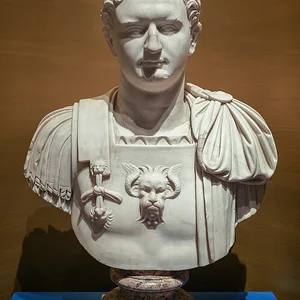

Domitian (51–96) was the third and last emperor of the Flavian dynasty. His authoritarian reign was marked by persecutions of Christians and senators, but also by efficient provincial administration.
Domitian(51 — 96)
Domitian
Rome antique
8 min read
Frequently asked questions
Key Facts
- Born on 24 October 51 in Rome, son of Emperor Vespasian
- Became emperor in 81 following the death of his brother Titus
- Led several military campaigns in Germania and Dacia (85–89)
- Persecuted Christians and Stoic philosophers
- Assassinated on 18 September 96, bringing the Flavian dynasty to an end
Works & Achievements
A monumental imperial palace on the Palatine Hill designed by Rabirius, featuring a throne room, a basilica of justice, and a triclinium of colossal proportions. It remained the official residence of Roman emperors for three centuries.
A forum dedicated to Minerva, Domitian's patron goddess, begun during his reign and inaugurated by Nerva in 97. It connected the Forum of Augustus to the Forum of Peace.
A large Greek-style stadium measuring 275 metres, built to host the Capitoline Games. Its oval footprint is perfectly preserved in the layout of today's Piazza Navona in Rome.
A sweeping reconstruction programme following the fires of 80, including the restoration of the Temple of Jupiter Capitolinus, re-roofed with gilded bronze tiles as a symbol of imperial magnificence.
Quinquennial Greek-style games founded by Domitian in honour of Jupiter Capitolinus, combining athletics, chariot racing, music, and poetry. They continued until the fourth century.
A systematic construction of forts, roads, and palisades along the Rhine following the campaigns against the Chatti, laying the foundations of the Upper Germanic–Raetian Limes, now a UNESCO World Heritage Site.
A significant increase in the silver content of the denarius, restoring Augustan standards. The measure had to be partially abandoned in the face of military expenditure, but stands as evidence of rigorous financial management.
Anecdotes
Domitian demanded to be called 'dominus et deus' (lord and god), breaking with the republican tradition that regarded such titles as an inadmissible insult. This claim to divinity deeply shocked the Senate and contributed to his reputation as a tyrant. After his death, the Senate decreed the damnatio memoriae: his name was erased from official monuments.
Suetonius recounts that Domitian spent his leisure time catching flies and piercing them with a sharp stylus. When someone asked whether anyone was with the emperor, Vibius Crispus replied that there was “not even a fly.” This anecdote illustrates the isolation and peculiarity of this all-powerful man.
Domitian established the Capitoline Games (Capitolia), quinquennial contests in honor of Jupiter that combined athletic events, music, and poetic recitation. He presided over these games dressed in a golden silk robe and wearing a crown bearing the images of Jupiter, Juno, and Minerva — the three deities of the Capitoline triad.
Domitian's reign was marked by persecutions that struck Christians and certain members of the imperial family suspected of sympathies toward this faith. His cousin Flavius Clemens was executed, and his wife Flavia Domitilla was exiled for “atheism” — the term Romans used to describe the refusal to worship the official gods. The Book of Revelation is sometimes associated with this period of persecution.
Domitian was assassinated on September 18, 96 AD in a conspiracy involving his own wife Domitia Longina, freedmen of the imperial household, and praetorian officers. According to Suetonius, the exact hour of his death had been foretold to him: he spent his final hours consulting omens, trying in vain to avert his fate.
Primary Sources
He had no other solitary pursuits at the start of his principate than catching flies and piercing them with a sharp stylus. And so when someone asked whether anyone was with Caesar, Vibius Crispus wittily replied that there was not even a fly.
Nunc demum redit animus ; et quamquam primo statim beatissimi saeculi ortu Nerva Caesar res olim dissociabiles miscuerit, principatum ac libertatem — "Now at last courage returns; and though from the very outset of this most blessed age Nerva Caesar united things once irreconcilable, the principate and freedom."
Vidimus enim, vidimus ultimae servitutis exemplum, Senatum detestandum alii, aliis miserandum, in eadem curia et iubente uno et spectante laudare — "We saw indeed the ultimate depth of servitude: a Senate compelled in that same chamber, at the command and under the gaze of one man, to offer praise."
Temporis iste sui gemma, decusque fuit — "He was the jewel and ornament of his age." Martial, who had sung Domitian's glory during his lifetime, quietly recanted after his death.
Recordor quantum discrimini fuerim sub Domitiano — "I recall the danger I faced under Domitian." Pliny evokes the constant fear that prevailed among senators throughout that reign.
Key Places
Enormous palatial complex completed around AD 92 on the Palatine Hill, designed by the architect Rabirius. Domitian ruled from here, held court, and hosted lavish banquets, surrounded by polished mirrors to detect assassins behind his back.
A large Greek-style stadium, 275 metres long and capable of holding 30,000 spectators, built for the Capitoline Games. Its oval footprint directly determined the shape of today's Piazza Navona.
The sacred hill home to the Temple of Jupiter Capitolinus, which Domitian had rebuilt after the fire of AD 80, its roof covered with gilded bronze tiles. It was here that he presided over the Capitoline Games in a toga embroidered with gold.
Domitian's summer retreat in the Castelli Romani hills, complete with an artificial lake, a private hippodrome, and a theatre. It was his preferred refuge for hunting, far from the intrigues of the capital.
A fortified line of palisades, ditches, and forts built and reinforced under Domitian following his campaigns against the Chatti. This defensive infrastructure foreshadowed the Upper German–Raetian Limes, now a UNESCO World Heritage Site.
Typical Objects

Crown worn by Domitian at the Capitoline Games, adorned with the effigies of Jupiter, Juno, and Minerva. It symbolized both his religious authority and his claim to divinity.

A staff of command topped with an eagle, emblem of Jupiter and insignia of imperial power. Domitian carried it during religious ceremonies and military triumphs.

Wax tablets on which informers (*delatores*) recorded their accusations against senators or wealthy citizens. Under Domitian, these practices reached a deeply alarming peak.

A silver coin struck with Domitian's likeness bearing the title *dominus et deus*. Domitian reformed the coinage by increasing the silver content of the denarius, only to reverse course later under the pressure of military expenditure.

A metal stylus used for writing on wax tablets, which Domitian reportedly repurposed, according to Suetonius, to skewer flies during moments of boredom — an emblematic anecdote that speaks to his solitary and unsettling character.

A gilded armor worn during military reviews and triumphs, embodying the martial dimension of imperial power that Domitian — a victorious general on the Rhine — cultivated with great care.

Large mirrors positioned throughout the throne room and corridors of the Flavian Palace so that Domitian could watch his back. They bear witness to the growing paranoia of a man who lived in constant fear of assassination.
School Curriculum
Vocabulary & Tags
Key Vocabulary
Daily Life
Morning
Domitian rose early for the salutatio, the morning ceremony during which senators, knights, and clients came to pay their respects in the atrium of the palace. He then dispensed justice in his Palatine basilica, handling legal and administrative matters with a rigor acknowledged even by his adversaries.
Afternoon
Afternoons were devoted to hunting in the grounds of the Villa Albana or to military reviews on the Campus Martius. Domitian, a fervent devotee of Minerva, also supervised the drafting of official texts and the preparation of religious ceremonies over which, as Pontifex Maximus, he personally presided.
Evening
Imperial dinners (cena) brought together selected guests in the sumptuous triclinium of the Flavian Palace, with rare delicacies and theatrical performances. Domitian was nonetheless deeply wary of his guests: polished bronze mirrors placed around the walls allowed him to monitor every gesture made behind his back.
Food
The imperial table offered refined dishes: farmed fish, game, exotic fruits, oysters from the shores of Britannia, and Greek wines. Domitian, according to Suetonius, ate sparingly but with care, and was particularly fond of roasted capon and fresh figs picked by his own hand from the gardens of his villa.
Clothing
The emperor wore the toga praetexta with its purple border for civil functions, and the paludamentum (military cloak) of crimson purple during military ceremonies. At the Capitoline Games, he donned a gold-embroidered silk robe and a crown depicting the Capitoline Triad.
Housing
Domitian resided primarily in the Flavian Palace on the Palatine Hill, a 40,000 m² complex comprising throne rooms, peristyle gardens, monumental fountains, and private apartments. He also stayed at his lavish villa in the Alban Hills, which featured an artificial lake and a private hippodrome.
Historical Timeline
Period Vocabulary
Visual Style
Un style visuel somptueux et oppressant : marbres polis, pourpre impériale et or côtoient la froideur des salles du trône et le regard sévère des portraits officiels flaviens.
Sound Ambience
L'atmosphère sonore du palais impérial flavien mêle le silence pesant d'une cour sous tension aux sons de la Rome vibrante : gardes, scribes, banquets fastueux et cérémonies religieuses.
Liens externes & ressources
Références
Œuvres
Domus Flavia (Palais Flavien)
92 ap. J.-C.
Forum de Nerva (Forum Transitorium)
85–97 ap. J.-C.
Stade de Domitien
86 ap. J.-C.
Reconstruction du Capitole et du Panthéon
80–94 ap. J.-C.
Jeux Capitolins (Capitolia)
86 ap. J.-C.
Réforme du limes germanique
83–85 ap. J.-C.
Réforme monétaire flavienne
82 ap. J.-C.