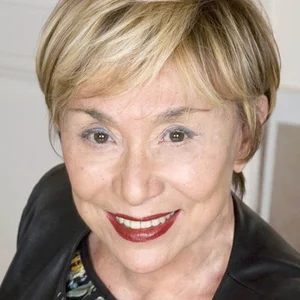

Bulgarian-born French philosopher, linguist, and psychoanalyst, born in 1941. A major figure in structuralist and post-structuralist thought, she developed the concepts of intertextuality and semoanalysis. A professor at the University of Paris VII, she profoundly reshaped literary theory and psychoanalysis.
Julia Kristeva(1941 — ?)
Julia Kristeva
France, Bulgarie
9 min read
Frequently asked questions
Famous Quotes
« Language is a skin: I rub my language against the other.»
« A woman can only be marginal in relation to society.»
Key Facts
- Born on June 24, 1941, in Sliven, Bulgaria
- Arrived in Paris in 1965 and joined the intellectual circle around the journal Tel Quel
- Introduced the concept of intertextuality in 1967, drawing on the work of Mikhail Bakhtin
- Published Revolution in Poetic Language in 1974, a monumental thesis on Mallarmé and Lautréamont
- Received the Simone de Beauvoir Prize in 2019 for her feminist commitment
Works & Achievements
Kristeva's first major theoretical work, it establishes semanalysis as a way of reading the signifying processes of literary texts. It introduces the concept of intertextuality, which revolutionized literary theory worldwide.
A monumental doctoral thesis (700 pages) devoted to Mallarmé and Lautréamont, it theorizes the distinction between the 'semiotic' (drives, the maternal) and the 'symbolic' (the order of language and law). A foundational reference in literary studies.
Kristeva develops the concept of 'abjection' — that which triggers simultaneous repulsion and fascination. Read around the world, this book has influenced literary criticism, the visual arts, and gender studies alike.
A psychoanalytic and literary essay on discourses of love across the centuries, from the Bible to contemporary novels. Kristeva shows how love shapes the identity of the subject.
Drawing on clinical cases and readings of Nerval, Dostoevsky, and Marguerite Duras, Kristeva explores the links between artistic creation and depression. One of her most accessible and widely translated books.
A philosophical and psychoanalytic meditation on otherness, exile, and the condition of the foreigner. Published amid French debates on immigration, it argues for a conception of nationhood open to difference.
A trilogy devoted to three women who shaped the twentieth century, blending intellectual biography with psychoanalysis. Kristeva celebrates singular creative capacity as a form of resistance to the flattening of the world.
Anecdotes
When Julia Kristeva arrived in Paris in December 1965, barely 24 years old, she could hardly speak French. Thanks to a French government research fellowship, she quickly joined Roland Barthes's seminars at the École Pratique des Hautes Études. Within a few months, this unknown young Bulgarian woman had established herself as a major intellectual voice in the most demanding Parisian circles.
It was while reading the work of Russian linguist Mikhail Bakhtin — virtually unknown in France at the time — that Kristeva developed the concept of 'intertextuality' in 1966–1967. She argued that every text is a mosaic of quotations from other texts. The term, coined in an article published in the journal Tel Quel, is now taught in secondary schools across France and has been translated into dozens of languages.
In 1974, Julia Kristeva was part of a Tel Quel group delegation that traveled to Maoist China, accompanied by her husband Philippe Sollers, Roland Barthes, and Marcelin Pleynet. This journey, during the Cultural Revolution, resulted in a collective book and stands as a testament to the enthusiasm — and illusions — of a segment of the French intelligentsia toward Maoism.
Alongside her academic career as a theorist, Kristeva trained in Lacanian psychoanalysis and became a practicing analyst herself. This double life — researcher in the morning, analyst seeing patients in the afternoon — fed into major works such as Powers of Horror (1980) and Black Sun (1987), which blend literary theory with psychoanalytic clinical practice.
In 2018, declassified documents from the Bulgarian secret service archives (the Darzhavna Sigurnost) revealed that Kristeva may have collaborated with Bulgarian communist intelligence during the 1970s. She categorically denied the accusations. The affair, widely covered in the international press, reignited debate about the relationships between French intellectuals and communist regimes during the Cold War.
Primary Sources
The poetic word is not a fixed point [...] but a crossing of textual surfaces. It is a dialogue of several writings: that of the writer, the addressee, and the current or anterior cultural context.
We shall call this a chora, a nonexpressive totality formed by the drives and their stases in a motility that is as full of movement as it is of its regulation.
The abject is edged with the sublime. It is not the ob-ject facing me, which I name or imagine. Abjection is, within me, a revolt of the person against an external menace from which one wants to keep oneself at a distance, but of which one has the impression that it is not only an external menace.
The foreigner is within us. And when we flee from or struggle against the foreigner, we are fighting our unconscious — that "improper" facet of our impossible "own and proper."
Language is a signifying practice: it cannot be reduced to the communication of a pre-existing content, but is itself a producer of meaning and of the subject.
Key Places
It was in Roland Barthes's seminar at the EPHE, on rue de Tournon, that the young Kristeva first made her mark in Paris in 1966. This place was the intellectual cradle of her French career.
Kristeva taught linguistics and semiotics there for most of her career, introducing generations of students to poststructuralist approaches to text and language.
This neighborhood, with its cafés (Café de Flore, Les Deux Magots), publishing houses, and bookshops, was the heart of Parisian intellectual life where Kristeva moved daily and encountered Sartre, Beauvoir, and Barthes.
Kristeva's hometown, in communist Bulgaria. It was here that she attended a French Catholic secondary school, earning her a bilingual education and the scholarship that would allow her to move to Paris.
Kristeva was regularly invited as a visiting professor at Columbia, where she helped introduce French theory to the United States and forged connections with the American intellectual scene.
Typical Objects

Kristeva arrived in Paris steeped in structural linguistics. Her copies of Saussure's Course in General Linguistics, covered in marginal notes, reveal the foundation on which she built her semanalysis.

This literary and theoretical journal founded in 1960 was the collective vehicle through which Kristeva spread her ideas. To publish there in the 1960s and 1970s was to speak directly to the French and international intellectual avant-garde.

Like most intellectuals of her generation, Kristeva wrote her articles and books on a typewriter. The clatter of the keys marked the rhythm of long writing evenings in her Parisian apartment.

After her Lacanian training, Kristeva received analysands in her practice. The couch is the clinical space that directly fed her theoretical reflections on melancholy, motherhood, and abjection.

Through her in-depth readings of Bakhtin — whose texts she read in the original Russian — Kristeva developed the concept of intertextuality. She was one of the first to introduce this thinker to the Western world.

A professor at the University of Paris VII for decades, Kristeva prepared her teaching meticulously. Her handwritten notebooks weave together linguistics, psychoanalysis, and literary theory in dense, closely written pages.
School Curriculum
Vocabulary & Tags
Key Vocabulary
Daily Life
Morning
Kristeva begins her day very early, around six o'clock, in her Parisian apartment. She devotes the first two hours to theoretical writing, working on her books in progress before the day's distractions set in. She reads the newspaper and browses new philosophical publications over a black coffee.
Afternoon
Her afternoons are divided between teaching at the University of Paris VII, where she leads seminars in linguistics and semiotics, and her practice as a psychoanalyst. She sees her analysands in her consulting room — a clinical experience that directly feeds her theoretical thinking on language and the subject.
Evening
Evenings are often spent at intellectual dinner parties in the bourgeois apartments of the Latin Quarter or Saint-Germain, where writers, philosophers, and critics mingle. Kristeva meets up with her husband Philippe Sollers, and their intense exchanges on literature and politics stretch late into the night over books and glasses of wine.
Food
Like many Parisian intellectuals of her generation, Kristeva eats simply but well: baguette, cheese, dishes prepared in the French tradition. She maintains a quiet attachment to Bulgarian flavors — thick yogurt, pickled vegetables — that recall her childhood in Sliven.
Clothing
Kristeva favors the understated, elegant style of the Parisian intellectual: a dark coat, a tailored suit, a silk scarf tied with care. She avoids ostentation but takes pride in her appearance, aware that in the circles she moves in, physicality and presentation contribute to intellectual authority.
Housing
She lives in a Haussmann-era apartment in the 5th arrondissement, its walls entirely covered by bookshelves overflowing with volumes in French, English, Russian, and Bulgarian. A large desk cluttered with manuscripts, typewriters, and journals forms the nerve center of a space where work and personal life are intimately intertwined.
Historical Timeline
Period Vocabulary
Visual Style
Esthétique intellectuelle parisienne des années 1960-1980 : noir et blanc photographique, bureaux encombrés de livres annotés, lumière chaude de lampe de bureau, élégance sobre et vêtements sombres.
Sound Ambience
Atmosphère sonore de l'intellectualité parisienne des années 1960-1980 : machine à écrire, séminaires animés, cafés de Saint-Germain et pluie sur les pavés parisiens.
Liens externes & ressources
Références
Œuvres
Séméiôtiké : Recherches pour une sémanalyse
1969
La Révolution du langage poétique
1974
Pouvoirs de l'horreur : Essai sur l'abjection
1980
Histoires d'amour
1983
Soleil noir : Dépression et mélancolie
1987
Étrangères à nous-mêmes
1988
Le Génie féminin (trilogie : Hannah Arendt, Melanie Klein, Colette)
1999–2002