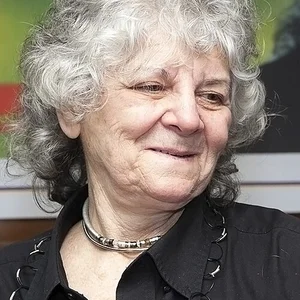

Julia Robinson (1919-1985) was an American mathematician famous for her work in number theory and mathematical logic. She made a decisive contribution to solving Hilbert's tenth problem.
Julia Robinson(1919 — 1985)
Julia Robinson
États-Unis
6 min read
Frequently asked questions
Key Facts
- Born December 8, 1919, in St. Louis (Missouri) and died July 30, 1985, in Oakland (California).
- Defended her doctoral thesis in 1948 at the University of California, Berkeley, under the supervision of Alfred Tarski.
- Made a major contribution to solving Hilbert's tenth problem, completed in 1970 by Yuri Matiyasevich thanks to her work (the Julia Robinson hypothesis).
- In 1975, became the first woman mathematician elected to the United States National Academy of Sciences.
- In 1983, was the first woman elected president of the American Mathematical Society.
Works & Achievements
Under the supervision of Alfred Tarski, she proves that the integers are definable in the field of rationals, establishing the undecidability of their arithmetic theory.
An important game-theory result stemming from her work at RAND, demonstrating the convergence of an iterative procedure for zero-sum games.
She formulates the “J.R. hypothesis,” the key condition that would become the pivot for solving Hilbert's tenth problem.
A collaborative work that reduces Hilbert's tenth problem to a problem of exponential growth, a decisive step toward the final solution.
Completed by Matiyasevich building on Robinson's work: there is no general algorithm to decide whether a Diophantine equation has integer solutions.
The first woman to lead the foremost mathematical society in the United States, after having been the first woman mathematician elected to the National Academy of Sciences.
Anecdotes
As a child, Julia Robinson caught scarlet fever and then acute rheumatic fever, which kept her bedridden for nearly two years. Isolated and taught at home, she was left with a weak heart from this illness that would affect her entire life. Yet it was during this long convalescence that she developed her solitary passion for numbers.
One of her earliest memories goes back to her childhood in the Arizona desert, near Phoenix, where she had been sent for her health: she loved to line up and count little pebbles in the shade of a cactus. This early fascination with counting already foretold the number theorist she would become.
Married to the mathematician Raphael Robinson, a professor at Berkeley, Julia was barred from a regular position in the same department because of the university's anti-nepotism rules. For years she carried out leading research without any real position or salary; she would not become a full professor until 1976, after her election to the National Academy of Sciences.
She devoted more than twenty years to Hilbert's tenth problem. In 1970, a young 22-year-old Soviet mathematician, Yuri Matiyasevich, completed the proof by building on Robinson's work: the answer was negative—no universal algorithm exists. Despite the Cold War, the two mathematicians became friends and warm correspondents.
Julia Robinson refused to be celebrated as “the first woman” to hold this or that distinction. She said she wanted simply to be remembered, like any mathematician, for the theorems she had proved. It is said that every year, on her birthday, she wished to see Hilbert's tenth problem solved: Matiyasevich's proof was, she said, her finest gift.
Primary Sources
“What I really am is a mathematician. Rather than being remembered as the first woman this or that, I would prefer to be remembered, as a mathematician should, simply for the theorems I have proved and the problems I have solved.”
In it, Robinson proves that the notion of integer is definable in the field of rational numbers, thereby establishing the undecidability of the arithmetic theory of the rationals.
An article in which Robinson formulates what would come to be called “the Julia Robinson hypothesis” (the J.R. hypothesis), a cornerstone of the eventual solution to Hilbert's tenth problem.
A joint work reducing Hilbert's tenth problem to the existence of a diophantine set with exponential growth, a decisive step toward the final solution.
An article arising from her work at RAND, proving the convergence of the iterative procedure (“fictitious play”) for two-player zero-sum games.
Key Places
Birthplace of Julia Robinson, born on December 8, 1919.
In the desert near Phoenix, the young Julia was sent for her health, and there she developed her love of numbers by counting pebbles.
She grew up here and began her higher education at San Diego State College.
The heart of her intellectual life: here she earned her doctorate under Alfred Tarski and carried out most of her mathematical career.
Research center where she worked on game theory in the late 1940s and early 1950s.
City where Julia Robinson died of leukemia on July 30, 1985.
Typical Objects

The mathematician's daily tool for writing out equations and proofs in front of colleagues and students. It let one erase and start over as the reasoning unfolded.

The intimate medium of research work, where Robinson jotted down conjectures, calculations and drafts of proofs. The essence of her work happened on paper.

An analog calculating instrument very common among 20th-century scientists before electronic calculators. It was used for multiplications, divisions and standard functions.

A gear-driven machine for additions and multiplications, used in research centers such as RAND. It foreshadowed the first computers on which Robinson worked.

Julia Robinson loved cycling, a pleasure she rediscovered after a heart operation that improved her health. For her it was a true physical freedom.

Used to produce clean copies of scientific papers intended for mathematics journals. Typing out the formulas, however, often remained handwritten.
School Curriculum
Vocabulary & Tags
Key Vocabulary
Tags
Daily Life
Morning
Having long gone without a regular university position, Julia Robinson often worked from home, near Berkeley. The morning began quietly, pencil in hand, going back over proofs or reading articles on logic and number theory.
Afternoon
The afternoon might take her to the Berkeley campus to talk with her husband Raphael and other colleagues, or to cover a blackboard with calculations. Her mathematical work advanced through long stretches of solitary reflection interspersed with conversations.
Evening
The evening was devoted to reading, to scientific correspondence — notably, later on, with Matiyasevich — and to married life with another mathematician who shared her interests.
Food
Her diet was that of a mid-twentieth-century American academic, with nothing out of the ordinary. Her heart, weakened by a childhood illness, nonetheless required her to pace her efforts.
Clothing
She wore the plain, practical clothes of an academic of her time: simple dresses, skirts, and blouses, with no desire for ostentation.
Housing
She lived in a house in the Berkeley–Oakland area of California, where much of her research work took place, for lack of an assigned office at the university over many years.
Historical Timeline
Period Vocabulary
Liens externes & ressources
Références
Œuvres
Thèse : « Definability and decision problems in arithmetic »
1948
« An iterative method of solving a game »
1951
« Existential definability in arithmetic » et l'hypothèse de Julia Robinson
1952
« The decision problem for exponential diophantine equations » (avec Davis et Putnam)
1961
Solution du dixième problème de Hilbert (théorème MRDP)
1970
Présidence de l'American Mathematical Society
1983-1984