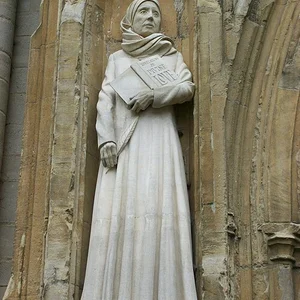

A fourteenth-century English mystic, Julian of Norwich is the first known woman to write in the English language. Following a divine vision received in 1373, she composed Revelations of Divine Love, a foundational work of medieval Christian spirituality. Living as an anchoress in Norwich, she developed a theology centered on divine love and mercy.
Julian of Norwich(1342 — 1500)
Julian of Norwich
royaume d'Angleterre
7 min read
Frequently asked questions
Famous Quotes
« All shall be well, and all shall be well, and all manner of thing shall be well.»
« Love was his meaning. Who showed it to you? Love. What did he show you? Love. Why did he show it? For love.»
Key Facts
- Around 1342: likely born in Norwich, England
- May 1373: receives sixteen visions (showings) during a serious illness, at the age of 30
- Around 1393: writes the long version of Revelations of Divine Love
- Lives as an anchoress in a cell attached to the Church of St Julian in Norwich
- 1416: last known mention during her lifetime; date of death unknown
Works & Achievements
The first text written shortly after her visions of May 1373, it offers a direct and relatively brief account of them. It is the oldest known text written by a woman in the English language.
The definitive and expanded version of her visions, the fruit of twenty years of theological reflection. Julian deepens themes such as the motherhood of God, mercy, and the nature of sin; it is her major work.
Anecdotes
In May 1373, Julian of Norwich, then around thirty years old, fell gravely ill and believed she was dying. It was during this crisis that, according to her account, she received sixteen visions — which she calls 'showings' — of the suffering Christ. Against all expectations, she made a full recovery the following day.
Julian chose to live as an anchoress in a cell attached to the Church of Saint Julian in Norwich. This cell had three windows: one opening into the church to follow the services, one facing outside to receive food and visitors, and one for conversing with those who sought her counsel. She never left this enclosed space.
Although she describes herself as ignorant and uneducated ('a simple creature unlettered'), Julian wrote two versions of her Revelations: a short text, composed shortly after her visions, and a long text, the fruit of twenty years of meditation and theological reflection. This paradox between her professed humility and her genuine intellectual depth continues to fascinate scholars.
Julian's most famous phrase, 'All shall be well, and all shall be well, and all manner of thing shall be well,' was, she says, revealed to her directly by God. This message of optimism, spoken in an age of plague and war, is a radical word of consolation that still earns her a wide spiritual audience today.
Margery Kempe, the first known autobiographer in the English language, visited Julian around 1413 to share her own mystical experiences. Julian encouraged her to persevere. This meeting between two major figures of medieval English female spirituality is documented in the Book of Margery Kempe.
Primary Sources
In this time I wanted to look beside the cross, and I durst not, for I wist well, while I beheld in the cross I was sure and safe from fiends.
He said not 'Thou shalt not be tempested, thou shalt not be travailed, thou shalt not be afflicted'; but He said: 'Thou shalt not be overcome.'
And then she was bidden by our Lord for to go to an anchoress in the same city which was called Dame Julian, and so she did and showed her the grace that God put in her soul.
Item lego Juliane anachorite apud Seynt Julyan in Norwico ijs.
Key Places
It was in this cell adjoining St Julian's Church that Julian lived as an anchoress for decades, writing her Revelations and receiving visitors seeking spiritual guidance. The church was rebuilt after the Second World War, but the cell has been restored.
The second largest city in England during the Middle Ages, Norwich was a thriving commercial and religious centre. Julian spent her entire known adult life there; the city was badly hit by the Black Death, a context that permeates the consoling tone of her work.
The main religious centre of Norwich, this Benedictine priory dominated the city's spiritual life. As an anchoress attached to a parish church, Julian was part of this local monastic and clerical network.
The conflict between France and England and successive outbreaks of plague formed the historical backdrop against which Julian developed her theology of love and divine mercy, as a direct response to the traumas of her age.
Typical Objects

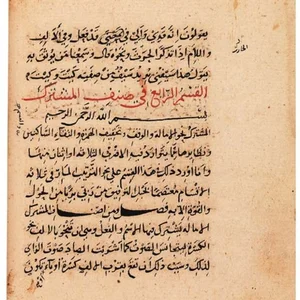
Julian wrote her Revelations on parchment, a costly and precious material in the Middle Ages. Her mastery of writing — rare for a woman of her time — allowed her to record her visions and deepen them over more than twenty years.

During her illness of 1373, a priest held a crucifix before her eyes. It was while gazing upon this crucifix that Julian received her visions; it is the object that triggered her entire spiritual work.

Like all anchoresses, Julian structured her days around the liturgical hours of prayer. These prayer books were her daily companions in her cell at the church of St Julian.

In the dimness of her cell, artificial light was essential for reading and writing. The flame is also a recurring symbol in medieval mysticism, associated with the divine presence.

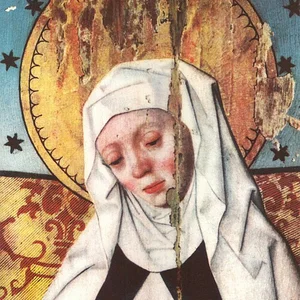
Medieval anchoresses wore a plain, often dark habit symbolizing their death to the world. Julian had officially been 'buried to the world' during the enclosure ceremony, clothed in a penitential habit.

In her Revelations, Julian describes a vision in which God shows her 'a little thing, the quantity of a hazel nut' to teach her that all that exists is held in being by the love of God. The hazelnut has become one of the most recognizable iconographic symbols associated with her thought.
School Curriculum
Vocabulary & Tags
Key Vocabulary
Tags
Daily Life
Morning
Julienne rose before dawn for Matins and Lauds, the liturgical prayers she followed through the window overlooking the altar of St Julian's Church. She devoted the rest of the morning to meditating on Scripture and personal prayer, in the silence of her stone cell.
Afternoon
In the afternoons, Julienne sometimes received visitors through the outer window of her cell — the faithful, pilgrims, or those seeking spiritual guidance. She was especially known for her spiritual direction, recognized for her wisdom and compassion. She also worked on writing and revising her Revelations.
Evening
Vespers and Compline marked the close of the liturgical day. Julienne then withdrew into contemplative prayer, meditating in particular on her visions of 1373. As night fell, lit by a single candle, the hours were well-suited to mystical writing and theological reflection.
Food
Like all medieval anchoresses, Julienne depended on offerings from parishioners and the charity of the church for her food, passed to her through the service window. Her diet was simple and frugal: bread, vegetables, pulses, and sometimes cheese or fish on permitted days. On liturgical fast days — numerous in the medieval calendar — she abstained from solid food.
Clothing
Julienne wore the plain, dark habit of medieval anchoresses, unadorned, symbolizing her symbolic death to the outside world. At the enclosure ceremony, she had formally put on this penitential garb. Her clothing was rough wool, suited to the cold of Norfolk, with no jewelry or ornamentation.
Housing
Julienne's cell, adjoining St Julian's Church, measured just a few square metres. It had three openings: a hagioscope toward the altar for following the services, a window onto the street for receiving food and visitors, and an inner squint. The cell contained a bed, a prie-dieu, a few devotional objects, and the bare essentials for writing.
Historical Timeline
Period Vocabulary
Visual Style
Style enluminure médiévale anglaise du XIVe siècle : tons chauds dorés et ocres, bleu cobalt et rouge vermillon, architecture gothique sobre, atmosphère de recueillement et de lumière de bougie dans un espace de pierre.
Sound Ambience
Ambiance sonore d'une cellule de recluse médiévale à Norwich : chant grégorien lointain, crissement de la plume sur le parchemin, cloches rythmant les heures liturgiques et bruits étouffés de la ville médiévale.
Liens externes & ressources
Références
Œuvres
Révélations de l'amour divin — Version courte (Short Text)
vers 1373
Révélations de l'amour divin — Version longue (Long Text)
vers 1393