Character Catalog

Historical Library

CollectionGalaxy
Portrait de Junko Tabei

Junko Tabei

Junko Tabei

1939 — 2016

Japon, empire du Japon

ExplorationExplorateur/trice20th Century

Émotions disponibles (6)

N

Neutre

par défaut

I

Inspirée

P

Pensive

S

Surprise

T

Triste

F

Fière

Key Facts

    Works & Achievements

    First Female Ascent of Everest (16 mai 1975)

    A historic feat that made Junko Tabei the first woman to reach the roof of the world. This achievement paved the way for generations of female mountaineers around the world.

    Foundation of the Ladies Climbing Club Japan (1969)

    The first all-female mountaineering club in Japan, founded by Tabei to allow women to practice high-altitude mountaineering in a country where mixed-gender clubs gave them little room.

    Completion of the Seven Summits (1992)

    Junko Tabei became the first woman to climb the highest point on each of the seven continents, a feat requiring 17 years of expeditions and considerable logistical and financial organisation.

    Hohoemi no Himalaya (Smile of the Himalayas) (1992)

    An autobiographical book in which Tabei recounts her expeditions, her emotions and her vision of women's mountaineering. Published in Japan, it inspired many young women to pursue mountain sports.

    Mount Fuji Clean-Up Programme (années 2000)

    An environmental initiative founded by Tabei to combat pollution on Japanese mountain trails. She involved schools and associations, turning her public profile into a tool for ecological awareness.

    Master's Degree in Environmental Sciences (2000)

    A degree obtained at university to ground her environmental commitment in rigorous academic expertise, enabling her to formulate policy recommendations on the management of mountain areas.

    Anecdotes

    During the 1975 Everest expedition, Junko Tabei and her team were buried under an avalanche on April 6th, at an altitude of 6,300 metres. She remained unconscious for six minutes before being freed by the Sherpas. Despite her injuries, she refused to give up and resumed the ascent twelve days later.

    When she joined a mountaineering club in her youth, the instructor told her that women were not made for climbing. Junko Tabei ignored this remark and founded the Ladies Climbing Club Japan in 1969, the first all-female mountaineering club in Japan, with the motto: 'Let's go on an overseas mountain expedition.'

    On May 16, 1975, Junko Tabei became the first woman to reach the summit of Everest. Upon her return to Japan, she was welcomed as a national heroine, but she remained humble, stating that she had climbed for her own enjoyment and not to represent her country or her gender.

    After retiring from competitive climbing, Junko Tabei dedicated herself to the protection of the mountain environment. She led clean-up operations on Mount Fuji and campaigned for mountaineers to respect the natural spaces they travel through, raising awareness about the waste left on the world's most frequented ascent routes.

    In 1992, Junko Tabei became the first woman to climb the Seven Summits, the highest peaks on each of the seven continents. She achieved this feat while raising her children and working as a piano teacher, proving that an ordinary family life and extraordinary ambitions were not incompatible.

    Primary Sources

    Beyond My Summit (Hohoemi no Himalaya) (1992)
    I did not want to be the first woman to summit Everest. I simply wanted to climb Everest. Being a woman was a circumstance, not a goal.
    Official Report of the Japanese Women's Everest Expedition (1975)
    On May 16, 1975, at 12:35 p.m. local time, Junko Tabei and sherpa Ang Tsering reached the summit of Mount Everest (8,848 m), making Tabei the first woman to achieve this feat in the history of world mountaineering.
    Speech at the Japanese Alpine Mountaineering Cultural Award Ceremony (1976)
    Mountains do not discriminate. They pose the same challenges to everyone. It is human societies that draw boundaries between what women and men can achieve.
    Interview Given to the Asahi Shimbun Newspaper (1975)
    After the avalanche, my sherpas saved my life. Without them, there would have been no summit. Mountaineering is always a collective adventure, even when only one person reaches the highest point.

    Key Places

    Mount Everest (Nepal/Tibet)

    The highest point on Earth at 8,848 metres, the site of Junko Tabei's historic triumph on 16 May 1975. She was the first woman to set foot on its summit, 22 years after Hillary and Norgay.

    Miharu, Fukushima Prefecture (Japan)

    Junko Tabei's hometown, in northeastern Japan. She grew up there in a modest family and discovered her passion for mountaineering during a school trip to Mount Nasu at the age of ten.

    Everest Base Camp (Nepal)

    The starting point for expeditions at an altitude of 5,364 metres, in the Khumbu Valley. It was here that the 1975 Japanese women's team organised itself before the fateful ascent interrupted by an avalanche.

    Mount Fuji (Japan)

    Japan's sacred volcano and highest mountain (3,776 m). After her retirement, Junko Tabei organised numerous clean-up operations there, raising public awareness of the problem of litter left behind by hikers.

    Kathmandu (Nepal)

    The capital of Nepal and a mandatory transit point for all Himalayan expeditions. It was here that Tabei obtained official permits, met her Sherpas, and made the logistical preparations for her ascents.

    Typical Objects

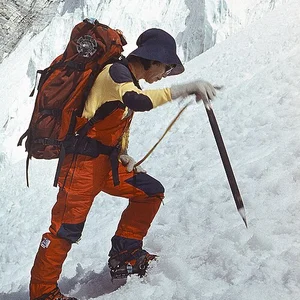
    Mountaineering ice axe

    An indispensable tool for mountaineers, used to progress on ice and snow and to arrest a fall. Junko Tabei used it on all her Himalayan ascents, notably during the ascent of Everest in 1975.

    High-altitude oxygen mask

    Vital equipment above 7,000 metres, where the air contains too little oxygen to breathe normally. Tabei and her team used oxygen bottles during the final ascent of Everest.

    Twelve-point crampons

    Metal spikes attached under boots to progress on ice and hard snow. Essential on the steep slopes of the Himalayas, they allow the mountaineer to secure each step.

    High-altitude tent

    An ultralight shelter resistant to snowstorms and violent winds at high-altitude camps. It was in such a tent that Tabei and her team were buried by the avalanche of 6 April 1975.

    Topographic map of the Himalayas

    An essential navigation tool for planning ascent routes and locating camps. Tabei's expeditions used maps produced by British and Indian military survey teams.

    Mountain notebook

    A personal journal kept by Tabei throughout her expeditions, in which she recorded weather conditions, feelings, and observations. These notebooks served as the basis for her testimonial books published in Japan.

    School Curriculum

    Cycle 4 (5e-3e)Géographie
    LycéeGéographie

    Vocabulary & Tags

    Key Vocabulary

    Tags

    Junko TabeiexplorationexplorateurExplorateurfeminismeFéminisme, droits des femmes

    Daily Life

    Morning

    On expeditions, Tabei would rise before dawn to take advantage of the stable morning weather conditions. She would put on her thermal undergarments, her down suit, and her crampons in freezing cold, then swallow a hot tea and a few biscuits before setting off toward the next camp.

    Afternoon

    Afternoons at high altitude were often spent waiting in the tent, when wind or blizzard made any progress impossible. Tabei would jot down observations in her notebook, check the equipment, and discuss strategy with the Sherpas and her teammates.

    Evening

    At camp in the evening, the team would prepare freeze-dried meals rehydrated with melted snow. Tabei would write in her journal, check the weather forecasts transmitted by radio from base camp, and go to sleep early to recover before the next day of climbing.

    Food

    At high altitude, the diet was dominated by freeze-dried and high-energy foods: dried rice, instant miso soup packets, chocolate, dried fruit, and biscuits. Hydration was crucial but difficult, as water had to be obtained by melting snow on a gas stove.

    Clothing

    Tabei wore the technical mountaineering gear of the 1970s: a goose-down suit, a wool balaclava, mirror-lens glacier goggles, lined leather gloves, and the iconic double-boot plastic mountaineering boots. Her equipment, though less advanced than today's, was at the cutting edge of the technology of the time.

    Housing

    During expeditions, Tabei lived in small high-altitude tents designed for two people, anchored in the snow with stakes and ropes. Back in Japan, she led a simple life in her suburban Tokyo home, teaching piano to neighborhood children to fund her next expeditions.

    Historical Timeline

    1939Naissance de Junko Tabei à Miharu, préfecture de Fukushima, Japon.
    1953Edmund Hillary et Tenzing Norgay réalisent la première ascension de l'Everest, inspirant une génération d'alpinistes.
    1960Junko Tabei commence l'alpinisme à l'université Showa Women's University, où elle rejoint le club d'escalade.
    1969Fondation du Ladies Climbing Club Japan, premier club d'alpinisme exclusivement féminin au Japon.
    1972Tabei gravit l'Annapurna III (7 555 m) lors d'une expédition féminine, se préparant pour l'Everest.
    1975Le 16 mai, Junko Tabei devient la première femme à atteindre le sommet de l'Everest (8 848 m), avec le sherpa Ang Tsering.
    1975La Népal Alpine Association lui décerne un prix d'honneur ; elle est reçue par le roi du Népal Birendra.
    1978Reinhold Messner et Peter Habeler réalisent la première ascension de l'Everest sans oxygène, nouvelle étape dans l'histoire de l'alpinisme.
    1985Richard Bass réalise le premier Sept Sommets de l'histoire, ouvrant la voie à Tabei pour relever ce défi.
    1990Junko Tabei commence son projet de gravir les Sept Sommets tout en poursuivant son engagement environnemental.
    1992Tabei complète les Sept Sommets en gravissant le Puncak Jaya (Indonésie), devenant la première femme à réaliser cet exploit.
    1996Catastrophe sur l'Everest : huit alpinistes morts en une journée, relançant le débat sur la commercialisation des expéditions himalayennes.
    2000Junko Tabei obtient un master en sciences de l'environnement et milite pour la préservation des écosystèmes montagnards.
    2016Décès de Junko Tabei le 20 octobre à Tokyo, des suites d'un cancer, à l'âge de 77 ans.

    Period Vocabulary

    High-altitude mountaineering — The practice of climbing and ascending summits exceeding 7,000 to 8,000 meters, requiring progressive acclimatization and specialized equipment to cope with extreme conditions.
    Sherpa — Member of the Tibetan Sherpa people living in the mountains of Nepal, many of whom have become indispensable guides and porters for Himalayan expeditions thanks to their natural adaptation to altitude.
    Death zone — Term referring to altitudes above 8,000 meters where atmospheric pressure is too low to allow the human body to survive for extended periods without supplemental oxygen.
    Freeze-drying — A food preservation process using cold desiccation, producing very lightweight meals that can be reconstituted by adding hot water, ideal for expeditions in remote environments.
    Acclimatization — The physiological process by which the body gradually adapts to altitude, notably by increasing red blood cell production to compensate for the reduced oxygen levels.
    Glacial pass — A high-altitude passage between two summits or two slopes of a mountain range, often covered in ice and snow, forming a key stage in many Himalayan ascent routes.
    Seven Summits — A sporting challenge consisting of climbing the highest point on each of the seven continents. This concept, popularized in the 1980s, became the ultimate goal of many mountaineers including Junko Tabei.
    Bivouac — An emergency or planned camp in high mountains, often reduced to a lightweight tent or even a sleeping bag laid in the snow, used when weather conditions or progress force an improvised halt.
    Himalayan monsoons — Season of intense rainfall (June to September) making any Himalayan ascent dangerous and practically impossible. Expeditions were planned during the pre-monsoon (April–May) or post-monsoon (October) windows.

    Gallery

    Junko Tabei

    Junko Tabei

    Mountaineers in Communism Peak in 1985

    Mountaineers in Communism Peak in 1985

    Junko Tabei (cropped)

    Junko Tabei (cropped)

    Junko Tabei, Jaapani alpinist 85

    Junko Tabei, Jaapani alpinist 85

    Junko Tabei 85 (7)

    Junko Tabei 85 (7)

    Visual Style

    Style visuel alliant photojournalisme alpin des années 1970 et esthétique japonaise épurée : contrastes forts entre combinaisons colorées et immensité blanche et grise de l'Himalaya.

    #1A3A5C
    #FFFFFF
    #C0392B
    #7F8C8D
    #F0C040
    AI Prompt
    Japanese female mountaineer, 1970s Himalayan expedition aesthetic, high-contrast photography style inspired by black-and-white alpine photojournalism, bright primary-colored down jackets and wool balaclavas against white snow and grey granite, dramatic perspective looking up at an ice wall or snow-covered summit ridge, heroic and documentary feel, Ansel Adams meets Japanese woodblock print in its contrast and serenity, deep blue glacial sky, golden light at altitude, texture of weathered gear and frost-covered ropes, dignity and determination in the composition.

    Sound Ambience

    Ambiance sonore des grandes expéditions himalayennes : vent glacial, crampons sur neige dure, respiration sous masque à oxygène et silence vertigineux des altitudes extrêmes.

    AI Prompt
    High altitude Himalayan soundscape: howling wind through rocky ridges, crampons crunching on compacted snow and ice, the rhythmic thud of a piolet anchoring into a frozen slope, labored breathing through an oxygen mask, distant rumble of a snow avalanche echoing in the valley, the flapping of a nylon tent in gusts of arctic wind, the creak of ropes under tension, silence broken only by the heartbeat and the sound of boots in deep powder snow, far below the murmur of prayer flags on a Tibetan monastery.

    Portrait Source

    Wikimedia Commons — CC BY-SA 4.0 — Jaan Künnap — 1985