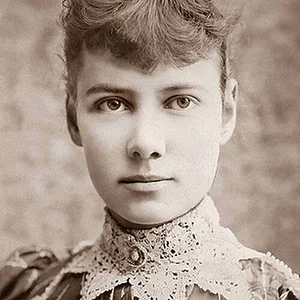

A pioneering American journalist, Nellie Bly made her mark through undercover investigative journalism, most notably by having herself committed to a psychiatric asylum to expose its conditions. In 1889, she traveled around the world in 72 days, breaking the fictional record of Phileas Fogg.
Nellie Bly(1864 — 1922)
Nellie Bly
États-Unis
8 min read
Frequently asked questions
Famous Quotes
« I said I could and I would. And I did.»
« Energy rightly applied and directed will accomplish anything.»
Key Facts
- 1887: goes undercover in the Blackwell's Island asylum in New York and publishes 'Ten Days in a Mad-House', triggering a reform of the psychiatric system
- 1889–1890: travels around the world in 72 days, 6 hours, and 11 minutes for Joseph Pulitzer's New York World
- Began her career at the Pittsburgh Dispatch around 1885, pushing for stories on the living conditions of working-class women
- 1913: covers World War I on the Austrian front, one of the few female war correspondents of the era
- 1920: actively campaigns for women's suffrage, secured that same year by the 19th Amendment
Works & Achievements
Account of her undercover investigation at the Blackwell's Island asylum, first published in the New York World and later as a book. This masterpiece of investigative journalism prompted immediate reform of New York's psychiatric system and remains a worldwide reference in the genre.
Account of her solo around-the-world journey completed in 72 days in 1889–1890, breaking the fictional record of Phileas Fogg. The book was a phenomenal success and made Nellie Bly an international celebrity.
Reportage drawn from her stays in Mexico, where she investigated the living conditions of the population and the policies of Porfirio Díaz. This book reflects her early interest in international social journalism.
A serialized novel published in the New York World, showing that Nellie Bly was not limited to reportage but also experimented with popular fiction.
A series of undercover articles on the working conditions of women in New York's factories and workshops. These pioneering texts contributed to debates on labor law and women's rights.
Anecdotes
In 1887, Nellie Bly feigned madness in order to be committed to the Blackwell's Island asylum in New York. For ten days, she endured the mistreatment inflicted on patients: revolting food, ice-cold baths, and violent guards. Her report published in the New York World caused a national scandal and led to an immediate reform of the American psychiatric system.
In November 1889, Nellie Bly left New York with the intention of traveling around the world in fewer than 80 days, challenging the fictional hero of Jules Verne. She traveled alone, with a single bag, by ship, train, and rickshaw. She completed the journey in 72 days, 6 hours, and 11 minutes, beating the record imagined by Verne, who sent her a congratulatory telegram.
During her around-the-world journey, Nellie Bly made a detour through Amiens to meet Jules Verne in person. The writer, curious and admiring, welcomed her into his home and followed her adventure with great enthusiasm on a wall map. This meeting between the real-life journalist and the fiction novelist perfectly illustrates the permeability between dream and reality at the end of the 19th century.
Before embarking on a career in journalism, Nellie Bly — born Elizabeth Jane Cochran — sent an indignant letter to the Pittsburgh Dispatch in response to a sexist article claiming that women belonged only in the home. The editor, rather than ignoring her, offered her a job. She was 18 years old at the time and had no professional experience.
In 1914, at over 50 years of age, Nellie Bly went to cover the First World War from the Austrian front for the New York Evening Journal. She was one of the first female war correspondents in American history, filing reports from conflict zones at a time when few women dared venture so far beyond the traditional role assigned to their sex.
Primary Sources
I said to myself that I would succeed in getting committed to the insane ward at Blackwell's Island. I had little belief in my ability to deceive the doctors, and yet I determined to try.
I always have a comfortable feeling that nothing is impossible if one applies a certain amount of energy in the right direction. When I want things done, which is always at the last moment, I get them done.
I have been reading your paper for some time past and have always enjoyed it very much, but I must say that your article on 'What Girls Are Good For' is a disgrace to your paper.
The insane asylum on Blackwell's Island is a human rat-trap. It is easy to get in, but once there it is impossible to get out.
Key Places
It was in this grim psychiatric institution that Nellie Bly was forcibly committed for ten days in 1887. Her report on the conditions of confinement there permanently changed American mental health policy.
At this newspaper founded by Joseph Pulitzer, Nellie Bly became one of the first great investigative journalists. It was from here that all her most famous assignments originated.
During her around-the-world trip, Nellie Bly made a detour to Amiens to meet Jules Verne, whose novel had inspired her challenge. This symbolic stopover brought fiction and reality together.
It was in this industrial city that Nellie Bly grew up and began her career at the Pittsburgh Dispatch. There she discovered the social inequalities that would fuel her entire journalistic work.
As the Asian leg of her around-the-world journey, Nellie Bly stopped in Japan in December 1889. She observed with curiosity a radically different culture and purchased a monkey there that accompanied her all the way back to America.
Typical Objects

An indispensable tool for the journalist, Nellie Bly took notes in secret during her undercover assignments, memorizing details to transcribe them in the evening. Her quick and precise handwriting was the hallmark of press correspondents of the Victorian era.

For her trip around the world, Nellie Bly took only a single small travel bag, proving that a woman could travel alone and light. This minimal luggage became a symbol of her independence and daring.

Steam-powered ocean liners were the primary means of crossing the oceans at the end of the 19th century. Nellie Bly made extensive use of them during her trip around the world, boarding ships connecting New York, Southampton, Port Said, Colombo, Hong Kong, and San Francisco.

Joseph Pulitzer's newspaper was the platform that made Nellie Bly famous. Her articles appeared on the front page with large sensational headlines, read by hundreds of thousands of New Yorkers every morning.

During her trip around the world, every minute counted: Nellie Bly regularly checked her watch to make sure she was keeping to her connections and beating the 80-day record. Time was both her enemy and her ally.

Nellie Bly wore functional clothing suited for travel, breaking away from the cumbersome fashion of the Victorian era. Her simple, sturdy travel dress, without excessive corsetry, illustrated her pragmatic relationship with femininity.
School Curriculum
Vocabulary & Tags
Key Vocabulary
Tags
Daily Life
Morning
Nellie Bly rose early in her New York apartment, read competing newspapers to identify untreated subjects, then headed to the newsroom of the New York World. She discussed with her editor-in-chief the investigations to pursue, often undercover missions that required meticulous preparation.
Afternoon
Her afternoons were devoted to field reporting: she slipped among factory workers, tenement immigrants, or interviewed political figures. She took discreet notes, sometimes from memory when using a notebook would have raised suspicion.
Evening
In the evening, back at the newsroom or at home, she wrote her articles by the light of a gas lamp, with a constant concern for factual accuracy and emotional impact on the reader. She revised her texts until late at night before handing them over to the typesetters.
Food
Like many middle-class New York women of the late 19th century, Nellie Bly ate simply: bread, cold meat, cooked vegetables, and strong coffee. During her travels, she adapted to local cuisines, noting with curiosity the Japanese or Indian dishes she encountered on her world tour.
Clothing
Nellie Bly wore dark wool dresses with high collars, practical and understated, avoiding the cumbersome crinolines then in fashion. For travel, she favored a single sturdy outfit that did not hinder her swift movements, breaking with the feminine dress conventions of her era.
Housing
She lived in a rented apartment in Manhattan, in the bustling Midtown neighborhood, close to the New York World newsroom. Her lodgings, modest but functional, reflected her status as an independent, salaried woman — rare for the time — without the domestic staff that bourgeois families typically employed.
Historical Timeline
Period Vocabulary
Visual Style
Esthétique victorienne tardive américaine : presse illustrée en noir et sépia, rues industrielles de New York sous les becs de gaz, voyage en paquebot sur fond de vastes horizons marins.
Sound Ambience
Ambiance sonore du New York industriel de la fin du XIXe siècle, entre le brouhaha d'une rédaction de presse et les bruits de la rue animée, ponctuée des sons d'un voyage en paquebot à vapeur.
Liens externes & ressources
Références
Œuvres
Ten Days in a Mad-House
1887
Around the World in Seventy-Two Days
1890
Six Months in Mexico
1888
The Mystery of Central Park
1889
Reportages sur les ouvrières new-yorkaises
1887-1888