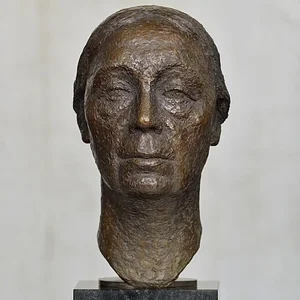

Käthe Kollwitz (1867-1945) was a German artist, printmaker and sculptor. Her socially committed work portrays working-class poverty, war and maternal grief. She was the first woman elected to the Prussian Academy of Arts, in 1919.
Käthe Kollwitz(1867 — 1945)
Käthe Kollwitz
république de Weimar, Empire allemand
7 min read
Frequently asked questions
Famous Quotes
« I want to be effective in this time when people are so helpless and in need of aid.»
Key Facts
- Born in 1867 in Königsberg, East Prussia
- Print cycle *The Weavers' Revolt* (1893-1897), inspired by Gerhart Hauptmann's play
- Cycle *The Peasants' War* (1902-1908), devoted to the 16th-century peasant uprisings
- First woman elected to the Prussian Academy of Arts, in 1919
- Loss of her son Peter in 1914 at the front, a grief that inspired the memorial *The Grieving Parents* (1932)
- Expelled from the Academy by the Nazis in 1933; died in 1945 in Moritzburg
Works & Achievements
Cycle of six prints inspired by Hauptmann's play, which brought Kollwitz to prominence and shaped German social art.
Series of seven engravings on the sixteenth-century peasant revolt, dominated by the heroic figures of “The Plough” and “Schwarze Anna.”
Pair of kneeling statues erected over the grave of her son Peter, one of the most poignant pacifist monuments of the Great War.
Seven woodcuts with powerful blacks denouncing the suffering of mothers, widows, and children in the face of war.
Lithograph that became an emblem of pacifism, created for a Social Democratic youth day.
Small sculpture of a mother holding her dead son, enlarged after 1945 for the Neue Wache in Berlin, a memorial to the victims of war and tyranny.
Final cycle of eight lithographs in which the artist confronts death in all its forms, a personal meditation in the twilight of her life.
Series of more than a hundred drawings, prints, and sculptures in which Kollwitz examines herself without indulgence, forming an autobiography in images.
Anecdotes
In 1898, the jury of the Great Berlin Exhibition proposed awarding a gold medal to Käthe Kollwitz for her engraved cycle on the weavers' revolt. Emperor Wilhelm II vetoed the decision, deeming this "gutter art" unworthy of an official prize. The scandal had the opposite effect, making the young artist known throughout Germany.
Her younger son Peter, a volunteer enlistee, was killed as early as October 1914, just a few days after leaving for the Flanders front. Käthe Kollwitz took nearly twenty years to complete the funerary monument in his honor
The Grieving Parents
two kneeling statues she sculpted in her own likeness and that of her husband.
In 1919, she became the first woman elected to the Prussian Academy of Arts, which earned her the title of professor and a studio. In 1933, after the Nazis came to power, she was forced to resign for having signed an appeal against Hitler.
The Gestapo summoned her and threatened to send her to a concentration camp; her advanced age and international fame likely protected her from deportation. Her works were removed from museums and excluded from exhibitions under the Nazi regime.
For decades, Käthe Kollwitz kept a private diary and wrote numerous letters in which she confided her doubts as an artist and her grief as a mother. These writings, published after her death, make her one of the artists whose inner life is most fully known.
Primary Sources
I want to be effective in this age in which people are so helpless and in need of aid.
There is in me a wound that will never close. My Peter, I want to stay faithful to you.
The motif of the mother protecting her child has always occupied me; it is a theme I have returned to again and again.
I have often been reproached for the tendentiousness of my art. But I am content for it to have a direction, as long as it stays alive.
Key Places
Town in East Prussia where Käthe Schmidt was born in 1867 and grew up in a cultured, socially committed family. It was there that she received her first drawing lessons.
In 1891 the Kollwitz couple settled in this working-class district where Karl worked as a doctor for the poor. There Käthe observed the poverty that would inspire all of her work.
Institution where she was elected its first female member in 1919, gaining the title of professor and a studio. She was forced to resign in 1933.
Site where her son Peter, killed in 1914, is buried and where in 1932 she installed her monument “The Grieving Parents.” A major place of remembrance of the Great War.
Having fled the bombing of Berlin, Kollwitz spent her final months in this small Saxon town, where she died on 22 April 1945, shortly before the end of the war.
Typical Objects

Steel tools used to incise copper plates for etching and intaglio engraving. Kollwitz mastered them very early and made them the heart of her art.

A heavy-cylinder press that uses pressure to transfer the ink held in the plate's grooves onto damp paper. It was used to pull proofs of etchings and engravings.

A block of polished limestone on which the artist draws with a greasy crayon before printing. Kollwitz turned to it mainly in her maturity for her large politically engaged posters.

A curved chisel for hollowing out the wooden blocks used in woodcut printing. She used it for the cycle “War,” with its starkly contrasting blacks and whites.

A wooden or metal modeling tool for working clay and plaster and preparing bronzes. It served for her sculptures such as “The Grieving Parents” or “The Pietà.”

A notebook and sticks of charcoal with which the artist captured from life the faces of workers, mothers, and children. These studies then fed into her prints and sculptures.

Throughout her life, Kollwitz portrayed herself in dozens of self-portraits scrutinizing aging and fatigue. Together they form a unique visual autobiography.
School Curriculum
Vocabulary & Tags
Key Vocabulary
Daily Life
Morning
Käthe Kollwitz starts her day early in her Berlin studio, taking advantage of the morning light to engrave her copper plates or model clay. She sometimes receives models from the working-class district, whom she draws in charcoal.
Afternoon
The afternoon is devoted to the patient work of the intaglio press and the printing of proofs. She also takes care of the house and welcomes colleagues, students, or activists who come to consult her.
Evening
In the evening, she rejoins her husband Karl, a doctor for the poor, and discusses with him the life of the neighborhood and the affairs of the day. She reads a great deal and keeps her diary regularly.
Food
The Kollwitz family eats like the modest Berlin middle class: rye bread, potatoes, soups, cabbage, and a little meat. During the wars and the inflation, like all Germans, she experiences rationing and shortage.
Clothing
She wears dark, plain dresses, without ornament, reflecting her grave temperament and her convictions. In the studio, she adds an apron to protect her clothes from ink and clay.
Housing
For nearly fifty years the family lives in a studio-apartment in the working-class district of Prenzlauer Berg, above Karl's medical practice. Destroyed by a bombing in 1943, this home forces her to take refuge in the provinces.
Historical Timeline
Period Vocabulary
Liens externes & ressources
Références
Œuvres
Un soulèvement de tisserands (Ein Weberaufstand)
1893-1897
La Guerre des paysans (Bauernkrieg)
1902-1908
Les Parents en deuil (Die trauernden Eltern)
1914-1932
Cycle La Guerre (Krieg)
1922-1923
Affiche « Plus jamais la guerre ! » (Nie wieder Krieg)
1924
La Mort (Tod)
1934-1937