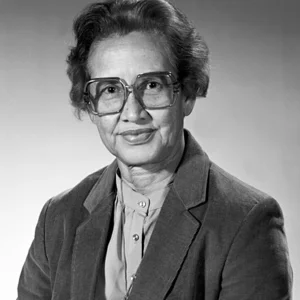

African-American physicist, mathematician, and space engineer
Katherine Johnson(1918 — 2020)
Katherine Johnson
États-Unis
8 min read
Frequently asked questions
Key Facts
- Katherine Johnson naît en 1918 en Virginie-Occidentale dans une Amérique ségrégationniste qui lui interdit l'accès à de nombreuses écoles.
- Elle intègre la NASA (alors NACA) en 1953 comme 'calculatrice humaine', effectuant à la main des calculs de trajectoires spatiales.
- En 1962, John Glenn exige personnellement que Katherine Johnson vérifie les calculs de l'ordinateur avant son orbite autour de la Terre.
- Elle contribue aux calculs de trajectoire de la mission Apollo 11 qui permet à l'Homme de marcher sur la Lune en 1969.
- Elle reçoit la Médaille présidentielle de la Liberté en 2015 ; ses travaux sont portés à l'écran dans le film 'Les Figures de l'ombre' (2016).
Works & Achievements
Katherine Johnson manually calculated the ballistic trajectory for the first crewed American spaceflight. This calculation, completed in a matter of hours, allowed Alan Shepard to become the first American in space.
John Glenn refused to launch for his orbital flight until Katherine had personally verified the IBM computer's calculations. Her manual verification confirmed the data, and Glenn completed three orbits around the Earth.
The first official research report co-signed by Katherine Johnson at NASA, covering the equations for placing a satellite into orbit. It marked a first for a woman in the agency's flight research division.
Katherine Johnson contributed to the equations enabling Apollo 11's lunar landing and the safe return of the astronauts to Earth, representing the pinnacle of a career dedicated to space exploration.
During her final years at NASA, Katherine worked on trajectory calculations for the Space Shuttle program, contributing to the new generation of reusable space vehicles.
Anecdotes
Katherine Johnson had such mastery of orbital calculation that, during the Apollo 11 mission in 1969, astronauts and engineers would systematically verify her results by hand before trusting the computers. John Glenn, before his orbital flight in 1962, refused to launch until Katherine had personally checked the trajectories calculated by the machines.
Admitted to West Virginia University at just 18 years old, Katherine Johnson was one of the first three Black students accepted as part of the institution's desegregation. She earned her bachelor's degree in mathematics and French in 1937, graduating with honors before she had even turned 20.
At NASA (then called NACA), calculations were performed by 'human computers' — women tasked with doing the mathematics by hand. Katherine worked in a separate section reserved for African Americans, with segregated bathrooms and a separate cafeteria. Despite this, the exceptional quality of her work quickly earned her a place among the white engineering teams, breaking racial and gender barriers simultaneously.
Katherine Johnson co-authored a research report in 1960 on orbital trajectory equations, becoming one of the first women in the flight research division to sign an official NASA report. This technical document, titled 'Determination of Azimuth Angle at Burnout for Placing a Satellite Over a Selected Earth Position', remains a foundational contribution to astronautics.
In 2015, at the age of 97, Katherine Johnson received the Presidential Medal of Freedom from President Barack Obama, the highest civilian honor in the United States. She said her secret was simple: 'Love what you do and do it with excellence.' Her story was brought to the screen in 2016 in the film Hidden Figures, revealing to the general public the crucial role of these forgotten mathematicians.
Primary Sources
This report presents equations and procedures for determining the azimuth angle at burnout required to place a satellite over a selected earth position at a specified time.
Katherine Johnson's mathematical genius helped ensure that the United States won the Space Race. She calculated the trajectory for Alan Shepard, the first American in space, and was asked personally by John Glenn to run the numbers for his own historic Earth orbit.
We needed to be assertive as women in those days — assertive and aggressive — and the degree to which I was able to be, I'm happy to say, was rewarded.
Johnson contributed to the calculations for the trajectory analysis used for the first American crewed spaceflights, including Freedom 7 and Friendship 7, and later for the Apollo lunar missions.
Key Places
Katherine Johnson's hometown, in a state where access to secondary and higher education was extremely limited for Black children. Her father drove 200 km every year to allow her to continue her studies.
Katherine earned her bachelor's degree here at age 18, then became one of the first three Black students to join the graduate programs during desegregation in 1939.
The site of Katherine Johnson's entire career at NASA (1953–1986). It is here that she calculated the trajectories for America's first space missions, in buildings still marked by racial segregation.
Launch site for the Mercury, Gemini, and Apollo missions whose trajectories Katherine Johnson had calculated. Each liftoff represented the realization of her mathematical equations.
In 2017, NASA renamed the Langley computing building in her honor, officially recognizing the contribution of African-American women to the conquest of space.
Typical Objects

Before electronic computers, Katherine used analog slide rules and logarithmic tables to perform complex trajectory calculations. These instruments were the everyday tools of NASA's human 'computers'.

The computing rooms at NACA and later NASA were equipped with large blackboards on which mathematicians worked out their differential equations and orbital systems. Katherine would spend hours solving celestial mechanics problems on them.

Introduced in the early 1960s, this massive computer performed calculations that women had previously done by hand. Katherine was trained to verify its results and program it, becoming a bridge between human computation and the machine.

In 1960, Katherine was one of the first women to officially sign a NASA research report. This document represented an institutional breakthrough in a field that was heavily male-dominated and racially segregated.

The access badge for Langley's research areas, obtained despite racial barriers, symbolized for Katherine and her colleagues their full and complete membership in the scientific team, in spite of the pervasive segregation.

These large graph sheets depicting Earth-Moon orbital transfer curves were the result of hundreds of hours of calculation. Katherine helped establish the mathematical parameters guaranteeing the safe return of the Apollo astronauts.
School Curriculum
Vocabulary & Tags
Key Vocabulary
Tags
Daily Life
Morning
Katherine woke up early and took the bus or drove to the Langley Center in Hampton, Virginia. In the early years, she was required to use the entrances and restrooms designated for Black employees. She began her day by reviewing trajectory problems left unresolved the day before.
Afternoon
Afternoons were devoted to intensive calculations — hours spent working with slide rules, logarithmic tables, and differential equations. Katherine also attended team meetings with the engineers, which women in her division were not supposed to join, but where she quickly established herself through the quality of her analysis.
Evening
In the evenings, Katherine returned to her home in Hampton, where she lived with her husband and three daughters. She handled domestic tasks like most women of her era, while sometimes continuing to think through unsolved mathematical problems. Hampton's African American community provided her with a strong social and cultural anchor.
Food
Katherine's diet reflected the African American cuisine of the American South: rice, beans, greens, roasted chicken, cornbread. In the early years at Langley, she could not eat lunch with her white colleagues and often brought her own meal or ate in the dining areas designated for Black employees.
Clothing
At work, Katherine wore the formal attire typical of professional women in the 1950s–60s: pencil skirt or modest dress, collared blouse, nylon stockings, low-heeled shoes. She took care with her appearance, aware that her image represented far more than just herself in an environment that viewed her as an anomaly.
Housing
Katherine lived in an African American neighborhood in Hampton, Virginia, separated from white neighborhoods by Jim Crow segregation laws. Her home was modest but comfortable, reflecting the steady salary of a federal employee. The neighborhood formed a tight-knit community of educated Black families, many employed at the military base or at NACA.
Historical Timeline
Period Vocabulary
Visual Style
Esthétique des bureaux gouvernementaux américains des années 1950-60, mêlant rigueur institutionnelle et modernité scientifique naissante, avec des femmes en tenue formelle travaillant parmi les équipements de calcul de l'ère spatiale.
Sound Ambience
Ambiance sonore feutrée et concentrée d'un centre de calcul scientifique des années 1960, mêlant le vrombissement des machines à calculer mécaniques, les discussions techniques à voix basse et l'écho lointain des préparatifs de lancement.
Liens externes & ressources
Références
Œuvres
Calcul de la trajectoire du vol Freedom 7 d'Alan Shepard
1961
Vérification des trajectoires du vol Friendship 7 de John Glenn
1962
Rapport : Determination of Azimuth Angle at Burnout for Placing a Satellite Over a Selected Earth Position
1960
Calculs de trajectoire pour la mission Apollo 11
1969
Calculs pour le programme de navettes spatiales
1970-1986