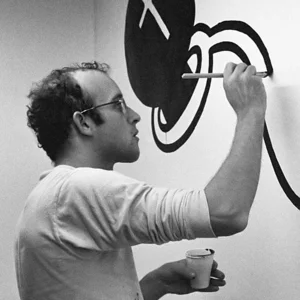

Keith Haring was an American artist and a major figure of 1980s New York street art. Known for his stylized figures with bold black outlines (crawling babies, barking dogs), he democratized art by placing it in public space and campaigned against AIDS and racism.
Keith Haring(1958 — 1990)
Keith Haring
États-Unis
6 min read
Frequently asked questions
Famous Quotes
« Art is for everybody.»
Key Facts
- Born on May 4, 1958 in Reading, Pennsylvania.
- From 1980, drew chalk drawings on the black advertising panels of the New York subway.
- Opened the Pop Shop in New York in 1986 to make his art accessible to all.
- Created the Keith Haring Foundation in 1989 to support the fight against AIDS and aid for children.
- Died of AIDS on February 16, 1990 in New York, at the age of 31.
Works & Achievements
Thousands of chalk drawings on the black panels of the New York subway. They made his art visible to millions of commuters and established his reputation.
The glowing crawling baby that became his visual signature. A symbol of innocence and positive energy recognized around the world.
A shop entirely covered with his black-and-white motifs, in New York. It turned the retail space into a total work of art.
A chain of colorful human figures painted on the western side of the wall. A message of unity in the face of the Cold War division.
An activist mural in Harlem against the crack epidemic. It became a landmark and a protected New York monument.
An AIDS prevention poster showing three figures covering their eyes, ears, and mouth. A major work of activist art confronting the epidemic.
An enormous mural on a wall of the Sant'Antonio church in Pisa, Italy. One of his last public works, a celebration of peace and harmony.
Anecdotes
In 1980, Keith Haring noticed empty advertising panels in the New York subway, covered with matte black paper. He drew his famous figures on them in white chalk: radiant babies, dogs, flying saucers. For five years, he created thousands of these “subway drawings,” sometimes getting arrested by the police for vandalism.
In 1986, Haring opened the “Pop Shop” in SoHo, a store where he sold T-shirts, badges, and posters bearing his designs. Many artists accused him of “selling out” his art, but he wanted to make it accessible to everyone, not just wealthy collectors: “I could have sold it for 100 times more, but I wanted kids to be able to afford it.”
That same year, Haring was invited to paint on the Berlin Wall, on the western side. He traced an unbroken chain of red, yellow, and black human figures, a symbol of unity, on the wall that then split the city in two. The work would disappear soon after, painted over by other graffiti artists.
Haring often collaborated with children: he organized mural-painting workshops in schools and hospitals around the world. He liked to say that children understood his art instantly, without needing any explanation, because he drew in a language of universal signs.
Diagnosed as HIV-positive in 1988, Haring founded the Keith Haring Foundation in 1989 to fund AIDS research and help children. He turned his illness into an artistic battle, producing numerous prevention posters such as *Ignorance = Fear / Silence = Death*. He died of AIDS on February 16, 1990, at just 31 years old.
Primary Sources
The public has a right to art. Art is for everybody. To think that art is only for the privileged is extremely cruel.
The subway drawing was, for me, the most perfect laboratory. People would stop and look, and I could talk with them while I was drawing.
Ignorance = Fear. Silence = Death. Fight AIDS, act up, protect yourself.
The Pop Shop made my art accessible. It was an extension of what I was doing in the subway, breaking down the barrier between high art and low art.
Key Places
Hometown of Keith Haring, where he grew up drawing comics with his father. This comic-drawing heritage shaped his style of clean outlines.
Underground network where Haring created his thousands of chalk drawings between 1980 and 1985. It was his true studio and his springboard to fame.
Shop opened in 1986 to sell affordable items bearing his designs. It embodies his philosophy of art for everyone.
In 1986, Haring painted a mural of chained figures here as a message of unity, on this symbol of the world's division.
Mural painted in 1986 on a handball court to denounce the devastation of crack in working-class neighborhoods. Today it is a protected New York landmark.
Typical Objects

Haring's emblematic tool, with which he drew his figures in chalk on the empty black panels of the New York subway. Erasable and cheap, it symbolizes his ephemeral and popular art.

A tool of street art and graffiti that Haring used for his large murals. It allows vast surfaces to be covered quickly with bright colors.

The figure of a crawling baby surrounded by rays, which became Haring's signature. He saw in it the purest and most positive human experience, and used it as a tag.

A garment printed with Haring's motifs, sold cheaply in his SoHo store. It embodies his desire to spread art into everyone's daily life.

An activist medium bearing slogans such as “Silence = Death.” Haring put his art at the service of the fight against the epidemic and ignorance.

Haring filled notebooks with drawings and diary entries in which he recorded his ideas about art and society. They bear witness to his constant reflection on the role of the artist.
School Curriculum
Vocabulary & Tags
Key Vocabulary
Tags
Lieu
Daily Life
Morning
Haring would get up in his New York loft and often jotted down his ideas and reflections in his diaries. The morning might be spent preparing his canvases, brushes and spray cans for the day's projects.
Afternoon
In the afternoon, he worked in his studio or created murals in public, sometimes surrounded by onlookers and children. He moved from sketches to large canvases to collaborations at an intense pace.
Evening
In the evening, Haring frequented the clubs and parties of New York's underground scene, like the Paradise Garage or Club 57. There he mingled with artists, musicians and hip-hop dancers, constant sources of inspiration.
Food
Like many young New York artists, he often ate on the go, between two work sessions. Nightlife and fast food were part of his urban daily routine.
Clothing
Haring wore a simple, casual outfit: jeans, sneakers and the round glasses that became iconic. He was often covered in paint stains, the mark of his constant hands-on work.
Housing
He lived and worked in Manhattan lofts and studios, places that were both home and creative space. These large open spaces allowed him to paint very large canvases.
Historical Timeline
Period Vocabulary
Liens externes & ressources
Références
Œuvres
Subway Drawings (dessins du métro)
1980-1985
Radiant Baby
vers 1980
Murale du Pop Shop
1986
Fresque du mur de Berlin
1986
Crack is Wack
1986
Ignorance = Fear / Silence = Death
1989