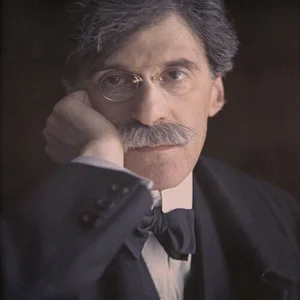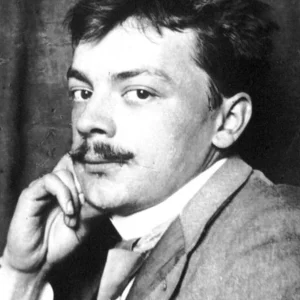

Austrian painter, graphic artist, and designer (1868-1918), co-founder of the Vienna Secession and the Wiener Werkstätte. A leading figure of Art Nouveau and Jugendstil, he revolutionized the decorative arts by uniting fine art and craft.
Koloman Moser(1868 — 1918)
Koloman Moser
Cisleithanie
9 min read
Frequently asked questions
Key Facts
- 1868: born in Vienna into a modest family
- 1897: co-founded the Vienna Secession with Gustav Klimt
- 1903: co-founded the Wiener Werkstätte with Josef Hoffmann
- Designed postage stamps, stained glass windows, furniture, and textiles that became icons of the Viennese style
- 1918: died in Vienna of cancer, leaving behind a versatile and influential body of work
Works & Achievements
Moser designed several iconic posters for the Secession exhibitions, including the one for the 5th Exhibition (1899). Bold geometric compositions, refined typography, and flat, vivid colors make them landmark references in Art Nouveau graphic design.
Major graphic contributions to the official journal of the Vienna Secession: drop caps, ornaments, illustrations, and page layouts that turned each issue into a work of art in its own right, revolutionizing the editorial art of the era.
A monumental ensemble of stained-glass windows for the psychiatric church designed by Otto Wagner, blending religious symbolism with Secessionist aesthetics. These works remain among the most impressive testimonies to Viennese decorative art of the early 20th century.
A series of postage stamps for the Austro-Hungarian Empire featuring geometric motifs characteristic of the *Jugendstil*. Recognized as masterpieces of functional graphic design, they brought modernist aesthetics into the daily lives of millions.
Moser designed hundreds of pieces — furniture, jewelry, textiles, tableware, glassware — for the Viennese Workshops. These creations embody the ideal of the *Gesamtkunstwerk* and profoundly influenced European design through to Art Deco.
After his departure from the Wiener Werkstätte, Moser turned to large-scale painting. This mythological canvas illustrates the evolution of his style toward a more assertive chromatic and formal freedom, far removed from the decorative rigor of his Secessionist years.
Anecdotes
In 1897
Koloman Moser was one of the nineteen artists who walked out of Vienna
s Künstlerhaus to found the Vienna Secession alongside Gustav Klimt and Josef Hoffmann. Their motto
engraved on the white building by Josef Maria Olbrich that he helped decorate
has become legendary:
To every age its art, to art its freedom." This break with official academicism marked a turning point in the history of European art.
Moser designed the Austrian postage stamps known as the "Numerals" series (*Ziffernserie*), issued from 1904 onward. These stamps, with their spare geometric motifs and Art Nouveau typography, are now regarded as masterpieces of functional graphic design. They represent one of the rare cases where an avant-garde artist left his mark on an everyday object used by millions of people.
For the psychiatric church Am Steinhof, built by architect Otto Wagner (1904–1907), Moser designed monumental stained-glass windows depicting angels with expressive faces set against stylized golden backgrounds. These windows, which blend traditional religious iconography with Secessionist aesthetics, are today among the most spectacular surviving examples of Viennese Art Nouveau.
In 1903, Moser co-founded the Wiener Werkstätte (Vienna Workshops) with his friend the architect Josef Hoffmann and the patron Fritz Waerndorfer. Their ambition was to abolish the boundary between fine art and craft by designing everyday objects — tableware, furniture, jewellery, textiles — as beautiful and carefully wrought as paintings. At its peak, the workshop employed more than a hundred skilled craftsmen.
When Moser left the Wiener Werkstätte in 1907, following financial and artistic tensions, he devoted himself entirely to painting. This return to canvas was for him a second creative birth: his style evolved toward freer, more colourful compositions, far from the decorative rigour that had made him famous. He died in 1918 from laryngeal cancer, just a few weeks before the collapse of the Austro-Hungarian Empire of which he had been one of the most brilliant artistic ambassadors.
Primary Sources
We wish to establish an intimate connection between the public, the designer, and the craftsman, and to create good, simple objects for the home. We start from the utilitarian purpose — comfort is our primary condition, and our constant concern is the beauty of form and material.
We recognize no distinction between fine art and minor art, between art for the rich and art for the poor. Art is art, whether it manifests itself in a palace or in a modest room.
The works on display bear witness to a shared ambition: to unite all artistic disciplines in an ideal of *Gesamtkunstwerk* — a total work of art in which painting, sculpture, architecture, and the decorative arts speak to and complete one another.
Art is a universal language that speaks to all people. In dedicating this exhibition to the genius of Beethoven, we affirm that music, painting, and the decorative arts all share the same spiritual impulse toward beauty and truth.
Key Places
Koloman Moser's birthplace, Vienna was the absolute center of all his artistic activity. It is here that he studied, created, taught, and died, at the heart of an exceptional cultural ferment that made the Austrian capital one of the world's great metropolises of Art Nouveau.
Inaugurated in 1898 and designed by Josef Maria Olbrich, this white building crowned by a dome of gilded laurel leaves is the iconic exhibition venue of the Secessionist movement. Moser contributed to several major exhibitions there, including the memorable Beethoven Exhibition of 1902.
A masterpiece by architect Otto Wagner, built between 1904 and 1907 for a psychiatric hospital, this church houses Koloman Moser's monumental stained-glass windows. It remains one of the most spectacular testaments to the collaboration between modernist architecture and the decorative arts of the Secession.
Founded in 1903 by Moser, Hoffmann, and Waerndorfer, the Wiener Werkstätte was located in Vienna's 7th district. It was here that Moser oversaw the artisanal production of furniture, jewelry, textiles, and decorative objects until his departure in 1907.
Moser began teaching here in 1899, training a generation of artists and designers in the new formal language of Viennese modernism. This school, today the University of Applied Arts Vienna (*Universität für angewandte Kunst*), remains one of the intellectual heartlands of the movement.
Liens externes & ressources
Références
Œuvres
Affiches pour les expositions de la Sécession viennoise
1898-1905
Mises en pages et ornements de Ver Sacrum
1898-1903
Vitraux de la Kirche am Steinhof, Vienne
1905-1907
Timbres-poste autrichiens — Série « Chiffres » (Ziffernserie)
1904-1907
Objets et mobilier pour les Wiener Werkstätte
1903-1907