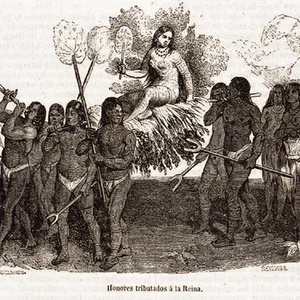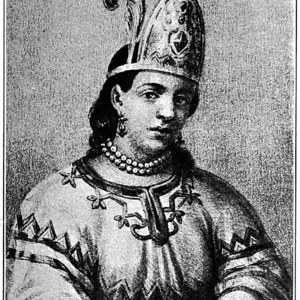

Born around 1500 into a noble Nahuatl family, sold into slavery and later given to Hernán Cortés, she became his interpreter, advisor, and companion. A central figure in the Conquest of Mexico, she remains an ambiguous symbol of betrayal and survival in Mexican historical memory.
La Malinche
La Malinche
Nouvelle-Espagne
8 min read
Frequently asked questions
Key Facts
- Born around 1500 in a Nahuatl region (likely Coatzacoalcos), from a noble Aztec family
- Sold or given away as a slave, she was fluent in Nahuatl and Maya before learning Spanish
- In 1519, she was given to Cortés along with other women during his march toward Tenochtitlan
- Played a decisive role in negotiations with allied peoples and in the fall of Tenochtitlan (1521)
- Gave birth to Martín Cortés around 1522, often regarded as one of Mexico's first symbolic mestizo children
Works & Achievements
With no written works bearing her name, La Malinche's contribution was oral and diplomatic: she translated between Spanish, Nahuatl, and Maya during all major negotiations of the Conquest, making possible the alliances with peoples subjugated by the Aztecs.
La Malinche led the negotiations with the leaders of Tlaxcala, a people hostile to the Aztecs. This mediation resulted in a crucial military alliance that changed the course of the Conquest.
By translating the traditions, myths, and laws of Nahuatl peoples for Spanish chroniclers, La Malinche indirectly contributed to the partial preservation of indigenous memory in the earliest colonial sources.
Though not created by her own hand, La Malinche is the most prominently depicted female figure in this indigenous pictographic document, which enshrines her status as an essential intermediary between the two civilizations.
Anecdotes
La Malinche originally spoke Nahuatl, the language of the Aztecs, but after being sold into slavery in the Maya region of the Yucatán, she also learned Yucatec Maya. When Cortés received her among twenty women given as a gift by the Maya in 1519, he discovered she could bridge Maya and Nahuatl, while his chaplain Jerónimo de Aguilar translated from Maya into Spanish. This translation relay allowed Cortés to negotiate with indigenous peoples with remarkable precision.
During the episode known as the 'Cholula Massacre' in October 1519, La Malinche is said to have been warned by an Aztec woman of a plot to slaughter the Spanish troops. She passed the information to Cortés, who launched a preemptive attack that killed thousands of Cholulans. This episode is cited by her detractors as proof of her betrayal, but also by her defenders as the act of a woman fighting to survive in a world at war.
La Malinche had a son with Hernán Cortés named Martín, born around 1523. This boy is often presented as one of Mexico's first symbolic mestizos, the offspring of the union between the European and indigenous worlds. Cortés officially acknowledged him and obtained a papal dispensation of illegitimacy on his behalf, allowing him to bear the Cortés name.
After the Conquest, La Malinche was married by Cortés to a Spanish conquistador, Juan Jaramillo, in a ceremony in 1524. She had a daughter with him named María. Although marginalized in official Spanish accounts that downplayed her role, she was recognized by some chroniclers such as Bernal Díaz del Castillo, who wrote that she deserved 'as much credit as the finest captains.'
In contemporary Mexican memory, the word 'malinchismo' refers to the tendency to favor foreign things at the expense of one's own national culture. This negative connotation of La Malinche's name developed mainly in the 19th and 20th centuries in the context of building Mexican national identity. Feminists and historians have since reappraised her role, emphasizing that she was above all an enslaved woman who used her talents to survive.
Primary Sources
"Doña Marina, though a native of these lands, was a great lady, and that is how she deserved to be treated. She carried herself with such presence that all the lords and caciques paid her great attention."
Cortés repeatedly mentions the role of his interpreter in negotiations with indigenous peoples, describing her as an essential instrument of diplomacy and persuasion.
This indigenous pictographic document, created by Tlaxcalan artists, depicts La Malinche alongside Cortés in numerous scenes of negotiation and battle, reflecting how central her role was perceived to be by the indigenous peoples themselves.
Sahagún's Nahuatl informants refer to "the tongue of Malintzin" as the channel through which Cortés's words reached the Aztec rulers, making her the indispensable intermediary of the Conquest.
Key Places
The presumed birthplace of Malintzin, on the Gulf of Mexico coast. It is here that she is believed to have grown up in a noble Nahuatl family before being sold into slavery.
The Maya region where La Malinche lived in slavery and learned Yucatec Maya. It was in Tabasco that Cortés received her in 1519 as one of twenty women given to him after the Battle of Centla.
A sacred indigenous city where the episode of the alleged conspiracy took place in 1519, in which La Malinche is said to have played a decisive role by warning Cortés of an ambush.
The capital of the Aztec Empire, now buried beneath Mexico City. It was here that La Malinche interpreted during the meeting between Cortés and Moctezuma II, and where she witnessed the fall of the Empire in 1521.
A city-state that was an enemy of the Aztecs and a decisive ally of Cortés. La Malinche played an essential role in diplomatic negotiations with the Tlaxcalans, whose alliance made the Spanish victory possible.
Typical Objects

A traditional Nahuatl women's garment, a long cloth embroidered with colorful patterns worn over the shoulders. Depictions of La Malinche in the codices show her wearing a huipil, marking her indigenous identity even within the Spanish entourage.

The Aztecs and Nahuatl peoples recorded their laws, calendars, and histories in illustrated codices. La Malinche, educated in a noble household, would have been familiar with these documents and helped interpret them for the Spanish.

In Aztec pictographic art, speech is represented by a scroll emerging from the mouth. In the Lienzo de Tlaxcala, La Malinche is almost always depicted with this symbol, emphasizing her unique role as a woman of words bridging two worlds.

Noble Nahuatl women wore fine cotton garments and jade ornaments, a precious stone associated with royalty and fertility. These elements reflect La Malinche's high social standing at birth, before she was enslaved.

Cacao was a drink reserved for elites and used during diplomatic exchanges among the Aztecs. La Malinche, present at meetings between Cortés and indigenous lords, moved through spaces where these drinking rituals punctuated negotiations.

The conquistadors carried steel swords, a weapon unknown in Mesoamerica. La Malinche found herself at the boundary between two worlds, translating the demands of sword-bearers to peoples who had never seen such weapons.
School Curriculum
Vocabulary & Tags
Key Vocabulary
Daily Life
Morning
La Malinche rose at dawn, an hour devoted to rituals in Nahuatl cultures. As a high-ranking woman at Cortés's side, she prepared the day's first translations, anticipating the diplomatic encounters ahead. She wore her embroidered huipil and braided her hair according to Nahuatl custom.
Afternoon
Afternoons were often consumed by lengthy negotiation sessions between Aztec envoys or allied lords and the Spaniards. La Malinche translated without pause, conveying not just words but cultural codes — carefully choosing terms that could prevent deadly misunderstandings.
Evening
In the evenings, at the Spanish camp, La Malinche lived in the space between two cultures: she slept in quarters close to Cortés, eating sometimes tortillas and cacao in the Nahuatl tradition, sometimes food brought by the Spaniards. Her days often ended with memorizing new geopolitical information gathered from the day's exchanges.
Food
La Malinche's diet was rooted in Mesoamerican tradition: corn tortillas, beans, chili peppers, squash, and cacao prepared as a bitter drink reserved for elites. After joining the Spanish entourage, she was gradually introduced to foods brought from Europe, such as wheat, olive oil, and pork.
Clothing
La Malinche wore the traditional Nahuatl huipil, a long white or colorful tunic embroidered with geometric patterns. Her hair, worn long and braided with ribbons, was a mark of her indigenous identity. After her Christian baptism she received Spanish clothing, but historical sources consistently depict her in her indigenous dress.
Housing
During the Conquest, La Malinche lived in the conquistadors' moving camps, in tents or makeshift lodgings — far removed from the noble palace of her childhood. In Tenochtitlán, she resided in the quarters set aside for Cortés's allies within Moctezuma's palace. After her marriage to Jaramillo, she was given a colonial house in Mexico City.
Historical Timeline
Period Vocabulary
Visual Style
Un style visuel hybride mêlant iconographie aztèque (volutes de parole, aplats colorés) et influences de la Renaissance espagnole, reflétant la position unique de La Malinche entre deux mondes.
Sound Ambience
Un monde sonore à la croisée des civilisations : percussions rituelles aztèques, rumeur des marchés nahuatl, et premiers bruits métalliques de l'armement espagnol envahissant Tenochtitlán.
Liens externes & ressources
Références
Œuvres
Rôle d'interprète lors de la Conquête du Mexique
1519-1521
Médiation dans les traités avec les seigneurs tlaxcaltèques
1519
Transmission des récits oraux nahuatl aux chroniqueurs espagnols
1519-1526
Lienzo de Tlaxcala (représentation dans l'art indigène)
vers 1550