 flip
flipPuran Poli
Puran Poli
Why this dish? The great Marathi sweet for holy days — Holi, Gudi Padwa, weddings. In the Rani's home, Brahmin and Marathi, puran poli sealed religious festivals; it would have been prepared for celebrations at the Jhansi court, where she maintained the rites of her native culture.
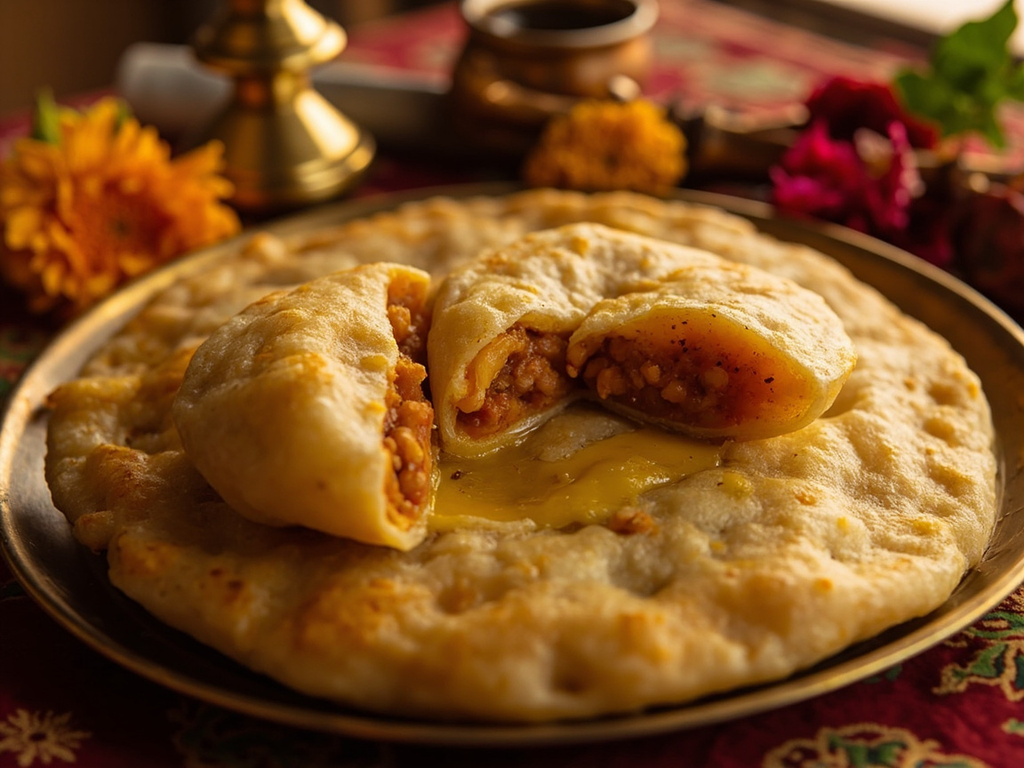
A thin, golden wheat flatbread stuffed with a melting paste of split chickpeas and jaggery, perfumed with cardamom and nutmeg, eaten warm and drenched in ghee. The sweet of great days.
For blessed days, my mother and later my women kneaded the puran: chana dal ground with gur until it ran between the fingers, fragrant with cardamom and a scrape of nutmeg. It is trapped inside a wheat flatbread that must be stretched so thin that light passes through — all the skill lies there, and woe to her who tears it! I tell you: pour the toop without measure, for a puran poli without ghee is a festival without a drum. Eat it warm, licking your fingers, and may the gods be kind to you.
- •Whole wheat flour — for the dough (wrapper)
- •Split chickpeas (chana dal) — two handfuls (filling)
- •Jaggery (gur) — same volume as dal (sweetener)
- •Green cardamom — a few crushed seeds (flavor)
- •Nutmeg — a grating (flavor)
- •Ghee — generously (cooking, serving)
Puran Poli
A thin, golden wheat flatbread stuffed with a melting paste of split chickpeas and jaggery, perfumed with cardamom and nutmeg, eaten warm and drenched in ghee. The sweet of great days.
Why this dish? The great Marathi sweet for holy days — Holi, Gudi Padwa, weddings. In the Rani's home, Brahmin and Marathi, puran poli sealed religious festivals; it would have been prepared for celebrations at the Jhansi court, where she maintained the rites of her native culture.
For blessed days, my mother and later my women kneaded the puran: chana dal ground with gur until it ran between the fingers, fragrant with cardamom and a scrape of nutmeg. It is trapped inside a wheat flatbread that must be stretched so thin that light passes through — all the skill lies there, and woe to her who tears it! I tell you: pour the toop without measure, for a puran poli without ghee is a festival without a drum. Eat it warm, licking your fingers, and may the gods be kind to you.
Ingredients (period version)
- Whole wheat flour — for the dough (wrapper)
- Split chickpeas (chana dal) — two handfuls (filling)
- Jaggery (gur) — same volume as dal (sweetener)
- Green cardamom — a few crushed seeds (flavor)
- Nutmeg — a grating (flavor)
- Ghee — generously (cooking, serving)
Ingredients
- Whole wheat flour (atta or T80) — 200 g (dough)
- Chana dal (split chickpeas) — 150 g (filling)
- Grated jaggery — 150 g (sweetener)
- Ground green cardamom — 1/2 tsp (flavor)
- Nutmeg — 1 pinch grated (flavor)
- Ghee — 4 tbsp (cooking and serving)
- Water and salt — for the dough (binder)
Method
- Cook the chana dal in water until completely tender, drain well.
- Cook it again dry with the jaggery until a thick paste forms that leaves the pan; flavor with cardamom and nutmeg. Let cool.
- Knead a soft dough from flour, water, and salt with a drizzle of ghee; rest 30 min.
- Flatten a disc of dough, enclose a ball of puran, seal, and roll out gently into a thin flatbread.
- Cook on a hot griddle (tava/pan), brushing with ghee on both sides until golden spots appear. Serve warm, drizzled with ghee.
How it was made : Puran poli is attested in Marathi cuisine well before the 19th century; jaggery (unrefined cane sugar) served as sweetener since ancient Indian times, white sugar remaining rare. The ultra-thin rolling was a domestic pride passed from mother to daughter.
The contemporary twist : Serve in wedges with a drizzle of steaming ghee poured at the table and a pinch of cardamom — a 'plated dessert' that preserves all the original gesture.
Sources : Kamalabai Ogale, Ruchira · Mangala Barve, Annapurna (Marathi cuisine)
Lakshmi Bai · Charactorium