 flip
flipVaran-bhaat with Ghee
Varan-bhaat with Ghee
Why this dish? Childhood dish of Manikarnika — her maiden name — raised in Varanasi in a Maratha Brahmin family. Varan-bhaat is the first meal one learns to love in a Marathi home: simple, pure, sattvic, the foundation on which her palate was built before she became Rani and shared the mess tin of her horsemen.
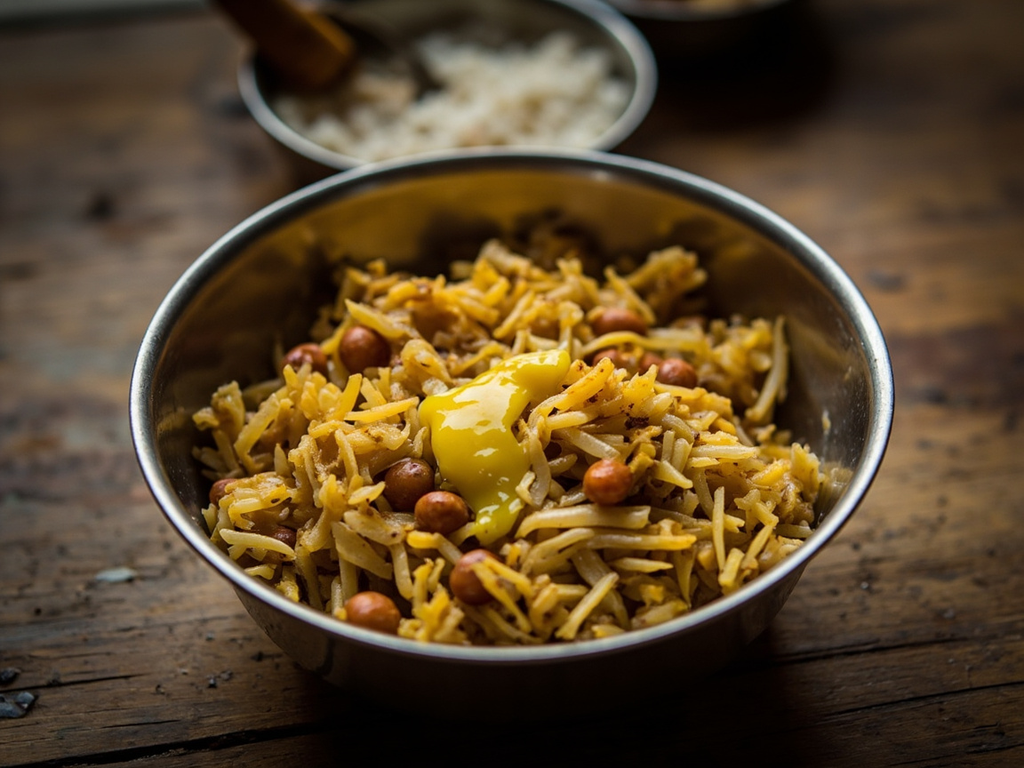
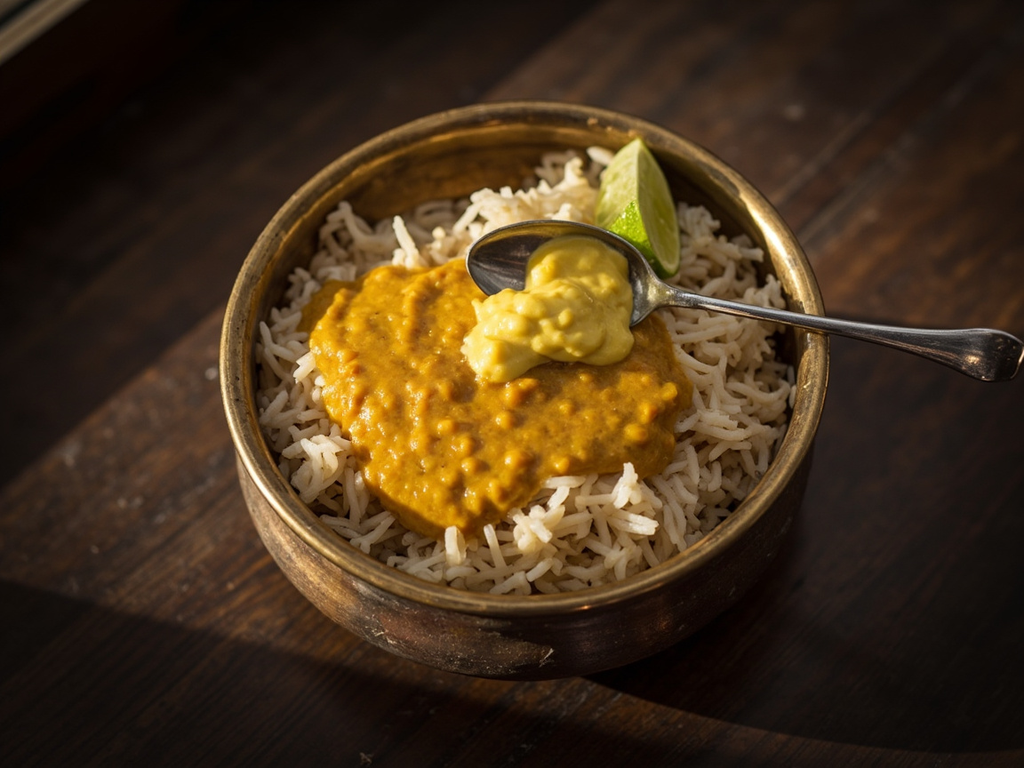
A very mild toor dal (split pigeon pea), barely seasoned with a pinch of turmeric and asafoetida, poured over hot rice and drowned in melted ghee with a squeeze of lime and a pinch of sugar. Absolute comfort, the taste of home.
Come, sit on the ground as we do. Before I was your Rani, I was Manikarnika, a little girl from Kashi, and this is the dish my hand has known since childhood: steaming rice, a toor varan barely spiced, and toop melted while chanting the names of the gods. No garlic, no onion on my table: food must be pure as the waters of the Ganga. Squeeze a little lime, throw a pinch of sugar, mix with your fingers — and you will know why, even in camp, I craved this taste of my home.
- •White rice from the plains — one bowl per diner (base)
- •Toor dal (split pigeon pea) — a generous handful (dal)
- •Fresh or dried turmeric — a pinch (color, digestion)
- •Asafoetida (hing) — a pinch (replaces garlic/onion, aroma)
- •Ghee (toop) — as desired (sattvic binder)
- •Lime juice — a squeeze (acidity)
- •Jaggery — a pinch (Marathi balance)
Varan-bhaat with Ghee
A very mild toor dal (split pigeon pea), barely seasoned with a pinch of turmeric and asafoetida, poured over hot rice and drowned in melted ghee with a squeeze of lime and a pinch of sugar. Absolute comfort, the taste of home.
Why this dish? Childhood dish of Manikarnika — her maiden name — raised in Varanasi in a Maratha Brahmin family. Varan-bhaat is the first meal one learns to love in a Marathi home: simple, pure, sattvic, the foundation on which her palate was built before she became Rani and shared the mess tin of her horsemen.
Come, sit on the ground as we do. Before I was your Rani, I was Manikarnika, a little girl from Kashi, and this is the dish my hand has known since childhood: steaming rice, a toor varan barely spiced, and toop melted while chanting the names of the gods. No garlic, no onion on my table: food must be pure as the waters of the Ganga. Squeeze a little lime, throw a pinch of sugar, mix with your fingers — and you will know why, even in camp, I craved this taste of my home.
Ingredients (period version)
- White rice from the plains — one bowl per diner (base)
- Toor dal (split pigeon pea) — a generous handful (dal)
- Fresh or dried turmeric — a pinch (color, digestion)
- Asafoetida (hing) — a pinch (replaces garlic/onion, aroma)
- Ghee (toop) — as desired (sattvic binder)
- Lime juice — a squeeze (acidity)
- Jaggery — a pinch (Marathi balance)
Ingredients
- Basmati rice — 150 g (base)
- Toor dal — 120 g (dal)
- Turmeric powder — 1/2 tsp (color)
- Asafoetida (hing) — 1 pinch (sattvic aroma)
- Ghee — 2 tbsp (binder)
- Lime — 1/2 (acidity)
- Jaggery or brown sugar — 1 tsp (balance)
- Salt — to taste (seasoning)
Method
- Rinse the dal and cook in water with turmeric until it breaks down (pressure cooker 15 min, or saucepan 40 min).
- Whisk the dal to make it smooth, add salt, jaggery, and a little water for a light soup-like consistency.
- Heat 1 tbsp ghee, add the pinch of hing, then pour over the dal.
- Cook the rice in water, then drain.
- Serve the hot rice, make a well, pour the varan over, drizzle with remaining ghee and a squeeze of lime. Mix with fingers.
How it was made : In 19th-century Maratha Brahmin homes, hing (asafoetida) replaced the forbidden garlic and onion, while also aiding legume digestion. Ghee was not an occasional luxury but a central food, a guarantee of ritual purity and health.
The contemporary twist : A spoonful of 'hazelnut' ghee (lightly browned) on top, and a few coriander leaves — the 'Rani's table' version of a universal comfort food.
Sources : Kamalabai Ogale, Ruchira (classic of Marathi cuisine) · K. T. Achaya, Indian Food: A Historical Companion, Oxford University Press
Lakshmi Bai · Charactorium