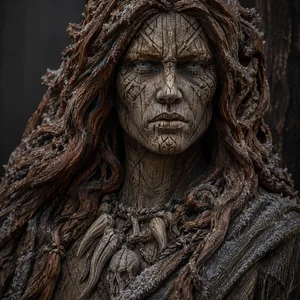

Laufey, also called Nál, is a figure from Norse mythology known as the mother of the god Loki. Medieval sources present her as a giantess (or goddess), wife of the giant Fárbauti.
Laufey
Laufey
5 min read
Frequently asked questions
Key Facts
- Mother of the god Loki in Norse mythology
- Wife of the giant (jötunn) Fárbauti according to the sources
- Also referred to by the name Nál ('needle') in Snorri's Edda (13th century)
- Loki is frequently named after her (the matronymic 'Loki Laufeyjarson'), an unusual feature in Norse mythology
- Known mainly through the Prose Edda and the Poetic Edda, compiled in Iceland in the 13th century
Works & Achievements
The principal role attributed to Laufey: having given birth to Loki, god of trickery and a central figure in many Eddic tales.
According to Snorri, Laufey is also the mother of Loki's brothers, Helblindi and Býleist, figures who have remained obscure in the mythology.
The marriage of Laufey to the giant Fárbauti (“the one who strikes dangerously”), whose union with Laufey-foliage evokes the birth of fire (Loki) through lightning striking wood.
A singular literary fact: Loki is referred to by his mother's name in the poems, perpetuating the memory of Laufey across the centuries.
Anecdotes
Laufey is best known as the mother of Loki, one of the most ambiguous figures in Norse mythology. Remarkably for the Viking age, Loki is almost always referred to by his mother's name, “Loki Laufeyjarson” (Loki, son of Laufey), rather than by that of his father Fárbauti — an unusual practice in a patrilineal society.
Laufey bears a second name, Nál, which means “needle” in Old Norse. The medieval poet Snorri Sturluson explains in his *Edda* that she was called this because she was “slender and frail as a needle,” one of the few physical details given about a female figure in these tales.
The name Laufey evokes leaves or foliage (from *lauf*, meaning leaf). Some modern scholars see in it a symbol of a tree or of dry wood, which catches fire easily — an image that fits her son Loki, often associated with fire and cunning.
The sources do not agree on her nature: depending on the passage, Laufey is presented either as a giantess (*jötunn*) or as a goddess (*ásynja*). This uncertainty reflects the blurred boundary, in Norse mythology, between the Æsir gods and the race of giants, their enemies with whom they nonetheless often mingle.
Primary Sources
How shall Loki be referred to? He is called the son of Fárbauti and Laufey, and of Nál; the brother of Býleist and Helblindi.
Loki, the son of Laufey, spoke up.
Then Loki spoke, the son of Laufey.
Loki was the son of Fárbauti and Laufey; he was handsome and fair of appearance, but wicked in character and very changeable.
Key Places
Realm of the giants (jötnar) in Norse cosmology, the likely place of origin of Laufey if she is counted among the giantesses.
City of the Æsir gods; some sources rank Laufey among the goddesses (ásynjur), which would tie her to this realm.
Cosmic ash tree linking the nine Norse worlds. Laufey's name, connected to foliage, echoes the plant imagery that structures the universe.
Island where the Eddas were written in the 13th century, the texts that preserved the memory of Laufey and her descendants.
Geographic region (Norway, Sweden, Denmark) where the Norse beliefs evoking Laufey arose and were handed down.
Typical Objects

The object that gives Laufey her nickname, compared by Snorri to a needle because of her slenderness. A symbol of fragility and thinness.

The leaves evoked by Laufey's very name. Dry wood and leaves catch fire easily, an image linked to the fire associated with Loki.

An emblematic tool of women in Norse mythology and society, associated with the domestic sphere of giantesses and goddesses.

A spinning instrument and traditional attribute of Norse female figures tied to the home and to fate, which is spun like a thread.

A jewel typical of women in the Viking Age, used to fasten the cloak or the strap dress; a marker of status among goddesses and giantesses.

An apron-dress worn over a tunic, a characteristic garment of Scandinavian women, attributed to the female figures of the myths.
School Curriculum
Vocabulary & Tags
Key Vocabulary
Tags
Daily Life
Morning
As one might imagine for a giantess or goddess of the Norse hearth, the morning began with the light, by rekindling the fire of the great hall's central hearth. The first tasks were tending the animals and preparing the meal.
Afternoon
The afternoon was devoted to working wool: spinning, weaving, and sewing the household's clothing, activities at the heart of Norse women's lives. Managing the provisions and the estate also fell under her authority.
Evening
The evening gathered the household around the hearth for the meal and for listening to tales and poems. It was during these evening gatherings that the myths featuring Laufey and her son Loki were passed down orally.
Food
The Norse diet was based on grain porridges (barley, oats), bread, dried fish, meat, and dairy products such as skyr, supplemented with berries and beer or mead.
Clothing
Women wore a long linen dress, covered by a woolen strap dress fastened with two oval brooches, and a shawl. Snorri describes Laufey as “slender and frail like a needle.”
Housing
One imagines her living in a longhouse (langhús) with a timber frame and a turf roof, organized around a central hearth — or, in the mythic imagination, in the stone dwellings of the giants of Jötunheim.
Historical Timeline
Period Vocabulary
Liens externes & ressources
Références
Œuvres
Maternité de Loki
temps mythique
Maternité de Helblindi et Býleist
temps mythique
Union avec Fárbauti
temps mythique
Transmission du matronyme « Laufeyjarson »
VIIIe-XIIIe siècle