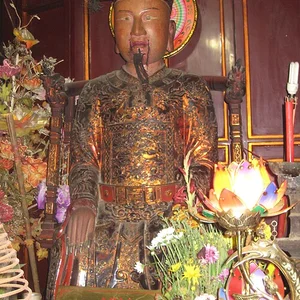

Founder of the Tiền Lê dynasty (980–1005), Lê Hoàn ruled Đại Cồ Việt for 25 years. A general under the Đinh dynasty who became regent and then emperor, he victoriously repelled the Song invasion in 981 and defended the country's independence.
Lê Hoàn(941 — 1005)
Lê Đại Hành
Dai Co Viet
9 min read
Frequently asked questions
Key Facts
- Born 10 August 941, died 18 April 1005 [1]
- Appointed Thập đạo tướng quân (commander of the ten circuits) under Emperor Đinh Tiên Hoàng in 971 [1]
- Seized power as regent (Phó vương) following the assassination of Emperor Đinh Tiên Hoàng in October 979 [1]
- Proclaimed emperor in 980 in the face of an imminent Song invasion, reigning under the era name Thiên Phúc [1]
- Defeated the Song army in 981 and killed General Hầu Nhân Bảo, preserving the independence of Đại Cồ Việt [1]
Works & Achievements
Personally commanding his troops, Lê Hoàn repelled the Chinese invasion, killed Song general Hầu Nhân Bảo, and captured two other generals. This victory preserved the independence of Đại Cồ Việt and established the military legitimacy of the Tiền Lê dynasty.
A strategic military fortification built to check the Song advance, later cited by general Trần Quốc Tuấn during the resistance against the Mongols in 1300 as proof of the effectiveness of national defenses.
Following the military victory, Lê Đại Hành developed agriculture, founded schools, and recruited talented individuals for the administration, consolidating the post-Đinh Vietnamese state on solid civilian foundations.
Lê Đại Hành led expeditions southward against Champa and inland against peoples of the borderlands, who submitted to the court of Hoa Lư, extending the influence of Đại Cồ Việt.
Anecdotes
In 980, faced with the imminent advance of Song armies, General Phạm Cự Lạng and his soldiers in battle dress forced their way into the imperial palace at Hoa Lư. Before an army acclaiming Lê Hoàn, Empress Dowager Dương Vân Nga yielded and solemnly handed over the imperial robe (long cổn) to the regent, who ascended the throne before the war had even begun. This episode illustrates how external military pressure was used to legitimize an internal seizure of power.
To slow the Song advance in 980, Lê Hoàn had a letter cleverly drafted in the name of the young Đinh Toàn, asking the Chinese imperial court to officially recognize Lê Hoàn as the legitimate successor. The Song responded by demanding that the mother and child present themselves in person at the imperial court — a demand Lê Hoàn flatly rejected. This delaying tactic bought him the time needed to prepare military resistance.
Confronted with the insurrection of generals Nguyễn Bặc and Đinh Điền, who refused to recognize his authority as regent, Lê Hoàn waited for the right moment to exploit favorable winds and set fire to the enemy vessels on the river. Đinh Điền was killed, Nguyễn Bặc captured and brought back to the capital in a cage, then executed. Having already mastered river combat well before the war against the Song, Lê Hoàn had demonstrated his tactical superiority on the water long in advance.
During the resistance against the Song invasion of 981, Lê Hoàn personally commanded his troops and ordered iron-tipped wooden stakes to be driven into the Chi Lăng River, replicating the tactics used by Ngô Quyền at Bạch Đằng in 938. Although the first river battle ended in a local defeat — with the Song seizing 200 vessels — the overall resistance led to the death of enemy general Hầu Nhân Bảo and the capture of two other Song generals, bringing the invasion to an end.
[STATUS: LEGENDARY] According to Vietnamese chronicles, on the night of Lê Hoàn's birth, his mother is said to have dreamed of a lotus flower blooming in her womb. Later, his adoptive father Lê Đột reportedly glimpsed a golden dragon watching over the sleeping child beneath an overturned vat — a sign of royal predestination. These accounts, recorded in the Đại Việt sử ký toàn thư, reflect the posthumous prestige accorded to the founder of the Tiền Lê dynasty, but carry no documented historical value.
Primary Sources
Mẹ ông họ Đặng nên gọi là Đặng thị — "His mother bore the family name Đặng and was called Đặng thị." ; and the account of the legendary birth involving the lotus and the golden dragon.
Vua tự làm tướng ra chống đánh, sai sĩ tốt cắm gỗ, đầu bịt sắt để ngăn cửa sông — "The king personally led the army and ordered his soldiers to drive iron-tipped wooden stakes into the rivermouth to block it."
Từ cuối đời Đường rối loạn, chia sẻ đất đai, rồi chúng làm ra một nước tiếm ngụy — "Since the disorders at the end of the Tang, they have divided the lands and formed a usurper state; though nominally submitting as tributaries, they maintain troops and harbour rebellious ambitions."
Tri châu Ung Hầu Nhân Bảo dâng thư khuyên hoàng đế Tống Thái Tông nên lựa thời cơ nước Nam rối ren, vua còn nhỏ, đem quân chinh phạt — "The governor of Ung Châu advised the emperor to seize upon the turmoil in the South and the king's minority as an opportunity to send troops on campaign."
Key Places
The kingdom's fortified capital, located in present-day Ninh Bình province, nestled among limestone formations that made it a natural defensive stronghold. This is where Lê Hoàn ruled, administered the state, and received Song prisoners of war.
A river in northeastern Vietnam, site of the naval battle against the Song fleet in 981. Although the initial engagement ended in a local defeat, Lê Hoàn's overall resistance ultimately forced the invading army to surrender.
A strategic corridor in present-day Lạng Sơn province where Lê Hoàn had iron-tipped stakes driven into the riverbed to halt the Song army's overland and waterborne advance in 981.
A fortress built by Lê Hoàn to stop the advance of Song troops. It was cited a century later by the great general Trần Quốc Tuấn (1300) as a model of effective defensive strategy against invaders from the north.
Lê Hoàn's native province is the subject of a documented historiographical debate: some sources point to Ninh Bình, others to Thanh Hóa. The question remains unresolved depending on the source consulted.
Liens externes & ressources
Références
Œuvres
Victoire sur l'armée Song (guerre de 980–981)
981
Construction de la forteresse Bình Lỗ
981
Réformes civiles : agriculture, écoles, recrutement de lettrés
après 981
Campagnes contre le Chiêm Thành (Champa) et les peuples frontaliers
après 981