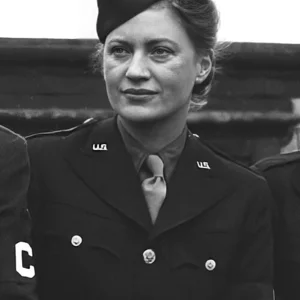

Lee Miller was an American photographer, first a fashion model and then a figure of Surrealism alongside Man Ray. Having become a war correspondent, she photographed the liberation of Europe and the concentration camps in 1945.
Lee Miller(1907 — 1977)
Lee Miller
États-Unis
6 min read
Frequently asked questions
Key Facts
- Born in 1907 in Poughkeepsie (New York), died in 1977 in England
- Collaborates with Man Ray in Paris from 1929 and contributes to the technique of solarization
- War correspondent for Vogue magazine during the Second World War
- Photographs the liberation of Paris and the Dachau and Buchenwald camps in 1945
- Author of the famous photograph of herself in Hitler's bathtub in Munich in 1945
Works & Achievements
A series of images playing on the solarization effect that outlines bodies with a dark contour. These works rank among the great achievements of Surrealist photography.
Photographs of the ruins and of daily life under the German bombings. They show the courage of Londoners and the strange beauty of the rubble.
Reports from the front in Normandy, during the liberation of Paris and the Allied advance into Germany. Lee Miller was one of the few women war correspondents.
Images among the first visual evidence of the horror of the concentration camps, published in Vogue under the title “Believe It” to bear witness to the reality.
An iconic photograph staged in Hitler's Munich apartment. It has become an ambiguous and powerful symbol of the end of the Nazi regime.
Portraits of Picasso, Max Ernst, Eileen Agar and Paul Éluard. Lee Miller, a close friend of these artists, built up a precious visual record of the Surrealist movement.
Anecdotes
In 1945, Lee Miller was photographed in the bathtub of Adolf Hitler's Munich apartment, on the very day his suicide was announced. Her boots, still caked with mud from the Dachau camp she had just left, dirtied the bath mat: an image that became one of the most disturbing symbols of the war's end.
According to the legend told by Man Ray, the technique of “solarization” was rediscovered partly thanks to a mistake by Lee Miller. A mouse is said to have brushed against her leg in the darkroom, making her switch on the light by reflex, partially reversing the image's tones and creating a striking artistic effect.
As a teenager in New York, Lee Miller was nearly run over by a car: a man pulled her back just in time. He was Condé Nast, the famous press magnate, who immediately launched her as a model for Vogue magazine.
After the war, Lee Miller stored her negatives and prints in boxes in the attic of her English farmhouse and barely spoke of them again until her death. It was only in the 1980s that her son, Antony Penrose, discovered this immense treasure of more than 60,000 images.
On the cover of Vogue, Lee Miller's face was even used to illustrate an advertisement for Kotex sanitary napkins in 1928, which caused a scandal at the time: it was the first time such an intimate product had been associated with a real photograph of a woman.
Primary Sources
“I implore you to believe this is true” — cable sent along with her photographs of the Buchenwald and Dachau camps to convince the editors to publish them.
Report and photographs by Lee Miller on the liberation of the concentration camps, published under the title “Believe It”.
Biography written by her son from the archives, letters, and photographs found in the attic of Farley Farm House after Lee Miller's death.
Image taken in Hitler's apartment in Munich showing Lee Miller washing herself, with Hitler's portrait propped on the edge of the bathtub and her muddy boots in the foreground.
Key Places
City in New York State where Lee Miller was born in 1907 and spent her childhood.
Capital of Surrealism where Lee Miller became Man Ray's pupil and collaborator from 1929 onward. There she developed her art and co-experimented with solarization.
Nazi camp near Munich that Lee Miller photographed during its liberation in 1945, delivering harrowing images of the horror of the camps.
Adolf Hitler's Munich residence where the famous photograph of Lee Miller in the bathtub was taken, on the day the dictator's suicide was announced.
City where Lee Miller settled with Roland Penrose and worked for British Vogue, notably photographing the capital during the Blitz.
English farm where Lee Miller spent her final years with her family and where she died in 1977. Her photographic archives were found there in the attic.
Typical Objects

A waist-level viewfinder camera very popular with photographers in the 1930s-1940s. Lee Miller used it notably for her photo reportages.

A khaki military outfit stamped with the “War Correspondent” insignia worn by accredited reporters. It allowed Lee Miller to follow the Allied troops to the front.

A roll of film coated with a light-sensitive emulsion, the medium behind every photograph before digital. Lee Miller's thousands of negatives slept for decades in her attic.

Tanks filled with chemicals used to develop negatives and make prints under red light. It was here that solarization was experimented with alongside Man Ray.

An international fashion and current-affairs magazine. Lee Miller first appeared on its cover as a model, then became a photographer, and finally a published war correspondent.

A device producing a burst of bright light to take photographs in the dark. Essential for reporters working in difficult conditions.
School Curriculum
Vocabulary & Tags
Key Vocabulary
Daily Life
Morning
In Paris during the 1930s, Lee Miller often began her day in the darkroom, developing the previous day's shots by red light. She prepared her cameras, checked her film and organized her photo sessions.
Afternoon
Afternoons were devoted to photo shoots, in the studio or on the street, and to meeting artists from the Surrealist circle. During the war, her days were spent as close as possible to the troops, camera in hand, in the liberated towns.
Evening
In the evening, she frequented the cafés and studios of Montparnasse where painters, poets and photographers gathered. Discussions about art, politics and Surrealism stretched late into the night.
Food
In peacetime, Lee Miller enjoyed cooking and later became an inventive and celebrated cook. At the front, she shared the soldiers' military rations, often cold and gulped down in haste between two reports.
Clothing
Elegant and photogenic, she wore the refined outfits of a Vogue model in the 1920s. Once she became a war correspondent, she traded these clothes for the army's khaki uniform, helmet and boots.
Housing
She lived in turn in lively Parisian apartments, New York studios, then in London. She ended her days at Farley Farm House, a Sussex farm transformed into a place of living and creation surrounded by works of art.
Historical Timeline
Period Vocabulary
Liens externes & ressources
Références
Œuvres
Portraits et nus solarisés (avec Man Ray)
vers 1929-1932
Reportage « Grim Glory » sur le Blitz de Londres
1940-1941
Couverture de la libération de l'Europe pour Vogue
1944-1945
Photographies des camps de Buchenwald et Dachau
1945
« Lee Miller dans la baignoire d'Hitler » (avec David E. Scherman)
30 avril 1945
Portraits d'artistes surréalistes
années 1930-1940