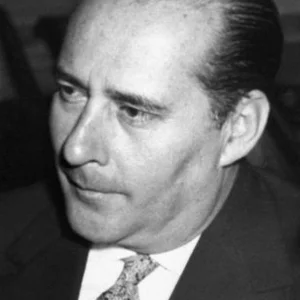

Roberto Rossellini (1906-1977) was an Italian director and a major figure of neorealism. With films like *Rome, Open City*, he revolutionized cinema by capturing the reality of postwar Italy, shooting with a handheld camera and non-professional actors.
Roberto Rossellini(1906 — 1977)
Roberto Rossellini
Italie, royaume d'Italie
6 min read
Frequently asked questions
Famous Quotes
« Things are there. Why manipulate them?»
Key Facts
- Born in Rome in 1906
- Directs *Rome, Open City* in 1945, the manifesto of Italian neorealism
- Shoots *Paisan* (1946) and *Germany, Year Zero* (1948), completing his war trilogy
- Collaborates with actress Ingrid Bergman from 1950 onward (*Stromboli*, *Journey to Italy*)
- Dies in Rome in 1977
Works & Achievements
The founding film of neorealism, about the Roman Resistance under German occupation. Anna Magnani delivers a scene that became legendary.
A six-episode account of the Allied advance through Italy in 1943-1944, blending professional actors with locals from the places filmed.
Shot in the ruins of Berlin, it follows a child crushed by poverty and the legacy of Nazism.
His first collaboration with Ingrid Bergman, set on a volcanic island; the film crystallized the scandal of their affair.
The portrait of a couple in crisis visiting Naples, regarded as a pivotal film that heralds modern cinema.
A work shot in India, on the border between documentary and fiction, about humankind and nature.
A historical film for television in which Rossellini meticulously reconstructs life at court; a model of his educational cinema.
Anecdotes
To shoot Rome, Open City in 1945, Rossellini lacked everything: Italy was barely out of the war and film stock was scarce. He bought up scraps of salvaged film of varying quality and shot in the real streets of Rome, which gives the image that distinctive documentary grain.
In 1948, the Swedish actress Ingrid Bergman, then a Hollywood star, was deeply moved by Rossellini's films. She wrote him a now-famous letter offering herself as an actress, explaining that in Italian she knew only the words “ti amo” (I love you). From this encounter would come both a collaboration and a marriage.
The love affair between Rossellini and Ingrid Bergman, both married at the time, caused an enormous international scandal in the late 1940s. The couple was even publicly attacked in the United States. Their daughter, Isabella Rossellini, would also become a well-known actress.
Rossellini was passionate about fast cars and motor racing; he spent recklessly and often found himself buried in debt. That same impetuousness showed up on his sets, where he improvised a great deal and preferred the unpredictability of reality to prepared sets.
In the last part of his life, Rossellini abandoned classic fiction cinema to make grand, didactic historical films for television, such as The Taking of Power by Louis XIV (1966), seeking to turn the image into a tool for education and the transmission of knowledge.
Primary Sources
If you need a Swedish actress who speaks English very well, who has not forgotten her German, who is not very understandable in French, and who, in Italian, knows only “ti amo,” I am ready to come and make a film with you.
Neorealism consists in following a human being, with love, through all their discoveries, all their impressions; it is a moral point of view from which one looks at the world, which then transforms into an aesthetic point of view.
Things are there, so why manipulate them? One must film reality as it is and seek to understand it rather than distort it.
Key Places
Rossellini's birthplace and the city where he died, but also the setting of Rome, Open City, shot in its streets barely emerged from German occupation.
Rome's great film studios, inaugurated in 1937. Rossellini represents their opposite: he often preferred real locations and natural light.
A volcanic island in the Aeolian archipelago where Rossellini shot Stromboli (1950) with Ingrid Bergman, using local fishermen and residents as extras.
The German capital in ruins after the war, the setting of Germany, Year Zero (1948), a film about a child lost in the rubble of Nazism.
A country Rossellini travelled across in the late 1950s for the film India Matri Bhumi (1959), blending documentary and fiction.
Home of the famous film festival. Rossellini presided over its jury in 1977, just a few weeks before his death.
Typical Objects

A lightweight 35 mm camera, held in the hand or on the shoulder, allowing the operator to follow characters through the streets. Rossellini made it an emblem of neorealism, far from the heavy tripod-mounted cameras of the studio.

A strip of silver-based film on which the images are exposed. After the war it was so scarce that Rossellini had to splice together pieces of varying quality.

A slate fitted with a hinged arm clapped in front of the camera at the start of each take. It marks the scene number and synchronizes picture and sound.

A cone-shaped voice amplifier that lets the director give instructions on a noisy shoot, outdoors or amid a crowd of extras.

A typed text describing scenes and dialogue. Rossellini used it as a flexible foundation, reshaped and improvised according to the reality of the shoot.

A machine for viewing and cutting the film frame by frame to assemble the picture. This is where the final rhythm of the work is built.
School Curriculum
Vocabulary & Tags
Key Vocabulary
Daily Life
Morning
When a film is in the works, the day starts early with scouting locations and organizing the shoot. Rossellini, rather anti-methodical, likes to keep things flexible and improvise until the last moment.
Afternoon
The afternoon is spent on set or on location, directing actors who are often non-professionals, adjusting the natural light, and capturing the unexpected moments of the street. He films reality rather than recreating it in a studio.
Evening
In the evening, they screen the takes, discuss the editing, and prepare for the next day. A mechanics enthusiast, he also enjoys talking about cars and motor racing with those close to him.
Food
He shares in the Italian cuisine of his time: pasta, vegetables, olive oil, cheeses, and strong coffee. Meals, warm and sociable, are moments for discussion and work among collaborators.
Clothing
A man of the mid-20th century, he wears understated suits, a shirt and tie in the city, and more practical outfits on location shoots.
Housing
Born into a well-off Roman family, he lives in Roman apartments and villas, but his spending and debts often make his lifestyle unstable.
Historical Timeline
Period Vocabulary
Liens externes & ressources
Références
Œuvres
Allemagne année zéro (Germania anno zero)
1948
India Matri Bhumi
1959