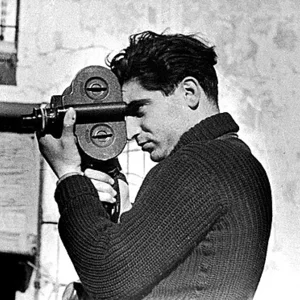

Robert Capa (1913-1954) was a photographer and war correspondent of Hungarian origin. A co-founder of the Magnum Photos agency, he covered five major conflicts of the 20th century and embodies war photojournalism.
Robert Capa(1913 — 1954)
Robert Capa
Hongrie, États-Unis, France
6 min read
Frequently asked questions
Famous Quotes
« If your photographs aren't good enough, you're not close enough.»
Key Facts
- Born on October 22, 1913, in Budapest under the name Endre Ernő Friedmann.
- Took the famous photograph “The Falling Soldier” in 1936 during the Spanish Civil War.
- Photographed the Normandy landings on June 6, 1944, at Omaha Beach (“The Magnificent Eleven”).
- Co-founded the cooperative agency Magnum Photos in 1947 with Henri Cartier-Bresson and others.
- Died on May 25, 1954, in Indochina after stepping on a landmine.
Works & Achievements
Photograph of a militiaman falling to a bullet during the Spanish Civil War, which became one of the most famous war images of the 20th century.
Eleven blurry photos taken in the heart of the D-Day assault, the only survivors of a darkroom accident, which later inspired cinema.
A cooperative created with Cartier-Bresson, David Seymour and George Rodger, giving photographers ownership of their images: a turning point for independent photojournalism.
A memoir in which Capa recounts his war years in Europe with humor and emotion, from the Normandy landings to the Liberation.
A series documenting the first Arab-Israeli war and the arrival of immigrants, published notably in the book Report on Israel.
Coverage of the Second Sino-Japanese War, bearing witness to Japanese aggression and the plight of Chinese civilians.
Capa's final images, taken alongside the French army just hours before his death on a landmine.
Anecdotes
Robert Capa was not his real name: born André (Endre) Friedmann in Budapest, he invented, together with his companion Gerda Taro, the character of a "famous American photographer" named Robert Capa in order to sell his photos to magazines at higher prices. The trick was uncovered, but the pseudonym stayed with him for the rest of his life.
His most famous photo
The Falling Soldier
(1936)
shows a Spanish militiaman struck down by a bullet. It became a worldwide icon of photojournalism and is still debated today among historians over whether it may have been staged.
On the morning of 6 June 1944, Capa landed with the first waves of American soldiers on Omaha Beach, under German fire. Of the many photos he took, only eleven survived a drying accident in a London darkroom: they came to be nicknamed "The Magnificent Eleven.
His motto remained famous among photographers:
If your photographs aren
t good enough
you
re not close enough." He applied it to the extreme
staying as close to danger as possible.
In 1954, in Indochina, Capa left a convoy to photograph a column of French soldiers in a rice paddy and stepped on an anti-personnel mine. He died with his camera in his hand, becoming the first American correspondent killed in that war.
Primary Sources
For the war correspondent, losing his bet means a wound or death; winning it means a good photograph.
If your photographs aren't good enough, you're not close enough.
Four photographers — Capa, Cartier-Bresson, Seymour and Rodger — joined together as a cooperative in order to retain ownership of their negatives and freely choose their assignments.
The images, slightly out of focus, show American soldiers advancing through the water under enemy fire at Omaha Beach.
Key Places
Birthplace of Endre Friedmann, where he grew up before fleeing the repressive political climate of Central Europe.
Capa's refuge in the 1930s, where he coined the pseudonym “Robert Capa” and met Gerda Taro and Cartier-Bresson. He would also photograph the Liberation there in 1944.
The D-Day landing beach where Capa joined the first assault wave on June 6, 1944, taking his most famous photographs under German fire.
Capa's American base, where the Magnum Photos agency was founded in 1947 and where he built his career as an international photojournalist.
Region of the Red River delta where Capa was killed by a landmine on May 25, 1954, while following a French column.
Theater of the Spanish Civil War where Capa took “The Falling Soldier” and where Gerda Taro died in 1937.
Typical Objects

A German 35 mm rangefinder camera that Capa favored for its speed and discretion in the field. It let him capture the action as close to the fighting as possible.

A small, light and handy 35 mm camera, emblem of the emerging field of photojournalism. Its compactness made it possible to work fast and unnoticed.

Rolls of black-and-white silver film, the fragile medium of all his images. It was a botched drying in the lab that destroyed most of his photos of the D-Day landings.

A notebook and press accreditation allowing Capa to follow the armies at the front. He wore the uniform of correspondents accredited to the Allied forces.

A military outfit without rank insignia worn by reporters following the troops. It protected and identified the journalist in the theaters of operations.

A medium-format camera with a top-down viewfinder, used for more posed portraits and reportage. It complemented his 35 mm cameras depending on the situation.
School Curriculum
Vocabulary & Tags
Key Vocabulary
Daily Life
Morning
While on assignment, Capa rose with the troops, often at dawn, so as not to miss any of the action. He checked his cameras, loaded his film and joined the front lines or the moving convoys.
Afternoon
He spent the afternoon as close as possible to the fighting or to the civilians, his camera always ready. He walked, waited and ran to the unpredictable rhythm of war, searching for the decisive moment.
Evening
In the evening, the film had to be shipped off to the newsrooms by plane or courier, captions had to be written and reports filed with the magazines. Away from the front, Capa loved to seek out cafés, bars and friends to unwind.
Food
In the field, he shared the military rations and the makeshift food of the soldiers. Behind the lines, he enjoyed fine dining, wine and long evenings in the restaurants of Paris and New York.
Clothing
On assignment, Capa wore the rankless uniform of accredited war correspondents, with a helmet and combat boots. In the city, he adopted the elegant, relaxed look of a man of the world, a cigarette on his lips.
Housing
His life was nomadic: hotel rooms, military billets, tents or makeshift shelters depending on the front. Between assignments, he stayed in Paris or New York, with no real permanent home.
Historical Timeline
Period Vocabulary
Liens externes & ressources
Références
Œuvres
Mort d'un soldat républicain
1936
Slightly Out of Focus (Légèrement flou)
1947
Reportage sur la naissance d'Israël
1948-1950
Reportage en Chine
1938
Photographies de la guerre d'Indochine
1954