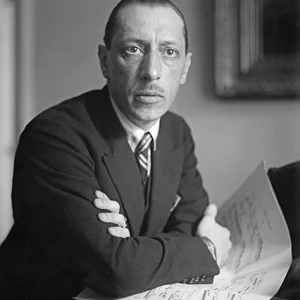

Igor Stravinsky is one of the most influential composers of the 20th century. With his ballets for the Ballets Russes — *The Firebird*, *Petrushka*, and above all *The Rite of Spring* — he revolutionized musical language through bold rhythms and dissonances. Naturalized as a French then American citizen, he traversed all the major aesthetic movements of his time.
Igor Stravinsky(1882 — 1971)
Igor Stravinsky
États-Unis, Suisse, France, Empire russe
7 min read
Frequently asked questions
Key Facts
- Born in 1882 near Saint Petersburg, in the Russian Empire
- Composed *The Firebird* (1910) and *Petrushka* (1911) for Diaghilev's Ballets Russes
- Created *The Rite of Spring* in 1913 in Paris, provoking a famous scandal
- Adopted a neoclassical style in the interwar period, then explored serialism after 1950
- Settled in the United States in 1939 and died in New York in 1971
Works & Achievements
First major ballet commissioned by Diaghilev for the Ballets Russes, based on Russian folk tales. Its triumph in Paris revealed Stravinsky to the world and established his international fame.
Ballet telling the tragedy of a puppet endowed with a soul at a Russian fair. The work innovates with its bitonality and the interweaving of Russian folk music into a sophisticated orchestral language.
Foundational work of musical modernity, evoking a sacrificial rite in prehistoric Russia. Its revolutionary rhythms, dissonances, and sonic violence transformed the musical language of the 20th century.
Piece for seven instruments, actors, and dancer, composed in Switzerland under the material constraints of war. It blends folk music, jazz, and moral narrative in a stripped-down chamber format.
Choral and orchestral work on biblical texts, commissioned for the 50th anniversary of the Boston Symphony Orchestra. It marks the deepening of Orthodox spirituality in Stravinsky's creation.
Three-act opera with a libretto by W. H. Auden and Chester Kallman, inspired by Hogarth's engravings. A pinnacle of the neoclassical period, it reconnects with the Mozartian tradition while remaining resolutely modern.
Stravinsky's first entirely twelve-tone work, on texts from the Lamentations of Jeremiah. It marks the surprising serial turn of his final creative period.
Anecdotes
On May 29, 1913, the premiere of *The Rite of Spring* at the Théâtre des Champs-Élysées caused a resounding scandal: from the first bars, part of the audience whistled and shouted, while the other applauded. The hall quickly became the scene of brawls between spectators, so violent that police had to intervene. Stravinsky, furious and hurt, left the theater before the end.
Before the premiere of *The Rite*, Stravinsky and Debussy played the score four-hands at the latter's home. Debussy, impressed but unsettled by the rhythmic violence of the work, reportedly said he did not know if this music was beautiful, but that it was extraordinarily wild. This is one of the most famous encounters in the history of modern music.
Stravinsky composed in a tiny room, on an out-of-tune piano with mutes, so as not to disturb his neighbors. He worked very methodically every morning, considering composition as rigorous craftsmanship as much as inspiration. This Spartan discipline contrasts with the romantic image of the genius struck by inspiration.
In 1940, Walt Disney used *The Rite of Spring* in the film *Fantasia* without obtaining Stravinsky's artistic approval and by modifying the tempo of the work. Stravinsky, who attended a screening, was furious at the liberties taken with his score. The case revealed the shortcomings of American copyright law at the time for foreign composers.
In 1962, at the age of 80, Stravinsky returned to the USSR for the first time since the Bolshevik Revolution. He was welcomed as a national hero despite decades of exile and Soviet condemnation of his music. Nikita Khrushchev himself attended one of his concerts, a significant event during the Cold War.
Primary Sources
I consider that music is, by its very nature, essentially powerless to express anything at all: a feeling, an attitude, a psychological state, a natural phenomenon. Expression has never been an immanent property of music.
Constraint is for me the path on which creative freedom willingly embarks. [...] The more art is controlled, limited, worked over, the freer it is.
I am working on a new piece for the ballet. The idea came to me from a vision: a great sacred pagan ceremony, with wise elders seated in a circle watching the dance to the death of a young girl.
Schoenberg's serial music had always repelled me, not for aesthetic reasons but because I perceived no necessity in it. It was the encounter with Webern that changed everything for me.
Key Places
Stravinsky's birthplace, where he grew up in a privileged musical environment as the son of a bass at the Imperial Opera. It was here that he received his first piano and music theory lessons.
Site of the foundational scandal of modern music: the premiere of *The Rite of Spring* on May 29, 1913. Paris was Stravinsky's artistic center of gravity for two decades.
Town on Lake Geneva where Stravinsky lived with his family during World War I. Here he composed *The Soldier's Tale* (1918), a chamber work born from the constraints of exile.
Stravinsky moved to this city in 1940, drawn by the California sun and the community of exiled European artists. He spent the last thirty years of his creative life here.
His favorite city, where *The Rake's Progress* premiered in 1951. Stravinsky is buried in San Michele Cemetery in Venice, not far from Diaghilev's tomb.
Typical Objects

Stravinsky composed on a small upright piano fitted with mutes so as not to disturb those around him. This modest instrument was the birthplace of all his major scores.

He used different colored pencils to annotate his scores and distinguish the instrumental voices. His manuscript of *The Rite of Spring*, preserved at the Paul Sacher Foundation, bears the traces of this practice.

Stravinsky was also a conductor and often led the premieres of his own works. His economical and precise gestures were characteristic.

The programs and scores of Diaghilev's Ballets Russes were the working documents around which the collaboration between composer, choreographer, and set designer was built.

Stravinsky placed extreme importance on metronome markings and rhythmic precision, noting tempos with obsessive rigor in his scores.

A devout Orthodox believer, he owned a vast collection of liturgical and theological texts that inspired his sacred works such as the *Symphony of Psalms*.
School Curriculum
Vocabulary & Tags
Key Vocabulary
Tags
Daily Life
Morning
Stravinsky rose early and systematically devoted the morning hours to composition, which he regarded as a craft requiring discipline and regularity. He would settle in his small studio at his muted piano and work for several hours without interruption, often starting at 8 a.m.
Afternoon
Afternoons were reserved for correspondence — extensive with Diaghilev, conductors, publishers —, rehearsals with musicians, and meetings with collaborators of the Ballets Russes. He meticulously supervised rehearsals and directly intervened on tempos and interpretation.
Evening
Evenings were often social, in Parisian salons or at concerts and premieres of the Ballets Russes. Stravinsky enjoyed dinners in good company, with artists like Picasso, Cocteau, or Debussy. Later in life, he retired earlier, his health requiring more rest.
Food
Stravinsky was known for his strong gastronomic tastes and love of traditional Russian cuisine: herring, vodka, caviar, blinis. Settled in France and then the United States, he adapted to local cuisines while retaining a preference for the flavors of his Russian childhood.
Clothing
He dressed with meticulous care and understated elegance, characteristic of the cultivated European bourgeoisie of the early 20th century. On the podium, he wore the traditional conductor's evening dress; in daily life, he favored well-tailored suits and thin-rimmed glasses that gave him an intellectual air.
Housing
In Paris, he lived in several bourgeois apartments in the 8th arrondissement. During his Swiss exile, he stayed in villas on Lake Geneva in Morges, then in Clarens. In Hollywood, he lived in a Spanish-style villa on North Wetherly Drive, surrounded by his piano, his library, and his Orthodox icons.
Historical Timeline
Period Vocabulary
Visual Style
L'esthétique de Stravinsky oscille entre le faste coloré des Ballets Russes et la rigueur neoclassique de ses œuvres ultérieures, avec une palette évoluant du rouge vif slave au blanc dépouilé du modernisme occidental.
Sound Ambience
L'univers sonore de Stravinsky mêle la rigueur du studio de composition au chaos créateur des répétitions des Ballets Russes, entre Paris, la Suisse et la Russie.