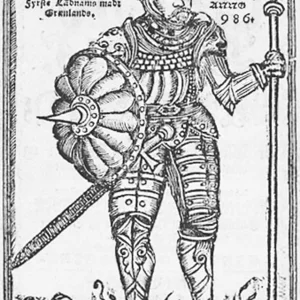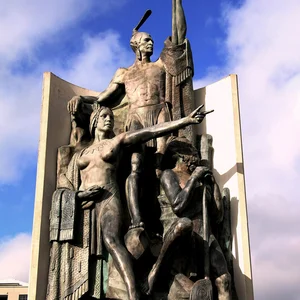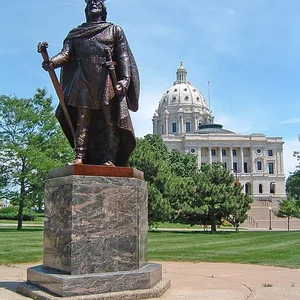

Viking explorer of Icelandic origin, son of Erik the Red. Around the year 1000, he is believed to have reached the coasts of North America (Vinland), becoming one of the first Europeans to set foot in the New World, five centuries before Christopher Columbus.
Leif Erikson(972 — 1020)
Leif Ericson
État libre islandais
6 min read
Frequently asked questions
Key Facts
- Son of Erik the Red, founder of the Viking colonies in Greenland (late 10th century)
- Around the year 1000, he reached a land west of Greenland that he named Vinland (probably Newfoundland, Canada)
- The first known European to land in North America, nearly five centuries before Christopher Columbus (1492)
- The archaeological site of L'Anse aux Meadows (Newfoundland) confirms a Viking presence around the year 1000
- His voyage is recounted in the Icelandic sagas (the Saga of Erik the Red, the Saga of the Greenlanders), written down at a later date
Works & Achievements
First documented European landing in North America, nearly five centuries before Christopher Columbus.
Leif names the three lands he sails past after their landscapes, providing the first Norse description of the American continent.
Construction of wood and turf shelters in Vinland, which would serve as a base for subsequent Viking expeditions.
A feat that earned him the nickname “Leif the Lucky” and strengthened his prestige as a leader.
Commissioned by King Olaf Tryggvason, Leif introduces the Christian faith to the Greenland colony.
Anecdotes
Leif is nicknamed "the Lucky
(Leifr hinn heppni). According to the sagas
during one of his voyages he spotted shipwrecked sailors clinging to a reef and rescued them
also bringing back a rich cargo. This feat earned him his reputation as a leader blessed by fortune.
According to the Saga of the Greenlanders, it was Leif's foster father, a German named Tyrkir, who discovered wild vines laden with grapes in the new land. Overjoyed, he spoke in his native tongue without anyone understanding him. Leif then named the region "Vinland
the land of wine.
The two main sagas tell two different versions of the voyage: in one, Leif deliberately sets out to find the lands that a merchant, Bjarni, had sighted without landing; in the other, he discovers America by chance, blown off course on his way back from Norway. Historians use these accounts with caution, as they were written nearly two centuries after the events.
For a long time, Leif's voyage was regarded as a mere legend. But in 1960, the Norwegian explorer Helge Ingstad and the archaeologist Anne Stine Ingstad discovered at L'Anse aux Meadows, in Newfoundland, the remains of a genuine Viking settlement dating to around the year 1000 — proof that Scandinavians had indeed reached America five centuries before Christopher Columbus.
Sent to the court of King Olaf Tryggvason of Norway, Leif converted to Christianity. The king charged him with spreading the new faith in Greenland. His mother Thjodhild converted and had a small church built, but his father Erik the Red remained faithful to the old gods until his death.
Primary Sources
“They found vines and grapes there… Leif said to his men: From now on we shall have two tasks, and one day we shall gather grapes, the next we shall fell vines and trees… He gave the land a name according to its riches and called it Vinland.”
“King Olaf asked Leif to proclaim Christianity in Greenland… On his way home, he came upon a land he had not expected, where wild wheat and the vine grew. He also rescued men stranded on a wreck: from then on he was called Leif the Lucky.”
“He also mentioned an island, discovered by many in that ocean, which is called Winland, because vines grow there of their own accord and yield the finest wine.” This is the oldest known written mention of Vinland.
Key Places
Island where Leif was reportedly born around 972, into a family of Scandinavian settlers, before his kin established themselves in Greenland.
Family estate founded by Erik the Red in the Eastern Settlement. Leif grew up here, organized his expeditions from here, and probably died here around 1020.
Seat of power of King Olaf Tryggvason, where Leif stayed and converted to Christianity before being given the mission of bringing it to Greenland.
“Land of the Flat Stones,” the first land named by Leif during his voyage southward, today identified as Baffin Island.
“Land of Forests,” the second land sighted by Leif, rich in timber, generally located along the Labrador coast.
Land where Leif set up his camp around the year 1000. The Viking site of L'Anse aux Meadows, excavated in 1960, remains its archaeological proof.
Typical Objects

Viking ocean-going ship, wider and deeper than the longship of war. It was this type of vessel, sturdy and able to carry men, livestock, and goods, that allowed Leif to cross the North Atlantic.

Crystal mentioned in the sagas, said to have helped navigators locate the sun's position in overcast weather. Its actual use is still debated by historians, but it symbolizes the Viking art of navigating without a compass.

Double-edged prestige weapon, a mark of a chieftain's status. An explorer like Leif owned one, as much for combat as to display his rank.

The most widespread weapon among the Vikings, as useful for fighting as for working wood. It was used to build shelters and camps such as Leifsbúðir.

Wooden shield rimmed with iron, carried by Scandinavian warriors. It protected the crew during stops in unknown territory.

Thick cape fastened with a fibula (brooch), essential against the cold of the North Atlantic and Greenland. Home-spun wool was the basic fabric of the Scandinavians.

Pendant or symbol of the new faith Leif adopted at the court of King Olaf. It recalls the mission to Christianize Greenland that was entrusted to him.
School Curriculum
Vocabulary & Tags
Key Vocabulary
Tags
Daily Life
Morning
At Brattahlíð, the day begins at dawn with tending the livestock — sheep, goats, and cows — and keeping the longhouse fire going. At sea, dawn is the time to set the course by the sun and the stars, and to trim the great woolen sail.
Afternoon
The afternoon is spent repairing the boats, preparing supplies for the voyage, and maintaining the weapons. Fishing, seal hunting, and trading with the other farms take up much of the time.
Evening
In the evening, the household gathers around the central hearth of the longhouse. There they share the meal, beer or mead, and listen to the tales of voyages and feats that would later become the sagas.
Food
Their diet relies on fish, seal, game, whale meat, and dairy products (milk, cheese, skyr). Since grain was scarce in Greenland, food was preserved by drying and salting for the long crossings; in Vinland, they discovered salmon, game, and wild grapes.
Clothing
People wore woolen tunics and trousers, leather shoes, and a cloak fastened with a brooch. Furs and woolen caps gave protection against the biting cold of the North Atlantic.
Housing
The typical dwelling is the longhouse built of turf and wood, with a central hearth for heating and cooking. The buildings excavated at L'Anse aux Meadows, made of sods of earth, resemble these Greenlandic farms.
Historical Timeline
Period Vocabulary
Liens externes & ressources
Références
Œuvres
Traversée de l'Atlantique Nord jusqu'au Vinland
vers 1000
Dénomination de Helluland, Markland et Vinland
vers 1000
Fondation du campement de Leifsbúðir
vers 1000
Sauvetage de marins naufragés
vers 1000
Christianisation du Groenland
vers 1000