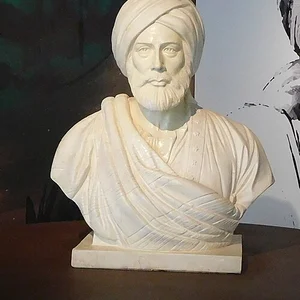

Muslim explorer and geographer of the 14th century, born in Tangier (Morocco). Ibn Battûta undertook a journey of over 120,000 km across Africa, Asia, and the Middle East, becoming the greatest medieval traveler. His accounts, recorded in the Rihla (the Journey), bear witness to the richness of the Muslim civilizations of his time.
Ibn Battûta(1304 — 1368)
Ibn Battuta
Maroc
7 min read
Frequently asked questions
Key Facts
- 1325: Departure from Tangier on a pilgrimage to Mecca, marking the beginning of his 30 years of travels
- 1326–1354: Traversal of trade routes across North Africa, the Middle East, Central Asia, and India
- 1352–1354: Journey to Mali and discovery of the Songhai Empire, an important Sahelian commercial center
- 1368: Return to Morocco and composition of the Rihla, an account of his travels
- 120,000 km: Estimated distance traveled, constituting the longest documented medieval journey before the modern era
Works & Achievements
Travel account dictated by Ibn Battuta to Ibn Juzayy on the orders of the Marinid sultan. It is the most comprehensive testimony about the Islamic world and beyond in the 14th century, covering more than 40 present-day countries.
Anecdotes
In 1326, Ibn Battuta arrived in Mecca to perform the pilgrimage, but he was so fascinated by the lands he had crossed that he decided not to return home. This first journey, planned as a simple hajj, transformed into an odyssey of nearly thirty years across the Islamic world.
At the court of the Sultan of Mali, Mansa Suleyman, Ibn Battuta was shocked by certain local customs that seemed to him contrary to Islam, such as women who appeared unveiled. He did not hide his disapproval, which earned him a reprimand from the sultan himself, who reminded him that these practices were ancient in his country.
Ibn Battuta crossed the Crimean desert in the depths of winter in a cart covered with furs, pulled by horses and camels. The severity of the cold surprised him so much that he noted in his account that he had never experienced anything like it, despite having crossed the burning deserts of Arabia.
During his stay in India, Sultan Muhammad ibn Tughluq offered him the position of judge (qadi) in Delhi, along with a considerable salary and lands. Ibn Battuta accepted, but lived a turbulent relationship with this unpredictable and brutal sultan, narrowly escaping disgrace and death on several occasions.
Upon returning to Morocco after nearly twenty-eight years of absence, Ibn Battuta learned that his mother had died a few months earlier, and his father many years before. Shortly after his return, on the orders of the Marinid sultan Abu Inan, he dictated all his memories to a scholar named Ibn Juzayy, giving birth to the Rihla.
Primary Sources
I set out alone, with no companion to cheer me and no caravan whose route I could follow, driven by an overmastering impulse within my soul and a long-cherished desire in my heart to visit these illustrious sanctuaries.
It is an immense city, which nature has favored on all sides; around it the sea embraces it on three sides. The markets are numerous and spacious, and the streets are wide.
The sultan of Mali is a man who loves justice and righteous people. He shows no leniency toward wrongdoers, regardless of their rank. The country is safe: neither the traveler nor the resident need fear the thief or the brigand.
China is the safest and finest country for the traveler. One can journey through it for nine months without fearing for one's life or belongings.
Key Places
Ibn Battuta's birthplace, the starting and ending point of his travels. It was there that he dictated his memoirs after nearly thirty years of absence.
The initial destination of Ibn Battuta's journey and the spiritual heart of Islam. He performed the hajj there several times throughout his wanderings.
Capital of the Delhi Sultanate where Ibn Battuta served as a qadi for several years. He experienced both wealth and fear there under the reign of Sultan Muhammad ibn Tughluq.
Ibn Battuta crossed the Sahara to reach the court of Mansa Suleyman, leaving a unique account of this prosperous West African empire.
A major seaport of medieval China and a key stop on Ibn Battuta's journey to the Far East. He describes the intense commercial activity there and the presence of Muslim merchants.
Capital of the Byzantine Empire visited by Ibn Battuta in 1332. He was received at the imperial court and described with wonder the churches, markets, and grandeur of the city.
Typical Objects

Navigation instruments used by medieval sailors and travelers to find their bearings. Ibn Battuta crossed seas and deserts relying on these tools as well as the stars.

Essential mode of transport for crossing the deserts of Arabia, Africa, and Central Asia. Ibn Battuta regularly joined merchant caravans to ensure his safety along the routes.

Tools of medieval Arabic writing. Ibn Battuta took notes throughout his travels, notes that would serve as the basis for the writing of the Rihla.

Typical garments of a Muslim scholar of the 14th century in North Africa. Ibn Battuta also adapted his attire according to the regions he passed through, sometimes adopting local dress.

A portable copy of the holy book of Islam, indispensable for a pilgrim and Muslim judge like Ibn Battuta, who recited and taught the Quran throughout his wanderings.

Large merchant vessel used in the Indian Ocean and the China Sea. Ibn Battuta describes these craft in precise detail during his journey to China.
School Curriculum
Vocabulary & Tags
Key Vocabulary
Daily Life
Morning
Ibn Battuta began his day with the dawn prayer (fajr), reciting Quranic verses. If the caravan was on the move, he would saddle his camel at daybreak to take advantage of the cool air before the desert heat set in.
Afternoon
Depending on the stage of the journey, he spent his afternoons meeting local rulers, scholars, and merchants, noting their customs and the curiosities of the region. He sometimes carried out his duties as a judge or attended royal audiences.
Evening
In the evening, Ibn Battuta performed the sunset prayer (maghrib) and dined in the company of his hosts or travel companions. He would mentally or in writing record his observations of the day before the night prayer (isha).
Food
His food varied enormously depending on the region: flatbread and dates in Arabia, rice and spices in India, millet and mutton in Mali, noodles and tea in China. He observed halal dietary rules and noted local culinary specialties with curiosity.
Clothing
Ibn Battuta generally wore the djellaba and white turban of a Muslim scholar, adapting his attire to the climates he passed through — furs in Crimea, light clothing in tropical India. He often accepted garments gifted by the rulers he encountered.
Housing
His accommodations ranged from simple caravan tents in the desert to sumptuous palaces offered by sultans. In cities of the Islamic world, he was happy to lodge in madrasas (Quranic schools) or with families of jurists who welcomed him as a learned guest.
Historical Timeline
Period Vocabulary
Visual Style
Esthétique de manuscrit enluminé islamique mêlant les palettes dorées des déserts arabes, les bleus profonds de l'océan Indien et les scènes de cour colorées d'Afrique et d'Asie médiévales.
Sound Ambience
Ambiance sonore mêlant les appels à la prière, les caravanes du désert, les marchés animés de l'océan Indien et les cours royales africaines et asiatiques traversées par Ibn Battûta.
Liens externes & ressources
Références
Œuvres
Rihla (Tuhfat al-nuzzar fi ghara'ib al-amsar wa-aja'ib al-asfar)
1355