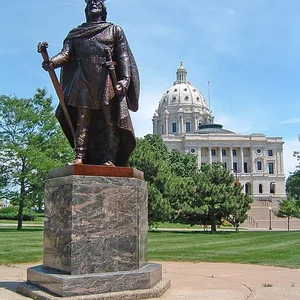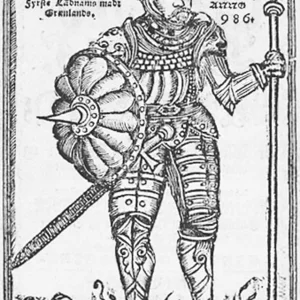

A Viking explorer of Norwegian origin, banished from Iceland for manslaughter, around 982 he explored a land he named Greenland (“green land”) to lure settlers there. Around 985 he founded the first lasting Scandinavian colony there.
Erik the Red(950 — 1003)
Erik the Red
Norvège
7 min read
Frequently asked questions
Key Facts
- Born around 950 in Norway (Rogaland), son of Thorvald Asvaldsson, who was exiled to Iceland
- Banished from Iceland for three years around 982 following a manslaughter
- Explored the coasts of a land he named Greenland around 982–985 to entice settlers
- Founded the colony of Brattahlíð around 985–986, the first lasting Viking settlement in Greenland
- Father of Leif Erikson, the future explorer of Vinland; died around 1003
Works & Achievements
During his banishment, Erik surveyed and wintered along the fjords of southwestern Greenland, scouting out the habitable lands.
By naming this frozen land the “green country,” Erik pulled off a marketing ploy that remains famous to this day, designed to attract settlers.
Erik set up his farm-headquarters, which became the political and social center of Norse Greenland.
The first lasting Norse settlement in Greenland, populated by the colonists who came in his wake.
Erik assembled 25 ships of settlers from Iceland to populate Greenland; 14 reached their destination.
By establishing the Greenland base, Erik made possible the voyages of his son Leif Erikson all the way to Vinland, in North America.
Anecdotes
Erik the Red is arguably the author of the first “publicity stunt” in history. When he discovered this vast land covered in ice, he named it “Greenland,” meaning “green land”: a flattering name, deliberately chosen to entice the Icelanders to come and settle there. The saga recounts that he believed “people would be far more tempted to go there if the land had a fine name.”
Banishment ran in the family. Erik's father, Thorvald, had been forced to flee Norway after killing a man, and had taken refuge in Iceland. Erik repeated the story: embroiled in deadly quarrels with his neighbors, he too was sentenced to three years of exile by the Icelandic assembly. It was precisely this banishment that drove him to set off and explore westward around 982.
When Erik organized the great colonizing expedition around 985, 25 ships laden with settlers, livestock, and provisions weighed anchor from Iceland. But the crossing of the North Atlantic was terrible: according to the sagas, only 14 ships reached Greenland. The others were wrecked or turned back.
Erik remained faithful to the old Norse gods all his life, which caused a crisis in his household. His wife Thjodhild converted to Christianity around the year 1000 and had a small church built near their farm at Brattahlíð. The saga says that from then on she refused to share Erik's bed, much to his dismay. The foundations of this “church of Thjodhild” were indeed found by archaeologists in Greenland in 1961.
Erik nearly took part in the expedition that discovered America. His son Leif asked him to lead the voyage to Vinland, but as he rode on horseback to the ship, Erik fell and injured himself. He saw this as a bad omen and declared that he was “not destined to discover other lands.” He therefore stayed ashore, leaving the glory of the crossing to his son.
Primary Sources
“He called this land Greenland (green land), for he said that men would be far more eager to go there if the country had a fine name.”
“The land that is called Greenland was discovered and settled from Iceland. Erik the Red was the man who went there to settle it; it was from him that the country took its name.” The text adds that the settlers found there the remains of dwellings, fragments of boats, and stone tools, a sign that people similar to the Skrælingar had once lived there.
Leif asks his father Erik to lead the expedition to the lands in the west. On the way to the ship, Erik falls from his horse and is injured; he then declares that he is not destined to discover any land other than the one where he lives, and gives up the voyage.
The book recounts the lineage of Erik the Red, his departure from Norway with his father Thorvald “because of some killings,” his settlement in Iceland, then his banishment and his departure for Greenland.
Key Places
Coastal region in southwestern Norway where Erik the Red is said to have been born around 950, before his family was exiled.
Northwestern coast of Iceland where Erik's father settled after being banished from Norway. Erik spent part of his youth there.
Erik the Red's farm in western Iceland, where his son Leif is said to have been born. It was from here that Erik was banished around 982.
Farm founded by Erik around 985, the heart of the colony and the seat of his authority. He died here around 1003; the remains of the farm and of Thjodhild's church can still be seen.
Cluster of farms founded by Erik and his companions in the fjords of southwestern Greenland, the first lasting Norse colony on the island.
Typical Objects

Viking cargo ship, wider and deeper than the warlike longship. It was this sturdy type of vessel that Erik used to carry settlers, livestock and provisions across the North Atlantic to Greenland.

A crystal said to help locate the sun's position in overcast weather, aiding orientation on the open sea. Indispensable to navigators like Erik for crossing the mists of the North Atlantic.

An axe with a blade extended downward, serving both as an everyday tool and a weapon of war. Erik, caught up in several deadly feuds, lived in a society where every free man bore a weapon.

A small hammer-shaped pendant, symbol of the god Thor. Erik the Red, who remained pagan all his life, belonged to this culture in which people wore this protective talisman, unlike his converted wife.

A metal clasp used to fasten the woolen cloak at the shoulder. It also marked social rank; a settlement chief like Erik wore richly decorated ones.

A hollowed-out cattle horn used to drink mead or beer at feasts in the longhouse. These banquets sealed the alliances between the settlers of Greenland.

A wooden shield ringed with iron and fitted with a central boss, the basic defensive arm of the Norse warrior. It accompanied Erik's men both aboard their ships and during conflicts in Iceland.
School Curriculum
Vocabulary & Tags
Key Vocabulary
Daily Life
Morning
From dawn, Erik and his household tend to the livestock: milking the cows and goats, caring for the sheep that graze the sparse meadows of the fjords. As a chieftain (*goði*), he also settles disputes between settlers and organizes the work on the farm.
Afternoon
The afternoon is devoted to the resources of the sea and the coast: fishing, seal hunting, and sometimes catching walruses for their ivory, which is highly prized. Boats and nets are repaired, and hay and driftwood — rare and precious in Greenland — are stored away.
Evening
In the evening, the whole household gathers around the central hearth of the longhouse. They share a hot meal, drink ale from horns, and listen to tales of voyages, gods, and ancestors — the oral memory of the Norse people.
Food
Their diet relies on fish, seal and game meat, and dairy products such as *skyr* (a fermented milk food). Grain, which barely grows in Greenland, has to be imported from Iceland or Norway; in summer, this is supplemented with wild berries.
Clothing
People wear tunics and dresses of home-woven wool, covered with a cloak fastened by a brooch. Leather boots and gloves, along with seal or reindeer furs, protect against the intense cold of the North Atlantic.
Housing
Erik lives in a longhouse (*skáli*) with thick walls of turf and stone that insulate against the wind and frost. A single large hall, dominated by a central hearth, serves at once as kitchen, living room, and sleeping quarters for the family and the servants.
Historical Timeline
Period Vocabulary
Liens externes & ressources
Références
Œuvres
Exploration des côtes du Groenland
vers 982-985
Fondation de la colonie de Brattahlíð
vers 985
Fondation de l'Établissement de l'Est (Eystribyggð)
vers 985-986
Organisation de la flotte de colonisation
vers 985
Une dynastie d'explorateurs
vers 1000