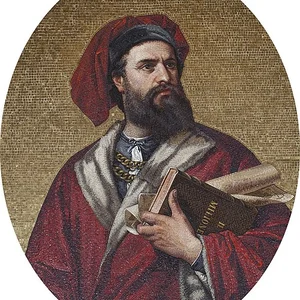

Venetian merchant and explorer (1254–1324), Marco Polo is famous for his long journey to Asia from 1271 to 1295, during which he reached the court of the Great Khan Kublai. His account, The Travels of Marco Polo, profoundly shaped European knowledge of Asia and its trade routes.
Marco Polo(1254 — 1324)
Marco Polo
république de Venise
8 min read
Frequently asked questions
Key Facts
- 1271: Departure from Venice with his father Niccolò and his uncle Maffeo for a 24-year journey across Asia
- 1275: Arrival at the court of Kublai Khan in China, where he became an adviser and diplomat
- 1292: Return westward by sea through the Indian Ocean
- 1295: Return to Venice after more than two decades away
- Early 14th century: Dictation of The Travels of Marco Polo while in prison; the account spread throughout Europe
Works & Achievements
Travel account dictated by Marco Polo to Rustichello da Pisa during his captivity in Genoa. It is the first detailed description of Central and East Asia for the European public, and a major source for geographers and cartographers until the 16th century.
Marco Polo accompanied an embassy tasked with escorting a Mongol princess to Persia by sea. This journey allowed him to explore Sumatra, Ceylon, southern India, and the Arabian coast, considerably enriching his geographical observations.
According to his own account, Marco Polo was appointed governor of the great city of Yangzhou by Kublai Khan. Whether he held this office or was simply stationed in the region, it attests to his integration into the Mongol imperial administration.
Anecdotes
When Marco Polo returned to Venice in 1295 after twenty-four years of absence, no one recognized him. According to tradition, he and his companions tore open their worn Mongol garments to reveal precious stones hidden in the seams, thus proving their identity and the fortune they had accumulated in the East.
Kublai Khan was so impressed by Marco Polo's talents that he employed him as an emissary and administrator across his vast empire. Marco Polo was appointed governor of the city of Yangzhou for three years — a considerable responsibility for a young Venetian merchant.
It was in prison, in Genoa, that Marco Polo dictated his adventures to a cellmate, Rustichello da Pisa, a professional novelist. Captured during a naval battle between Venice and Genoa in 1298, Marco Polo turned his imprisonment into a literary opportunity to commit his extraordinary memories to paper.
Marco Polo described with precision technologies and products unknown in Europe: coal (which he called 'black stones that burn'), paper banknotes used in the Mongol empire, and spices such as nutmeg. His European contemporaries often found these accounts implausible, earning him the nickname 'Marco Millions' for his supposed exaggerations.
On his deathbed in 1324, those close to him begged Marco Polo to admit he had invented or exaggerated his accounts so that he might die in peace. He reportedly replied: 'I have not told half of what I saw.' This phrase encapsulates the disbelief of his contemporaries when faced with Asian realities that surpassed all European imagination.
Primary Sources
Know that since Our Lord God formed Adam our first father until this day, no Christian, nor Saracen, nor Tartar, nor Indian, nor any man of any kind, explored so many diverse parts of the world as did Messer Marco Polo.
I leave and bequeath to Pietro Bragadin, formerly a slave whom I have freed, twenty Venetian grossi and also the fustian cloth robe lined with sable that I customarily wear.
Venice is the most beautiful and pleasant of all cities, and merchants flock there from every country in the world.
The Great Khan receives foreign ambassadors and merchants with magnificence; he assigns them residences and provides for their needs throughout the duration of their stay.
Key Places
Marco Polo's birthplace and a major commercial power in the Mediterranean. Venice controlled trade between Europe and the Orient, which explains the Polo family's natural inclination toward long-distance commerce.
A strategic port where Marco Polo considered embarking before choosing the overland route. An unavoidable crossroads of trade between the Mediterranean, India, and China.
Kublai Khan's summer capital where Marco Polo was received for the first time in 1275. He described the marble palace and gardens as architectural wonders without equal in Europe.
Kublai Khan's winter capital, which Marco Polo called Cambaluc. He stayed there for extended periods and produced a detailed account of its palaces, markets, and administrative organization.
The city over which Marco Polo claims to have served as governor for three years on the orders of Kublai Khan. This claim remains debated by historians, but testifies to the trust the Great Khan placed in him.
The city where Marco Polo was imprisoned from 1298 to 1299 following the Venetian naval defeat. It was in this prison that he dictated his adventures to Rustichello da Pisa, giving birth to The Description of the World.
Typical Objects

A gold or silver safe-conduct issued by Kublai Khan to trusted messengers and envoys. Marco Polo received one, guaranteeing him protection and provisions throughout the Mongol empire.

A magnetic navigation instrument already refined in China for several centuries. Marco Polo encountered this tool during his crossings of the China Sea, long before it became widespread in Europe.

Paper currency issued by the Yuan Empire and described with astonishment by Marco Polo, who was one of the first Europeans to explain how it worked and to highlight its effectiveness.

Precious fabrics brought back or described by Marco Polo, symbolizing the extraordinary wealth of China and the Silk Road. These textiles were the subject of a highly lucrative trade between East and West.

Marco Polo's accounts informed European cartographers for generations. The famous Fra Mauro world map (1450) draws directly on The Description of the World to depict Asia.

Merchant vessels of Venice, the dominant commercial power of the Mediterranean in the 13th century. Marco Polo embarked on such ships to reach the Levantine ports at the start of his journey.
School Curriculum
Vocabulary & Tags
Key Vocabulary
Daily Life
Morning
During his years at the court of Kublai Khan, Marco Polo rose at dawn to attend imperial audiences or prepare for a diplomatic mission. He quickly learned several languages of the empire, including Mongolian, Persian, and several Chinese dialects, devoting part of his mornings to this essential study.
Afternoon
Afternoons were often spent on inspection journeys across the empire's provinces, a task Kublai Khan willingly entrusted to Marco Polo for his curiosity and eye for detail. He observed and mentally noted local produce, customs, trade routes, and the fortifications of the cities he passed through.
Evening
In the evenings at court, Marco Polo took part in imperial banquets where dishes unknown in Europe were served. In his memoirs he recounts being fascinated by the acrobats, musicians, and storytellers summoned to entertain the Great Khan and his thousands of guests.
Food
Travelling along the Silk Road, Marco Polo subsisted on flatbread, dried or smoked meat, fermented mare's milk (koumiss), and dates depending on the region. At the Mongol court he discovered rice, noodles, rare spices, and exotic ingredients such as fresh ginger and cinnamon.
Clothing
In Venice, Marco Polo wore the typical dress of prosperous merchants: a long tunic, a fur-lined cloak, and soft leather shoes. During his years in Asia he adopted Mongolian and Chinese garments, notably the long embroidered robes gifted by Kublai Khan to members of his court.
Housing
In Venice, the Polo family lived in a merchant's palazzo near the Rialto, reflecting their standing as successful traders. During his travels, Marco Polo slept in caravanserais along the Silk Road, in Mongolian yurts on the steppe, and in the luxurious apartments of the imperial palace at Khanbaliq.
Historical Timeline
Period Vocabulary
Visual Style
Un mélange de miniature médiévale occidentale et d'enluminures orientales, dominé par les ors, les bleus lapis et les rouges profonds des soieries, évoquant le faste de deux civilisations au sommet de leur puissance.
Sound Ambience
De l'animation bruyante des canaux vénitiens aux steppes silencieuses d'Asie centrale, en passant par la splendeur sonore de la cour mongole, l'univers de Marco Polo mêle les sons de trois continents.
Liens externes & ressources
Références
Œuvres
Le Devisement du monde (Le Livre des merveilles)
vers 1298-1300
Mission diplomatique pour Kubilaï Khan en Inde et en Perse
1292-1293
Administration de Yangzhou
vers 1282-1285