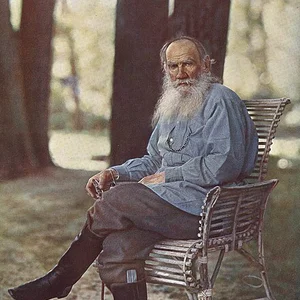

Russian writer, 19th - early 20th c.
Leo Tolstoy(1828 — 1910)
Leo Tolstoy
Empire russe
8 min read
Frequently asked questions
Key Facts
- Né en 1828 dans une famille de la noblesse russe, il perd ses parents très jeune et est élevé par des tuteurs
- Il participe à la guerre de Crimée (1853-1856), expérience qui nourrit ses réflexions sur la violence et la guerre
- Il publie 'Guerre et Paix' entre 1865 et 1869, fresque historique sur la Russie napoléonienne considérée comme l'un des plus grands romans de la littérature mondiale
- Il publie 'Anna Karénine' (1877), roman sur la société russe et la condition féminine, qui lui apporte une renommée internationale
- À partir des années 1880, il développe une philosophie morale et spirituelle (le 'tolstoïsme') prônant la non-violence, la simplicité et le refus de l'autorité
Works & Achievements
An epic fresco of 1,500 pages tracing the Napoleonic Wars through the destinies of Russian aristocratic families. Considered one of the greatest novels in world literature.
A novel about adultery and the condition of women in 19th-century Russian society. Dostoevsky called it a flawless work.
A masterly novella about a judge confronted with his imminent death, which forces him to question the meaning of his bourgeois life. A masterpiece of psychological realism.
Tolstoy's last great novel, a scathing critique of justice, the Church, and Russian society, told through the story of a prince seeking to repair a past injustice.
A spiritual autobiography in which Tolstoy recounts his existential crisis and his conversion to a radical form of Christianity, rejecting dogma and ecclesiastical institutions.
A major theoretical essay in which Tolstoy defines art as the transmission of sincere feelings and condemns much of the elitist art of his time, including some of his own works.
Three short stories drawn from his direct experience of the Crimean War, which revealed to the world a new realistic and anti-heroic perspective on warfare.
Anecdotes
Tolstoy was an aristocrat who lived on a vast estate, Yasnaya Polyana, but one day he decided to plow his own fields alongside his peasants. He cobbled his own boots and wore peasant clothing, much to the dismay of his wife Sofia, who could not understand his rejection of noble life.
War and Peace, one of the longest novels in world literature, was rewritten seven times by Tolstoy, sometimes entirely by hand. His wife Sofia copied out the manuscripts every night by candlelight, making her his first and indispensable collaborator.
At 82, Tolstoy secretly fled his home on a freezing October night in 1910, abandoning his family and fortune to finally lead an ascetic life in keeping with his convictions. He died a few days later at the small station of Astapovo, before photographers and journalists who had rushed from around the world.
Tolstoy was excommunicated by the Russian Orthodox Church in 1901 because of his heterodox religious ideas. Far from marginalizing him, this decision made him a worldwide celebrity, and thousands of letters of support poured into Yasnaya Polyana from across Europe.
Gandhi and Tolstoy exchanged letters between 1909 and 1910. Tolstoy admired Gandhi's nonviolent resistance in South Africa, and Gandhi recognized himself in the Russian novelist's philosophy of non-resistance to evil through violence.
Primary Sources
History is the life of peoples and of humanity. To grasp and express in words — that is, to describe — the life not only of humanity but even of a single people, seems impossible.
I am ugly, awkward, untidy and lacking in social graces. I am irritable, tiresome to others, immodest, intolerant and as bashful as a child.
The further you advance in your work, the more I rejoice in reading your writings. Your question about what I think of your passive resistance activity… Love, that is to say the desire for the good of men, expressed through action, is the supreme and sole law of human life.
Art is a human activity consisting in this, that one man consciously, by means of certain external signs, hands on to others feelings he has lived through, and that other people are infected by these feelings and also experience them.
My life had come to a stop. I could breathe, eat, drink, sleep, I could not help doing these things; but there was no real life in me, because there were no desires whose satisfaction I would have found reasonable.
Key Places
The Tolstoy family estate, located 200 km south of Moscow, where Leo was born, lived, and wrote almost his entire body of work. Now a national museum, it draws thousands of visitors every year.
Tolstoy took part in the Siege of Sevastopol (1854–1855) during the Crimean War. This experience of real warfare directly fed into his writing in the Sevastopol Sketches and later in War and Peace.
A central setting in Anna Karenina and War and Peace, Moscow represents in Tolstoy's work Russian aristocratic society with its balls, intrigues, and moral hypocrisy.
The small railway station where Tolstoy died on November 20, 1910, following his nocturnal flight from Yasnaya Polyana. His death was the first global media event captured on film by movie cameras.
The imperial capital where Tolstoy was introduced into literary circles through Turgenev in the 1850s. He maintained a complex relationship with the city, which he associated with bureaucracy and artificiality.
Typical Objects

Tolstoy wrote his manuscripts with a quill pen, covering thousands of pages in his small, dense handwriting. He rewrote War and Peace seven times, producing a considerable volume of handwritten text.

Convinced that manual labor was morally superior to intellectual work, Tolstoy plowed his fields with a plow alongside his peasants, a gesture that symbolized his Tolstoyan philosophy of returning to the land.

Tolstoy learned shoemaking to craft his own boots, rejecting aristocratic luxury. He often gave pairs of boots to his visitors as a symbolic gift.

The samovar, a traditional Russian copper kettle, was the center of family life at Yasnaya Polyana. Around the evening tea gathered family, visitors, and intellectuals who came from all over the world.

Tolstoy read and annotated the Gospels in Greek, developing his own vision of Christianity stripped of all dogma. He wrote a personal version of the Gospels, which was censored by the Church.

At over sixty years old, Tolstoy learned to ride a bicycle, a gift from the Moscow Cycling Society. He considered this physical activity perfectly compatible with his philosophy of simple living.
School Curriculum
Vocabulary & Tags
Key Vocabulary
Daily Life
Morning
Tolstoy rose early, around 6 or 7 o'clock, and began his day with a long walk through the birch forests of Yasnaya Polyana, in all weathers. He then devoted the morning to writing in his study, working for several hours at a stretch with total concentration.
Afternoon
The afternoon was reserved for physical work: plowing, carpentry, or cobbling. Tolstoy also received many visitors — intellectuals, peasants, disciples who came from all over the world — with whom he discussed philosophy and religion in the family sitting room.
Evening
In the evening, the family and guests would gather around the samovar for tea. Tolstoy would sometimes read aloud, play chess, or play the piano. He also kept a personal diary almost daily from the age of nineteen.
Food
Tolstoy became a vegetarian from the 1880s onward, convinced that eating meat was morally incompatible with non-violence. His diet consisted mainly of black bread, kasha (buckwheat porridge), vegetables, mushrooms, and fruit from his estate.
Clothing
He habitually wore a long white tunic of coarse linen, belted at the waist with a leather strap, identical to the garment worn by Russian peasants. He refused noble attire and cobbled his own thick leather boots himself, earning the contempt of Russian high society.
Housing
He lived at Yasnaya Polyana, a vast 400-hectare estate with a two-story wooden manor house surrounded by orchards and forests of birch and oak trees. His study was a simple room with a wooden desk, a bookcase, and sparse decoration, in stark contrast to the richly furnished salons in the rest of the house.
Historical Timeline
Period Vocabulary
Visual Style
Style réaliste russe du XIXe siècle, inspiré des peintres Repin et Kramskoi — tons terreux et verts profonds, lumières hivernales blafar des, intérieurs chaleureux au bougeoir contrastant avec l'immensité des plaines enneigées.
Sound Ambience
L'ambiance sonore d'Iasnaïa Poliana mêle le silence enneigé des grandes plaines russes aux bruits intérieurs d'un manoir aristocratique animé — plumes qui grattent, samovar qui siffle, paysans au loin.
Liens externes & ressources
Références
Œuvres
Guerre et Paix
1865-1869
Anna Karénine
1875-1877
La Mort d'Ivan Ilitch
1886
Résurrection
1899
Ma Confession
1882
Qu'est-ce que l'art ?
1897
Récits de Sébastopol
1855-1856