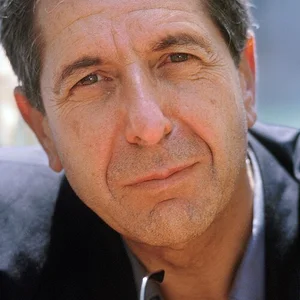

Canadian singer-songwriter, poet, and novelist. First recognized as a writer, he became one of the great figures of folk music, blending poetry, spirituality, and melancholy. His song *Hallelujah* became a worldwide classic.
Leonard Cohen(1934 — 2016)
Leonard Cohen
Canada
5 min read
Frequently asked questions
Famous Quotes
« There is a crack in everything. That's how the light gets in.»
Key Facts
- Born in 1934 in Montreal, Canada.
- Published his first poetry collection, *Let Us Compare Mythologies*, in 1956.
- Released his debut album, *Songs of Leonard Cohen*, in 1967.
- Composed *Hallelujah* in 1984, which became a globally covered standard.
- Died in 2016 in Los Angeles.
Works & Achievements
First collection of poems, which established him as one of the voices of young Canadian poetry.
Bold experimental novel, now considered a major work of Canadian literature.
First album, featuring *Suzanne* and *So Long, Marianne*, which revealed him as a singer-songwriter.
Song that became a folk classic, based on a poem dedicated to Suzanne Verdal.
Became one of the most covered songs in the world, blending biblical references with intimate emotion.
Comeback album with a synthetic sound that revived his career for a new audience.
Dark and prophetic album containing *Anthem* and its famous line about the light entering through cracks.
Final album, released shortly before his death, hailed as an artistic and spiritual testament.
Anecdotes
Before becoming a singer, Leonard Cohen was a recognized poet and novelist in Canada. He only released his first album at age 33, in 1967, an advanced age to start a singing career. Many thought he was too old and that his deep voice was too strange for success.
His song *Hallelujah* (1984) went almost unnoticed upon release. He reportedly wrote up to 80 different verses before settling on the final version. The song only became a worldwide classic years later, covered by hundreds of artists.
Between 1994 and 1999, Cohen retreated to a Zen Buddhist monastery on Mount Baldy, near Los Angeles. He lived there as a monk under the name Jikan ("the silent one") and was ordained as a monk in 1996.
In 2005, Cohen discovered that his former manager had embezzled nearly all of his savings, amounting to several million dollars. Ruined at over 70, he had to go on a world tour in 2008, which led to a triumphant comeback and renewed popularity.
His final album, *You Want It Darker*, was released on October 21, 2016, barely three weeks before his death. In the title track, he sang "Hineni, hineni" ("here I am" in Hebrew), a biblical response that sounded like a serene farewell in the face of death.
Primary Sources
I've heard there was a secret chord / That David played, and it pleased the Lord.
There is a crack, a crack in everything / That's how the light gets in.
Hineni, hineni / I'm ready, my Lord.
I've seen the future, brother: it is murder.
Key Places
Cohen's hometown, to which he remained deeply attached and where he regularly returned to live.
He bought a house there in 1960 and wrote poetry and novels, living in an artists' community.
Legendary hotel of New York's bohemian scene where he stayed and which inspired the song *Chelsea Hotel #2*.
Buddhist monastery where he retreated from 1994 to 1999 and was ordained as a monk under the name Jikan.
City where he spent his final years, recorded his last albums, and died in 2016.
Typical Objects

Cohen played a nylon-string guitar, having learned a few flamenco chords from a Spanish musician he met in Montreal.

A meticulous poet, he accumulated dozens of versions of his texts, tirelessly rewriting each song for years.

The wide-brimmed felt hat became one of his iconic attributes, especially during his later tours.

On stage and in photos, Cohen almost always wore an elegant dark suit, an image of grave and polished distinction.

On the album *I'm Your Man* (1988), he adopted cheap keyboards and drum machines that transformed his sound.

During his retreat at Mount Baldy, he lived as a Buddhist monk, dressed in the black robe and serving his master Roshi.
School Curriculum
Vocabulary & Tags
Key Vocabulary
Tags
Daily Life
Morning
Cohen was an early riser and a hard worker. He often started his days writing, tirelessly refining his texts line by line. During his monastic period, he would get up before dawn for Zen meditation.
Afternoon
His afternoons were devoted to composition, guitar, or reading. He could spend months, even years, on a single song, accumulating dozens of versions before being satisfied.
Evening
In the evening, in his younger years, he frequented the cafés and clubs of Montreal, New York, or the parties on Hydra. Later, he preferred calm, reflection, and writing at night.
Food
Sober in his tastes, he enjoyed simple food. At the monastery, he shared the frugal vegetarian meals of the monks. He nevertheless liked wine and smoked a lot, especially during his tours.
Clothing
He took care of his appearance with dark suits, elegant shirts, and often a fedora hat. This discreet and serious elegance was part of his public image.
Housing
He lived in contrasting places: a modest apartment in Montreal, a white house without electricity on the island of Hydra, rooms in legendary hotels like the Chelsea, and the spartan cabin at the Mount Baldy monastery.
Historical Timeline
Period Vocabulary
Visual Style
Une élégance grave en clair-obscur : costumes sombres, lumière de lampe chaude, contraste fort entre ombre et lumière, mélancolie raffinée.
Sound Ambience
Une ambiance feutrée et mélancolique : guitare folk, voix grave et profonde, chœurs féminins et nappes de synthé teintées de spiritualité.