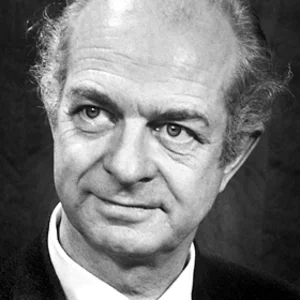

American chemist (1901–1994), Linus Pauling is one of the founders of modern molecular chemistry. He is one of the very few individuals to have received two Nobel Prizes: Chemistry in 1954 and Peace in 1962.
Linus Pauling(1901 — 1994)
Linus Pauling
États-Unis
8 min read
Frequently asked questions
Famous Quotes
« The best way to have a good idea is to have lots of ideas.»
« I have something that I call my Golden Rule. It goes something like this: 'Do unto others twenty-five percent better than you expect them to do unto you.'»
Key Facts
- 1901: born in Portland, Oregon
- 1939: publication of 'The Nature of the Chemical Bond', a founding work of modern chemistry
- 1954: Nobel Prize in Chemistry for his work on chemical bonding and the structure of complex molecules
- 1962: Nobel Peace Prize for his campaign against atmospheric nuclear testing
- 1994: died in Big Sur, California
Works & Achievements
A founding work of modern structural chemistry, translated into several languages and republished three times. It synthesizes Pauling's theory of covalent bonds, resonance, and electronegativity — concepts still taught today in every chemistry curriculum.
Pauling and Robert Corey describe the two fundamental secondary configurations of proteins, paving the way for structural molecular biology. This discovery came two years before the double helix model of DNA.
The first article in history to demonstrate that a hereditary disease has a precise molecular cause. Pauling shows that the hemoglobin of patients with sickle cell anemia has an abnormal structure, establishing the paradigm of molecular medicine.
A popular essay in which Pauling explains the dangers of nuclear radiation and advocates for general disarmament. Translated into several languages, it helped raise worldwide public awareness of the nuclear threat during the Cold War.
A document signed by 11,021 scientists from 49 countries and submitted to the United Nations. Directly linked to the signing of the Partial Nuclear Test Ban Treaty in 1963, this petition remains one of the most effective scientific mobilizations in history.
A widely popular science book advocating the use of high doses of vitamin C. Although its conclusions were disputed, the book sparked decades of research into antioxidants and popularized nutritional supplementation.
Anecdotes
In 1952, the U.S. government refused to renew Pauling's passport, preventing him from attending a conference in London on the structure of DNA. This decision, motivated by his pacifist views deemed 'communist,' may have cost him the discovery of the double helix: Watson and Crick would publish their model just a few months later, in 1953.
Pauling is one of the very few people to have received two Nobel Prizes in entirely different fields. In 1954, he received the Nobel Prize in Chemistry for his work on chemical bonds. In 1962, he was awarded the Nobel Peace Prize for his fight against nuclear testing — a unique combination in the history of science.
In 1949, Pauling published a landmark article demonstrating that sickle cell disease (an inherited blood disorder) is caused by a molecular abnormality in hemoglobin. In doing so, he coined the concept of 'molecular disease,' opening the door to all of modern molecular medicine.
From the 1970s onward, Pauling became the most prominent advocate of high-dose vitamin C, consuming several grams himself every day. Although his theories on preventing cancer and colds through vitamin C were largely debunked, they sparked a worldwide scientific debate and popularized the idea of vitamin supplementation.
In 1958, Pauling presented the United Nations with a petition signed by more than 11,000 scientists from around the world, including 36 Nobel laureates, demanding an end to atmospheric nuclear testing. Written at the height of the Cold War, this document directly contributed to the signing of the Partial Nuclear Test Ban Treaty in 1963.
Primary Sources
The properties of a substance depend upon the nature of the forces acting between the atoms. The chemical bond is described as involving the sharing of a pair of electrons between two atoms.
We have examined sickle-cell anemia patients and have found that the hemoglobin of these individuals is different from that of normal adults and from that of the fetus.
We have in common with our fellow men a deep concern for the welfare of all human beings. As scientists we have knowledge of the dangers involved and a special responsibility to make those dangers known.
We must work for peace — not just the absence of war, but the active and positive presence of justice, equality, and human brotherhood and sisterhood.
I believe that there will never again be a great world war — a war in which the terrible weapons involving nuclear fission and nuclear fusion would be used. I believe instead that we are entering a new era of peace and reason.
Key Places
Birthplace of Linus Pauling, born on February 28, 1901. His father, a pharmacist, introduced him to chemistry at an early age by letting him watch the preparation of medicines.
Pauling spent his entire career here, from his doctorate in 1925 through the 1960s. It was in these laboratories that he made nearly all of his landmark discoveries in molecular chemistry.
Pauling's alma mater for his undergraduate studies, and today home to the Linus Pauling Institute and the complete archives of his scientific and activist work.
The city where Pauling received the Nobel Peace Prize on December 10, 1963, at a ceremony marked by the recent signing of the Partial Nuclear Test Ban Treaty.
Pauling owned a secluded ranch at Deer Flat Ranch, on the cliffs of Big Sur. He would retreat there to write and think, and it was there that he died on August 19, 1994.
Typical Objects

Pauling used three-dimensional ball-and-stick models to visualize and build molecular structures. It was through these models that he discovered the alpha-helix shape of proteins in 1951.

X-ray diffraction on crystals made it possible to indirectly observe the arrangement of atoms within molecules. Pauling had mastered this technique since the 1920s and made it the central tool of his structural discoveries.

An everyday instrument for any chemist, the periodic table was for Pauling the map of the molecular world. His work on electronegativity profoundly deepened the understanding of this fundamental tool.

In 1958, Pauling presented the United Nations with a petition signed by 11,021 scientists opposing nuclear testing. Collected from around the world, this document stands as a symbol of researchers' civic commitment during the Cold War.

From the 1960s onward, Pauling himself consumed several grams of vitamin C each day. Bottles of ascorbic acid supplements became the emblem of his theories on vitamin "megadosing."

Pauling recorded his hypotheses and calculations in detailed laboratory notebooks. His 1951 notes on protein structure, preserved in the Oregon State University archives, show how he deduced the alpha helix in just a few hours of intensive thought.
School Curriculum
Vocabulary & Tags
Key Vocabulary
Tags
Daily Life
Morning
Pauling began his mornings very early, often at dawn, with a reading session of the latest scientific publications. He made a habit of immediately jotting down his ideas and hypotheses in a notebook, believing that the first hours of the day were the most conducive to creative thinking.
Afternoon
His afternoons were divided between laboratory work, molecular modeling sessions, and teaching at Caltech. He was committed to personally supervising his doctoral students and regularly organized informal seminars where everyone could present their progress and uncertainties.
Evening
In the evenings, Pauling devoted time to writing his articles and books, as well as corresponding with scientists from around the world. A passionate music lover, he also enjoyed relaxing with his family around the piano. From the 1950s onward, activist meetings and the drafting of pacifist speeches took up an increasingly large share of his evenings.
Food
Pauling was convinced of the benefits of micronutrients and followed his own recommendations himself: he took several grams of vitamin C each day along with other supplements. Otherwise, his diet was that of an educated twentieth-century American — relatively simple, with no particular excesses noted by his biographers.
Clothing
In the laboratory, Pauling wore the standard white coat, a symbol of scientific rigor. In his role as a teacher and during public lectures, he wore a plain suit and tie, in keeping with American academic norms of the 1940s–1960s. For activist appearances or trips abroad, he favored a relaxed but neat style of dress.
Housing
Pauling lived with his family in a comfortable house in Pasadena, close to Caltech, in a residential neighborhood typical of California in the 1940s–1950s. From the 1960s onward, he acquired an isolated ranch at Big Sur on the California coast, where he regularly retreated to write, away from the bustle of university life and the media.
Historical Timeline
Period Vocabulary
Liens externes & ressources
Références
Œuvres
The Nature of the Chemical Bond and the Structure of Molecules and Crystals
1939
Découverte de l'hélice alpha et du feuillet bêta des protéines
1951
Sickle Cell Anemia, a Molecular Disease (article, Science)
1949
No More War!
1958
Pétition internationale contre les essais nucléaires
1958
Vitamin C and the Common Cold
1970