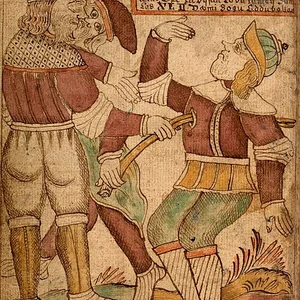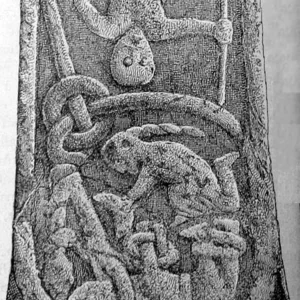

The trickster god of Norse mythology, Loki is an ambivalent deity capable of shapeshifting. A figure of chaos and transgression, he plays a crucial role in the stories of the end of the world (Ragnarök), where he fights against the Aesir alongside the giants.
Frequently asked questions
Key Facts
- Loki is one of the three children of Farbauti, a giant, in Norse mythology
- He embodies chaos and transformation, capable of changing his form and sex depending on the story
- Responsible for the death of the god Baldr by placing mistletoe in the hands of the blind god Höðr
- Bound beneath the earth after the murder of Baldr, with a serpent whose venom drips onto his face
- A major figure in the end of the world (Ragnarök): he breaks his chains and fights against the Aesir alongside the giants
Works & Achievements
According to the Prose Edda, Loki helps Odin steal the mead of poetry guarded by the giant Suttungr. This quest explains the origin of poetic power and divine inspiration in Norse mythology.
Loki indirectly causes the death of the most beautiful of the Aesir by guiding the blind god Höðr to throw a branch of mistletoe. This act sets off a chain of catastrophic consequences leading to Ragnarök.
After the death of Baldr, the Aesir capture Loki and punish him by binding him underground with the entrails of a serpent that drips venom on him. This imprisonment holds him immobile until the day of Ragnarök.
Loki plays a central role in Norse eschatology, breaking free and leading the forces of chaos and the giants against the Aesir during the end of the world. This cosmic conflict represents the eternal cycle of destruction and renewal.
Loki is the father or progenitor of the major chaotic creatures: the wolf Fenrir, the serpent Jörmungandr, and the goddess Hel. These beings play essential destructive roles in the eschatological narratives.
Loki transforms into a salmon, a fly, a woman, and various other forms to carry out his deceptive schemes. These shapeshifting abilities make him the quintessential trickster of Norse mythology.
Anecdotes
Loki transforms into a salmon to escape the Aesir who are pursuing him. According to the Prose Edda, the gods captured him using a magical net, which is said to explain why salmon have markings resembling the mesh of a net. This story illustrates Loki's shapeshifting power and his cunning nature.
Loki brings about the death of Baldr, the most beautiful and beloved of the gods. He tricks the blind god Höðr into throwing a branch of mistletoe at Baldr, which kills the young god. This act marks the beginning of the Aesir's downfall and brings the world closer to Ragnarök, the end of times.
As punishment for his crimes, Loki is chained underground with a venomous serpent hanging above his head. The snake's venom drips onto Loki's face, causing him terrible suffering. According to Norse mythology, he will remain chained there until Ragnarök, when he will break free to fight against the gods.
Loki fathers his own monstrous offspring: he is the parent of the wolf Fenrir, the world serpent Jörmungandr, and Hel, the goddess of the realm of the dead. These creatures will play crucial roles during Ragnarök, fighting alongside Loki against the Aesir and the giants.
Loki and Heimdall, the guardian of the rainbow bridge Bifrost, face each other at the end of times during Ragnarök. Their two existences are bound by a deep and ancient enmity, and in the final battle, they slay each other, symbolizing the complete destruction of the old world according to Norse mythology.
Primary Sources
Loki will break free from his chains, and the wolf Fenrir will break free as well. The world serpent will rise from the seas. That is when the ship Naglfar will slip its moorings, with the giant Surtr at its prow, sailing toward the north.
Loki is the son of the giant Fárbauti and the giantess Laufey. He is pleasing to look at, but of evil disposition and very changeable in mood. He had a particular talent for deception and was gifted in all manner of cunning schemes.
Loki fathered the wolf Fenrir with the giantess Angrboða. He also fathered the world serpent Jörmungandr and the goddess Hel. Fenrir grew so fast and became so enormous that his jaws stretched from earth to sky.
Loki entered the feast of the Æsir and began insulting the gods, laying bare their weaknesses and hidden wrongdoings, and provoking the fury of the assembled gods.
Key Places
The realm of the Aesir where Loki resides among the Norse gods. It is the main setting for his schemes and conflicts with the other deities, particularly Thor and Odin.
The realm of fire where Loki is destined to lead the forces of chaos during Ragnarök. It is from this place that the fire giants and Surtr emerge to battle the Aesir.
The world of the giants where Loki maintains ambiguous ties. He visits regularly and there fathers several of his monstrous children, including the wolf Fenrir and the serpent Jörmungandr.
The world of humans where Loki appears in several Norse legends. It is also the final battlefield of Ragnarök, where his forces invade the mortal realm.
The primordial world of cold and mist where Loki is chained as punishment following the death of Baldr. It is the place of his imprisonment until Ragnarök.
Typical Objects
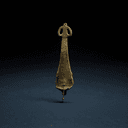
A magical chain forged by dwarves in Norse mythology, used to bind Loki until Ragnarök. This chain symbolizes the trickster god's captivity and the consequences of his actions.

A magical attribute allowing Loki to shapeshift into various creatures (salmon, seal, fly). This object embodies the shapeshifting power that is one of the god's defining characteristics.

A weapon typical of ancient Norse warriors, engraved with runes. Loki, as a god of cunning and transgression, is associated with the weapons wielded by the Aesir and the giants alike.

Ritual drinking vessel used at Norse feasts (among the skalds). Despite his ambiguous status, Loki takes part in the Aesir's banquets — a symbol of his complex belonging to this divine community.

A protective object engraved with runes, typical of medieval Scandinavian folk magic. It represents the magical and occult arts associated with the figure of Loki.

An everyday Norse tool tied to the legend in which Loki transforms into a salmon and invents the fishing net. This object symbolizes his role as a clever inventor and creator.

A prestigious ornament worn by Norse deities and warriors. Despite his chaotic nature, Loki remains a god among the Aesir and shares their insignia of power.

The weapon that causes Baldr's death in Norse mythology, often linked to Loki's malice and schemes. This object symbolizes the tragedies brought about by the trickster god.
School Curriculum
Vocabulary & Tags
Key Vocabulary
Daily Life
Morning
Loki wakes in Asgard, the realm of the Aesir. Unlike the major gods, he holds no stable status and must constantly navigate between acceptance and suspicion from the other deities. He begins his day plotting schemes or testing the limits of the other gods, often through tricks and cunning.
Afternoon
Loki spends his afternoons moving between the worlds: Asgard, Midgard, and the underrealms. He frequently transforms into animals — salmon, fly, seal — to carry out his plans or escape the consequences of his actions. He interacts with mythological creatures and other supernatural beings, taking part in the great cosmic intrigues.
Evening
In the evening, Loki joins the gods' feasts in Asgard or retreats into the shadows depending on his standing at the time. He tells stories, stirs up debates, or lays the groundwork for his next schemes. His presence is both sought after and dreaded — he brings entertainment, but also danger and disruption.
Food
As a Norse deity, Loki consumes the divine fare typical of the gods: mead (the drink of the gods), game meat, fish (especially salmon, which he can become in animal form), and the miraculous food of Asgard's banquets. His diet transcends ordinary human needs.
Clothing
Loki wears the garments of the Aesir: fine tunics and cloaks befitting Norse deities. His appearance is shifting and ambiguous, reflecting his nature as a shapeshifter. He is often described with seductive yet unsettling features, embodying deceptive beauty and transgression.
Housing
Loki officially resides in Asgard among the other gods, though his position there is marginal and unstable. He has no permanent dwelling to compare with those of Odin or Thor, reflecting his role as an outsider and disruptor. After his binding (as told in the mythological narratives), he is confined beneath the earth with a venomous serpent, far removed from the world of the gods.
Historical Timeline
Period Vocabulary
Visual Style
Un style mêlant l'esthétique des manuscrits vikings et scandinaves médiévaux avec une atmosphère sombre et chaotique. Les illustrations combinent les motifs entrelacés nordiques, les symboles runiques et une énergie métamorphique, évoquant le caractère fripon et transggressif de Loki à travers des contrastes d'éclairage dramatiques entre les tons chauds et froids.
Sound Ambience
Une ambiance sonore sombre et déstabilisante mêlant éléments naturels nordiques (vent, tonnerre, feu) et instruments traditionnels scandinaves distordus, évoquant le caractère ambigu et chaotique du dieu fripon Loki, entre séduction trompeuse et menace destructrice.
Liens externes & ressources
Références
Œuvres
Le vol du miel de poésie
inconnue
La mort de Baldr
inconnue
La capture et l'emprisonnement de Loki
inconnue
Le Ragnarök
inconnue
La paternité des monstres
inconnue
Diverses métamorphoses et tromperies
inconnue