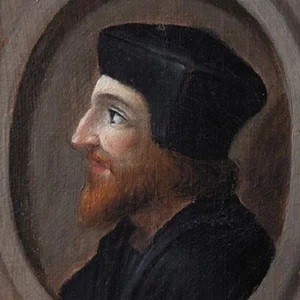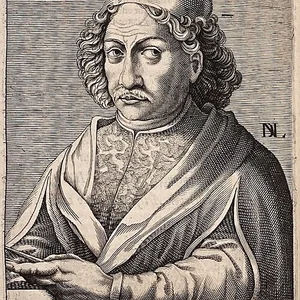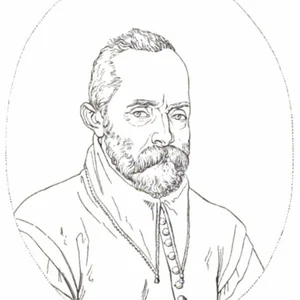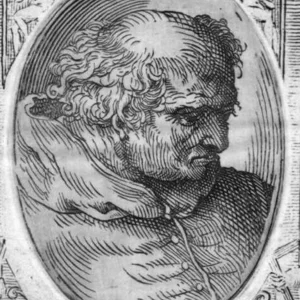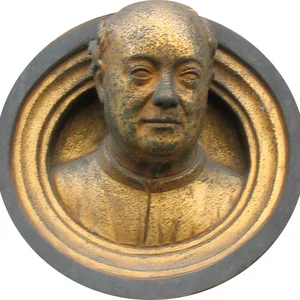

Florentine goldsmith and sculptor (1378–1455), Ghiberti is renowned for creating the bronze doors of the Florence Baptistery, including the Gates of Paradise, a masterpiece of Renaissance sculpture.
Lorenzo Ghiberti(1378 — 1455)
Lorenzo di Clone Ghiberti
République florentine
9 min read
Frequently asked questions
Key Facts
- 1401: wins the competition for the north doors of the Florence Baptistery, defeating Brunelleschi
- 1403–1424: creation of the north doors of the Florence Baptistery (28 panels)
- 1425–1452: creation of the Gates of Paradise (east doors of the Baptistery), admired by Michelangelo
- Writes the *Commentarii*, the first art history treatise written by an artist
- Contributes to the spread of perspective and naturalism in Florentine sculpture
Works & Achievements
Bronze relief created for the Arte di Calimala competition; its dynamic composition and refined modeling earned him victory over Brunelleschi, and it is considered the first masterpiece of Renaissance sculpture.
A set of twenty-eight bronze panels depicting scenes from the New Testament and the Evangelists; the fruit of twenty-one years of collective work, they established Ghiberti as the most celebrated sculptor of his time.
The first large bronze statue cast in Florence since Antiquity, commissioned by the Arte di Calimala; it marks a decisive technical turning point in Florentine monumental sculpture.
A bronze statue commissioned by the bankers' guild (Arte del Cambio), depicting the evangelist in a posture of classical restraint that bears witness to Ghiberti's full artistic maturity.
An absolute masterpiece: ten large gilded bronze panels depicting the Old Testament with a mastery of illusionistic perspective that would influence sculptors of the Renaissance and all subsequent centuries.
A reliquary in silver and gilded bronze made for the convent of Santa Maria degli Angeli, demonstrating Ghiberti's goldsmithing skills beyond his large-scale architectural sculpture.
A treatise in three books devoted to the history of art from Antiquity, to optics, and to the author's autobiography; the first direct account by a Renaissance artist of his own practice and his era.
Anecdotes
In 1401, the merchants' guild of Florence organized a competition to decorate the north doors of the Baptistery of San Giovanni. Ghiberti, a young goldsmith in his twenties, faced seven competitors, including the talented Filippo Brunelleschi. After examining the panels depicting the sacrifice of Isaac, the jury named him the winner, praising the refinement of his modeling and the elegance of his narrative composition.
The construction of the north doors lasted twenty-one years, from 1403 to 1424. Ghiberti ran a large workshop where promising young artists came to train, among them Donatello, Paolo Uccello, and Michelozzo. These future masters of the Renaissance got their start chiseling and polishing the bronze reliefs under the exacting eye of their patron.
When the guild commissioned a second set of doors in 1425, Ghiberti was given far greater artistic freedom. He devised ten large rectangular panels depicting scenes from the Old Testament with striking perspectival depth. According to tradition, later recorded by Vasari, Michelangelo reportedly declared these doors “worthy of being the Gates of Paradise.”
Ghiberti was one of the first Italian artists to write his own autobiography. In his Commentarii, written toward the end of his life, he describes himself as a recognized genius of his time, lists his works, and analyzes the ancient masters he admired. This text is an invaluable source for understanding how a fifteenth-century artist conceived of his own place in the history of art.
To cast his monumental doors, Ghiberti had to overcome considerable technical challenges. The lost-wax technique, applied to panels of this size, required perfect mastery of the bronze alloy composition and casting temperature. Ghiberti personally supervised each stage of the casting to prevent air bubbles and flaws in the metal, ensuring the exceptional quality of every relief.
Primary Sources
A me solo fu dato l'onore di fare la porta di bronzo del detto tempio. A me fu conceduto la vittoria da tutti i periti e da tutti coloro che erano in questa gara con me.
Che Lorenzo di Cione Ghiberti faccia e compisca la porta del metallo del decto battistero con quelle storie, ornamenti e figure come parrà e piacerà agli operai della detta Opera di San Giovanni.
La scultura e la pittura sono scienzie di molte discipline e di varii ammaestramenti adorne, delle quali è ornamento il principale disegno: e senza questo niuno è pittore né scultore eccellente.
Io Lorenzo di Bartolo detto Ghiberti fo bottega d'orafo in Firenze e ò contratto colla Arte di Calimala di fare le porte di bronzo del battistero di San Giovanni.
Key Places
An 11th-century Romanesque building dedicated to Saint John the Baptist, for which Ghiberti created two pairs of bronze doors (the North Doors, 1403–1424, and the Gates of Paradise, 1425–1452) that brought him worldwide renown.
A former grain market converted into a church, for which Ghiberti sculpted bronze statues of Saint John the Baptist, Saint Matthew, and Saint Stephen, commissioned by the major Florentine guilds.
A large workshop where Ghiberti led a team of around twenty specialized craftsmen for more than fifty years; the heart of his entire sculptural output and the training ground for Donatello, Uccello, and Michelozzo.
Ghiberti traveled to Rome to study ancient sculptures and monuments — a humanist pursuit that enriched his figurative language and drove him to move beyond Gothic conventions in his reliefs.
The Tuscan city-state where Ghiberti was born, lived, and died; the cradle of the Italian Renaissance under the patronage of the Medici and the great merchant guilds who commissioned his major works.
Typical Objects

Bronze plaque cast using the lost-wax technique, depicting a narrative scene in bas-relief; each panel of the Gates of Paradise weighs several dozen kilograms and measures approximately 80 cm on each side.

Hardened steel-tipped tool used to chisel and refine metal details once the bronze has cooled and been removed from the mold; inherited from Ghiberti's training as a goldsmith, it enables exceptionally fine detailing.

Intermediate maquette sculpted in beeswax, used to verify the composition and proportions before the final bronze cast; an indispensable step in the production process.

Collection of preparatory drawings on parchment or paper kept in the workshop to record compositions, figure studies, and observations of antique sculptures seen in Rome.

Refractory clay vessel capable of withstanding temperatures above 1,000 °C, in which bronze is melted before being poured into the mold; a central instrument of Ghiberti's foundry.

Document kept by the Arte di Calimala recording payments made to Ghiberti and his assistants, making it possible to track the progress of the commission and reconstruct its history.
School Curriculum
Vocabulary & Tags
Key Vocabulary
Daily Life
Morning
Ghiberti rises early and reaches his workshop at dawn, like any Florentine craftsman. He begins by reviewing the previous day's work, assigns tasks to his assistants, and sketches compositions or sculpting details on parchment. The day opens with the most delicate operations — drawing, wax modeling — which require the natural light of morning.
Afternoon
The afternoon is devoted to overseeing the casting, chiseling the cooled panels, and meeting with representatives of the Arte di Calimala who fund the project. Ghiberti inspects each relief with care, identifies imperfections, and instructs the chiselers on the retouches to be made. He may also receive other patrons or welcome visiting artists to his workshop.
Evening
In the evening, after closing the workshop, Ghiberti turns to reading and writing. He pores over treatises on optics — notably those of Alhazen, whose ideas he draws on in his Commentarii — and records his reflections on ancient and contemporary art. Exchanges with humanists and cultivated merchants nourish his thinking on the artist's place in the city.
Food
The table of a prosperous Florentine craftsman is modest but varied: wheat bread, beans, seasonal vegetables, sheep's cheese, and pork or poultry on ordinary days. Chianti wine, diluted with water, accompanies every meal. On religious feast days, the meals are more generous, featuring roasted meats and pastries made with honey and spices.
Clothing
At work, Ghiberti wears a short thick woolen coat and a leather apron to protect himself from splashes of molten metal and bronze shavings. Outside the workshop, he dons a long, good-quality robe and a cloth cap — marks of his standing as a recognized master craftsman. His growing prosperity allows him a quiet elegance befitting his rank within the guild.
Housing
Ghiberti lives in a multi-story stone house in the San Giovanni quarter, close to the baptistery. The ground-floor rooms serve as storage and as a reception space for visitors and patrons. Upstairs, the soberly furnished rooms — a bed, a walnut chest, a few precious objects — attest to the comfortable means of a master craftsman at the height of his career.
Historical Timeline
Period Vocabulary
Liens externes & ressources
Références
Œuvres
Portes nord du baptistère de Florence
1403-1424
Saint Matthieu (Orsanmichele)
1419-1423
Portes du Paradis (portes est du baptistère de Florence)
1425-1452
I Commentarii
vers 1447-1455