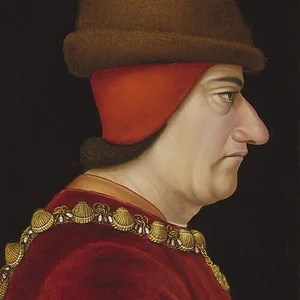

King of France from 1461 to 1483, nicknamed “the Prudent” or “the Universal Spider.” Son of Charles VII, he consolidated royal power by weakening the great nobility, notably Charles the Bold, Duke of Burgundy, and considerably expanded the territory of the kingdom.
Louis XI(1423 — 1483)
Louis XI of France
France
6 min read
Frequently asked questions
Famous Quotes
« He who knows not how to dissemble knows not how to reign.»
Key Facts
- Becomes King of France in 1461 upon the death of his father Charles VII
- Confronts the League of the Public Weal, a coalition of great lords, in 1465
- The episode of the meeting at Péronne in 1468, where he is held by Charles the Bold
- Death of Charles the Bold at Nancy in 1477, allowing part of Burgundy to be attached to the kingdom
- Recovers Anjou, Maine, Provence, and Bar-sur-Seine, expanding the royal domain until his death in 1483
Works & Achievements
Establishment of horse relays and mounted couriers to swiftly transmit royal orders and intelligence across the kingdom.
After the death of Charles the Bold, Louis XI recovered Burgundy and part of the Burgundian territories, greatly enlarging the royal domain.
Through the inheritance of King René, Louis XI annexed these territories to the crown, extending the kingdom all the way to the Mediterranean.
A diplomatic agreement that removed the threat of an English invasion through the payment of money, illustrating his preference for negotiation.
A multiplication of ordinances, control over the great feudal lords and reliance on the bourgeoisie to consolidate the central power of the monarchy.
Encouragement of fairs (notably in Lyon) and trade, along with an interest in developing silk manufacturing in France.
Anecdotes
Louis XI was superstitiously devout: he covered his hat with little lead medals depicting saints and the Virgin, and multiplied pilgrimages and offerings to win Heaven's protection. Toward the end of his life, terrified of death, he summoned the hermit Francis of Paola from Italy in the hope that he would prolong his days.
He is traditionally credited with developing the royal postal service in 1464: relays of horses spread along the kingdom's roads allowed messengers to carry the king's orders swiftly. This network mainly served the state and intelligence-gathering, for Louis XI loved being informed of everything.
An adversary of Charles the Bold, Duke of Burgundy, Louis XI preferred cunning and money to battle. It is said that he bought off his rival's advisers and allies; his patient diplomacy earned him the nickname “the universal spider”, weaving its web.
In 1468, Louis XI made the rash decision to go to Péronne to negotiate with Charles the Bold. At that very moment a revolt broke out in Liège that the king had encouraged: furious, the duke held Louis prisoner for several days and forced him to accompany him in crushing the rebellious city.
Distrustful and cruel toward his enemies, Louis XI is said to have shut certain opponents in narrow cages of iron or wood, the “fillettes”, sometimes for years. Cardinal Jean Balue, his former favorite turned traitor, is said to have been one of its most famous victims.
Primary Sources
He was by nature a friend to people of middling rank and an enemy to all the great lords who could do without him. No man ever lent so ready an ear to others, nor inquired into so many things as he did.
The king showered his servants with instructions, demanding to be kept informed “with all diligence” of the kingdom's affairs and the movements of his adversaries.
An account of the events of the reign by a Parisian contemporary, reporting in particular the revolts, the royal entries, and the tensions with Burgundy.
An agreement concluded between Louis XI and Edward IV of England, by which the English king renounced his expedition against France in exchange for a large sum and an annual pension.
Key Places
City where Louis XI was born in 1423, then the residence of his father Charles VII, who had taken refuge south of the Loire during the Hundred Years' War.
Louis XI's favorite residence near Tours, where he surrounded himself with guards and where he died in 1483. He lived there in seclusion and suspicion during his final years.
Cathedral where Louis XI was crowned King of France in 1461, following the tradition of the Capetian kings.
Town in Picardy where Louis XI was held prisoner by Charles the Bold during the meeting of 1468.
Place near Amiens where the treaty with Edward IV of England was concluded in 1475, putting an end to the English threat.
Typical Objects

Louis XI wore a hat adorned with small lead badges depicting saints and the Virgin. These pilgrimage medals attested to his piety and his quest for divine protection.

The wax seal authenticated the king's letters and ordinances. It gave material form to Louis XI's authority throughout the kingdom and gave his decisions the force of law.

Messages carried by the riders of the postal relays established during his reign. They made it possible to swiftly transmit royal orders and intelligence across the kingdom.

A narrow cage of wood ringed with iron, designed to confine certain prisoners for long periods. It symbolizes the king's severity and his distrust of his enemies.

Emblem of the French monarchy received at the coronation in Reims. It embodied the king's divine legitimacy and the continuity of the Capetian monarchy.

Administrative and legislative texts issued by the king to govern the kingdom. They strengthened central power and the unification of the administration.
School Curriculum
Vocabulary & Tags
Key Vocabulary
Daily Life
Morning
An early riser and tireless worker, Louis XI often began his day with Mass and his devotions, multiplying prayers and offerings to the saints. He then read letters and reports, for he wanted to be informed of the smallest matter in the kingdom.
Afternoon
The afternoon was devoted to governing: audiences, dictating letters, receiving merchants, ambassadors, or spies. He preferred to surround himself with men of modest birth, more obedient than the great lords.
Evening
In the evening, during his final years, the king lived withdrawn and fearful at Plessis-lès-Tours, surrounded by guards. He loved conversation, listened to the news, and dreaded plots as much as death itself.
Food
The royal table offered meats, game, fish, white bread, and wine, but Louis XI, mindful of his health especially toward the end, watched his diet carefully. Spices, a sign of wealth, seasoned the dishes of the powerful.
Clothing
Known for his modest, even shabby attire for a king, he often wore simple garments of grey cloth or coarse fabric, far from the ostentatious luxury of the great lords. His famous hat covered with lead medallions was his trademark.
Housing
The king resided in castles, especially Plessis-lès-Tours, which he had fortified and guarded by archers. Thick walls, moats, and guards reflected his constant distrust of his enemies.
Historical Timeline
Period Vocabulary
Liens externes & ressources
Références
Œuvres
Création de la poste royale
1464
Rattachement du duché de Bourgogne
1477
Acquisition de l'Anjou, du Maine et de la Provence
1480-1481
Traité de Picquigny
1475
Renforcement de l'administration royale
1461-1483
Soutien à l'essor économique
1461-1483