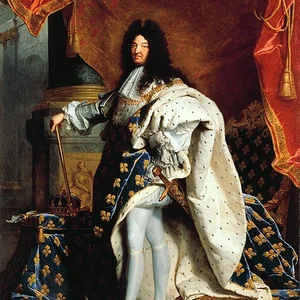

King of France and Navarre from 1643 to 1715, Louis XIV is the symbol of French royal absolutism. He concentrated power in his own hands and transformed the monarchy into a centralized political system, embodied by the Palace of Versailles, which he had built.
Louis XIV(1638 — 1715)
Louis XIV
royaume de France
8 min read
Frequently asked questions
Famous Quotes
« L'État, c'est moi»
« Nulla dies sine linea»
Key Facts
- 1643: Accession to the throne at the age of 5 following the death of Louis XIII
- 1661: Beginning of his personal reign after the death of Cardinal Mazarin
- 1682: Establishment of the royal court at the Palace of Versailles, symbol of absolute power
- 1685: Revocation of the Edict of Nantes, ending religious tolerance toward Protestants
- 1715: Death after 72 years of reign, the longest in French history
Works & Achievements
An architectural masterpiece combining the talents of Louis Le Vau, Jules Hardouin-Mansart, and André Le Nôtre, Versailles became the model of absolute monarchy and influenced European courts for a century.
Under the impetus of Colbert, Louis XIV developed royal manufactories to make France economically self-sufficient and export its luxury goods throughout Europe.
Louis XIV created this institution to support scientific and technical research in the service of the kingdom, embodying the royal patronage of the nascent Enlightenment.
These major legal ordinances reformed French civil and criminal procedure, unifying the law across the kingdom and laying the foundations of modern French law.
A major and controversial act of his reign, this edict ended the religious tolerance granted to Protestants in 1598, causing the exile of hundreds of thousands of Huguenots and weakening the French economy.
Written by Louis XIV himself for his son, these memoirs set out his conception of the craft of kingship, the state, and the exercise of absolute power.
The Canal du Midi, built by Pierre-Paul Riquet with royal support, linked the Atlantic to the Mediterranean and facilitated domestic trade, serving as a symbol of the kingdom's modernization.
Anecdotes
Louis XIV, nicknamed the 'Sun King', chose this star as his emblem because the sun illuminates and governs the entire universe. This symbol was adopted from his childhood, during a court ballet in 1653 where the young king himself danced the role of Apollo, god of the sun.
The king rose each morning according to a strictly codified ritual known as the 'lever du roi' (the king's rising). Dozens of courtiers would crowd in to witness his awakening, his washing, and his dressing, considering it a supreme honor. Holding the candlestick or presenting the royal shirt were highly coveted privileges.
Louis XIV was passionate about dance and practiced this art form, considered noble, with great dedication. In 1661, he founded the Académie royale de danse, thereby establishing the foundations of French classical ballet, and personally participated in numerous court ballets until the age of 32.
The construction of Versailles mobilized tens of thousands of workers for more than fifty years. It is estimated that more than 30,000 workers were employed simultaneously during certain periods, and that thousands lost their lives on the construction site, notably due to fevers contracted in the neighboring marshes.
Louis XIV almost never bathed, in keeping with the hygiene habits of his era, which considered water dangerous to one's health. He cleaned himself with alcohol-soaked cloths and used perfume in large quantities, which partly explains the reputation of French perfumery at Versailles.
Primary Sources
I have often been astonished that those fortunate enough to approach princes do not render them the service of telling them the truth. The interest of the State must come before everything.
Louis XIV was made to be king; his figure, his bearing, his natural gravity, his beauty, everything about him proclaimed the master. He had an admirable art of making himself loved and respected.
His Majesty, despite the fatigues of hunting and audiences, maintains robust health. His regimen, though copious, allows him to attend to all his royal obligations without respite.
I order you to ensure that the kingdom's manufactories produce fabrics of such quality that it shall no longer be necessary to seek in Flanders or England what France can produce herself.
We have by this present perpetual and irrevocable edict suppressed and revoked the edict of the king our grandfather given at Nantes in the month of April 1598 [...] and consequently desire that all the temples of said subjects of the so-called Reformed religion be forthwith demolished.
Key Places
Louis XIV's main residence from 1682, Versailles is the architectural symbol of absolutism. Its colossal construction was intended to impress European courts and keep the nobility away from Paris.
The royal Parisian residence before Versailles, Louis XIV lived there notably during the Fronde and had the eastern façade expanded (the Louvre Colonnade) before leaving Paris for good.
Louis XIV was consecrated King of France there on 7 June 1654, following Capetian tradition. The coronation conferred divine legitimacy upon him, making him God's lieutenant on earth.
Louis XIV's birthplace in 1638 and royal residence of his childhood. It was here that he lived through part of the Fronde with his mother Anne of Austria.
Founded under Louis XIV and directed by Charles Le Brun, it produced tapestries, furniture, and artworks glorifying the reign. It embodied the cultural prestige policy championed by Colbert.
Typical Objects

Louis XIV began wearing imposing wigs once he started losing his hair. The fashion he launched spread throughout Europe, making the wig a symbol of aristocracy and power in the 17th century.

A royal insignia presented during the coronation at Reims, the scepter symbolized the king's temporal authority. Louis XIV holds them in official portraits to assert his divine legitimacy.

Louis XIV popularized high-heeled shoes with red soles and heels, reserved for nobles admitted to court. This fashion affirmed the social superiority of the Versailles aristocracy over the rest of the population.

The sun was the personal emblem chosen by Louis XIV, depicted on the gilded gates of Versailles, tapestries, and royal medals. It symbolized a king dispensing light and blessings upon his kingdom.

Royal travel was conducted in richly adorned carriages, true symbols of power. The coronation carriage, entirely covered in gilding and sculptures, was visible from afar during official processions.

Louis XIV had thousands of medals struck recording his military victories and great works. These propaganda objects spread his image throughout Europe and ensured the lasting legacy of his deeds.
School Curriculum
Vocabulary & Tags
Key Vocabulary
Tags
Mouvement
Daily Life
Morning
Louis XIV rose each day at 8:30 AM according to an immutable ritual, the 'lever'. Senior officers and courtiers entered his bedchamber successively according to their rank to attend his toilette, hand him his shirt, or hold his dressing gown. This ritual lasted approximately one hour.
Afternoon
The afternoon was devoted to audiences, councils (Council of State, Council of Finances), and walks in the gardens of Versailles. Louis XIV hunted several times a week, an activity he pursued with passion well into old age despite his health problems.
Evening
Evenings at Versailles were marked by the 'Appartements', receptions held three times a week where the court gathered to play games, dance, and be entertained. Louis XIV attended in full majesty, observing the courtiers and granting a few words to those he wished to distinguish.
Food
Louis XIV ate with a legendary appetite, consuming multiple entrées, meats, game, and desserts at each meal. He dined alone in public (the 'Grand Couvert'), under the gaze of hundreds of standing courtiers, and was particularly fond of green peas, strawberries, and oysters.
Clothing
The king wore costumes embroidered with gold and silver, costly lace, and voluminous wigs. He changed outfits several times a day depending on the occasion — hunting dress, court attire, costume for balls — each garment serving as a political statement of power and refinement.
Housing
Louis XIV resided primarily at Versailles in sumptuous apartments dominated by the King's Bedchamber, the central room of the château placed on the east-west solar axis. He also stayed at Marly and Fontainebleau, but regarded Versailles as the heart of his power.
Historical Timeline
Period Vocabulary
Visual Style
Le style visuel de Louis XIV s'incarne dans le baroque versaillais : ors, marbres, symétrie parfaite et omniprésence du soleil comme symbole royal.
Sound Ambience
Les sons de Versailles mêlent musique baroque sophistiquée, bruits de cour feutrés et fastes des cérémonies royales, reflétant l'étiquette stricte imposée par Louis XIV.
Liens externes & ressources
Références
Œuvres
Construction du château et des jardins de Versailles
1661-1710
Création des grandes manufactures royales (Gobelins, Sèvres, Saint-Gobain)
à partir de 1665
Fondation de l'Académie française des sciences
1666
Code Louis (ordonnances civile et criminelle)
1667-1670
Édit de Fontainebleau (révocation de l'Édit de Nantes)
1685
Mémoires pour l'instruction du Dauphin
1661-1668
Agrandissement du réseau routier et du canal du Midi
1666-1681