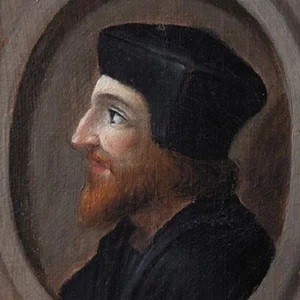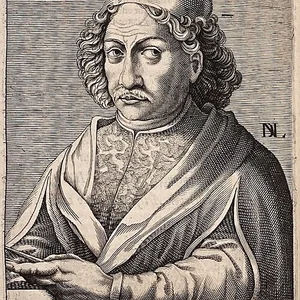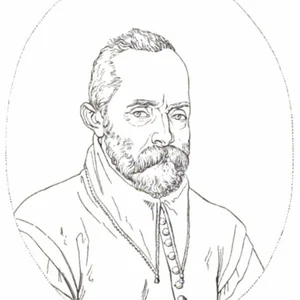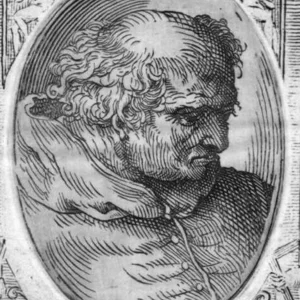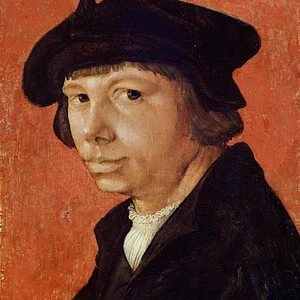

Dutch Renaissance painter and engraver (1494–1533), Lucas van Leyden is celebrated for the refinement of his copper and woodcut engravings. A contemporary of Dürer, he transformed the art of printmaking by introducing genre scenes and innovative perspective.
Lucas van Leyden(1494 — 1533)
Lucas van Leyden
Pays-Bas septentrionaux
8 min read
Frequently asked questions
Key Facts
- Born around 1494 in Leiden (Netherlands), he produced his first known engraving at approximately age 14 (1508)
- His engraving 'Mohammed and the Monk Sergius' (1508) reveals a precocious mastery and a curiosity for unusual subjects
- He met Albrecht Dürer during the latter's visit to the Netherlands in 1521, a landmark encounter between the two masters of engraving
- His triptych 'The Last Judgment' (c. 1526–1527, Leiden Museum) is regarded as his greatest painted work
- He died in 1533 in Leiden, leaving behind a body of more than 170 prints that had a lasting influence on European printmaking
Works & Achievements
One of his earliest known engravings, made when he was around fourteen years old. It shows a precocious mastery of intaglio technique and a taste for unusual narrative subjects.
A large-format copper engraving depicting the presentation of Christ to the crowd. Admired for the complexity of its composition and the variety of its figures, it is considered one of the masterpieces of Northern Renaissance printmaking.
A genre scene showing a peasant woman bringing her milk back to the village. This pioneering engraving illustrates Lucas's attention to everyday life — a remarkable novelty in the printmaking of his time.
A copper engraving drawn from the Old Testament, combining biblical drama with an elaborate landscape. It reveals the influence of Dürer while asserting Lucas's own personality in the treatment of figures.
A genre scene showing chess players gathered around a table, with a female observer in the background. This print illustrates Lucas's fondness for scenes of manners and the psychology of his characters.
A large oil painting on panel, now held at the Museum De Lakenhal in Leiden. It is Lucas's most ambitious painted work, demonstrating coloristic mastery and a monumental composition influenced by Michelangelo.
One of his last major paintings, preserved at the Hermitage Museum in Saint Petersburg. The luminous treatment and the gentleness of the faces anticipate the great achievements of Dutch painting in the following century.
Anecdotes
Lucas van Leyden is often described as a child prodigy: according to the biographer Karel van Mander, he reportedly made his first copper engravings around the age of nine. His early mastery of the burin astonished his contemporaries, who could scarcely believe that such a young boy could produce works of such refinement.
In 1521, Albrecht Dürer traveled through the Netherlands and met Lucas in Middelburg. In his travel journal, Dürer noted that he had exchanged prints with this engraver he admired, adding that Lucas was “small and sickly in appearance” but of extraordinary talent. This meeting between the two greatest engravers of their generation has remained famous in art history.
Lucas van Leyden was one of the first artists to introduce genre scenes into printmaking: peasant women, card players, and traveling merchants populate his prints at a time when art was dominated by religious subjects. This attention to everyday life foreshadows the great Flemish realism of the seventeenth century.
His fragile health forced him to slow his output in the final years of his life. According to Van Mander, at a banquet held in his honor in Middelburg in 1527 by local artists, Lucas fell so seriously ill that he had to be carried back to Leiden on a stretcher. He died six years later, at just 39, leaving behind a considerable body of work of more than 170 prints.
Primary Sources
I gave Lucas van Leyden one of my prints for a florin. He gave me one of his in exchange. He is small and slight, but his art is great.
Lucas van Leyden, painter and engraver, was so skilled with the burin from his earliest youth that his works surpassed in refinement and invention everything previously seen in the Netherlands.
Registration of Lucas Huighensz, known as Lucas van Leyden, as a master painter admitted to the painters' guild of the city of Leiden.
Key Places
Lucas van Leyden's birthplace and main home. It was in this commercial city in the Netherlands that he learned engraving, ran his workshop, and died in 1533.
The commercial and artistic capital of the Netherlands in the 16th century, where Lucas van Leyden travelled to sell his prints and build connections with other artists, including Albrecht Dürer during his 1521 journey.
A town in Zeeland where Lucas met Dürer in 1521. Local artists organised a banquet in his honour, during which he fell gravely ill.
A major Flemish city that Lucas is thought to have visited in the course of his professional travels; his altarpiece of the “Last Judgement” was made for Leiden, yet it reflects the artistic exchanges he maintained with Flanders.
Typical Objects

A steel tool with a sharp cutting point used to incise lines directly onto a copper plate. The burin is the emblematic instrument of the intaglio engraver, demanding precise mastery and wrist strength.

A polished metal surface on which the engraver incises a design in reverse. The copper plate allows hundreds of copies of the same composition to be printed, enabling the wide distribution of engraved images.

A roller-based machine that applies uniform pressure to the inked plate and damp paper to transfer the image. Its invention and spread in the 15th century revolutionized the production and trade of prints.

A wooden board on which the painter lays out and mixes pigments ground in linseed oil. Lucas van Leyden used costly pigments such as lapis lazuli for his oil paintings on panel.

A thick mixture of lampblack and linseed oil applied to the engraved plate before printing. The quality of the ink and its viscosity determine the sharpness and depth of the blacks in the finished print.

The standard support for Flemish and Netherlandish painting in the Renaissance, typically oak or walnut. Lucas van Leyden painted in oils on panel, a technique inherited from the great Flemish masters of the 15th century.
School Curriculum
Vocabulary & Tags
Key Vocabulary
Daily Life
Morning
Lucas van Leyden began his day early in his Leiden workshop, taking advantage of the morning's natural light for the most delicate work. He would polish his copper plates or prepare his pigments, assisted by one or two apprentices trained according to the customs of the painters' guild.
Afternoon
The afternoon was devoted to the actual work of engraving or painting. Engraving copper with a burin demanded intense concentration and a tense posture: Lucas often worked seated at a sturdy table, the plate held on a sand cushion that allowed it to be rotated without effort.
Evening
In the evening, Lucas examined by candlelight the proofs pulled during the day to correct the slightest imperfections. His fragile health sometimes forced him to stop early; according to Van Mander, he could also work lying down when his constitution would not allow him to remain seated. He attended guild meetings from time to time.
Food
The diet of a prosperous craftsman in the sixteenth-century Netherlands included rye or wheat bread, dried or smoked fish, boiled vegetables (cabbage, turnips, onions), and light beer as the everyday drink. On feast days, roasted meat and local cheese rounded out the meal.
Clothing
Lucas wore the dress of a bourgeois craftsman of Leiden: a linen shirt, a woolen cloth doublet, hose, and a short-brimmed hat. For work, he put on a leather or canvas apron to protect his clothes from inks and pigment oils.
Housing
Lucas lived and worked in a multi-storey brick townhouse typical of the architecture found in Dutch cloth-weaving cities. The main room served as a workshop, with large north-facing windows providing constant, diffuse light; engraved plates, tools, and ink trays shared the space with wooden panels being prepared for painting.
Historical Timeline
Period Vocabulary
Liens externes & ressources
Références
Œuvres
Mahomet et le moine Sergius
c. 1508
Ecce Homo
1510
La Laitière (De Melkmeid)
c. 1510
Lot et ses filles
c. 1509
Le Joueur d'échecs
c. 1508