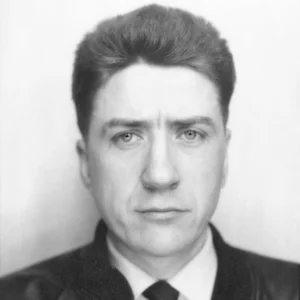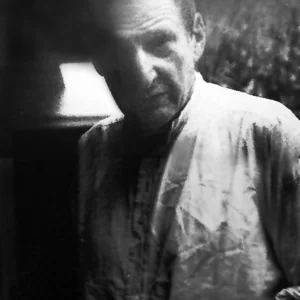

British painter and printmaker of German origin, grandson of Sigmund Freud. A major figure of 20th-century figurative painting, he is famous for his portraits and fleshy nudes of stark realism.
Lucian Freud(1922 — 2011)
Lucian Freud
Royaume-Uni, Allemagne
5 min read
Frequently asked questions
Famous Quotes
« I paint people not because of what they are like, not exactly in spite of what they are like, but how they happen to be.»
Key Facts
- Born in 1922 in Berlin, he emigrated to the United Kingdom in 1933 with his family to flee Nazism.
- Grandson of the founder of psychoanalysis, Sigmund Freud.
- A central figure of the “School of London” alongside Francis Bacon, with whom he was close.
- In 2001 he painted a portrait of Queen Elizabeth II.
- Died in 2011 in London; his painting “Benefits Supervisor Sleeping” broke sale records for a work by a living artist in 2008.
Works & Achievements
Portrait of his first wife, Kitty Garman, in a style still smooth and precise. An iconic work from his early manner.
A double portrait showing the artist standing and his second wife lying in bed, marking the shift to a denser, more tormented brushwork.
An unflinching self-portrait in which Freud scrutinizes his own aging face with the same rawness he applied to his sitters.
A monumental nude of Sue Tilley, a welfare officer, which in 2008 became the most expensive work ever sold at auction by a living artist.
A small, controversial official portrait of the monarch, unusually candid for a royal likeness.
A full-length nude self-portrait, brutally honest, in which Freud depicts himself palette and knife in hand.
Anecdotes
Lucian Freud was the grandson of Sigmund Freud, the famous founder of psychoanalysis. His Jewish family fled Nazi Germany in 1933, when Lucian was ten years old, to settle in London, where he would become one of the greatest British painters.
Freud painted with extreme slowness: his models had to pose for hundreds of hours, sometimes for more than a year for a single painting. He worked standing up, scrutinizing every centimeter of skin, and demanded a real physical presence, refusing to paint from photographs.
In 2008, his painting *Benefits Supervisor Sleeping*, depicting a nude, sleeping social services worker, sold at auction for more than 33 million dollars, a record at the time for a work by a living artist.
In 2001, Freud created an official portrait of Queen Elizabeth II. The small-format work, with its careworn face, sparked heated controversy in the British press because it broke so sharply with traditional flattering royal portraits.
Freud had a passion for horses and racing, and he sometimes lost large sums of money gambling. As a young man, he even worked in a stable, and animals often appear in his paintings, rendered with the same intensity as humans.
Primary Sources
“I want paint to work as flesh.” This was how Freud expressed his ambition to make the painted material the equivalent of the human body he was depicting.
Freud stated that he worked only from people he knew well, refusing anonymous professional models, because he sought to paint a particular presence and life.
The press hotly debated the royal portrait painted by Freud, deemed unusually candid, showing the sovereign’s face without any conventional flattery.
Key Places
Lucian Freud's birthplace, where he spent his early childhood in a cultured Jewish family before going into exile.
His adopted city, where Freud lived, painted, and worked for most of his life, and where he died in 2011.
The neighbourhood where Freud's studio was located, in which he painted many of his most famous portraits and nudes.
The art school run by Cedric Morris where the young Freud received a formative training in the 1930s and 1940s.
Where Freud represented Great Britain in 1954, an important milestone in his international recognition.
Typical Objects

Freud used stiff hog-bristle brushes that left a thick, heavily loaded paint surface. They allowed him to build up flesh through dense, sculpted strokes.

A very dense lead-white pigment that Freud favoured for rendering the pallor and thickness of skin. It gave his flesh a fleshy, heavy quality.

The support on which Freud set up his canvases, often very large ones. He worked standing, pacing back and forth between the easel and his model.

An engraving tool used by Freud, a renowned printmaker, to incise the metal plate directly. The drypoint gave his prints a velvety, nervous line.

Plain beds with worn, paint-stained sheets served as the setting for many of his nudes. Freud painted his studio exactly as it was, embellishing nothing.

Freud piled up mountains of rags on his walls for wiping his brushes, until they became a veritable sculpture of colour. His crusted palette bore witness to his slow, laboured way of painting.
School Curriculum
Vocabulary & Tags
Key Vocabulary
Tags
Daily Life
Morning
Freud had iron discipline and often worked from early in the morning in his London studio. He began his sittings with specific models, studying the daylight on their skin before picking up his brushes.
Afternoon
The afternoon stretched into long painting sessions, where he progressed with methodical slowness, stroke after stroke. He would sometimes pause to observe his subject for long minutes without painting.
Evening
In the evening, Freud sometimes painted other models, as he often worked on several pictures at once, some daytime, others nocturnal. He also frequented restaurants, friends, and London artistic circles.
Food
Known as a bon vivant, Freud enjoyed good restaurants and the company gathered around a table. He readily invited his models and friends to dine after the sittings.
Clothing
In the studio, he wore worn work clothes constantly smeared with paint, especially large scarves and stained shirts. In town, he could display a polished and eccentric elegance.
Housing
Freud lived and worked in cluttered London studios, their walls covered with rags and crusts of paint. The living setting, unmade beds and worn floors, often became the very subject of his paintings.
Historical Timeline
Period Vocabulary
Liens externes & ressources
Références
Œuvres
Girl with a White Dog (Jeune fille au chien blanc)
1950-1951
Hotel Bedroom
1954
Reflection (Self-portrait)
1985
Benefits Supervisor Sleeping
1995
Portrait de la reine Élisabeth II
2001
Painter Working, Reflection
1993