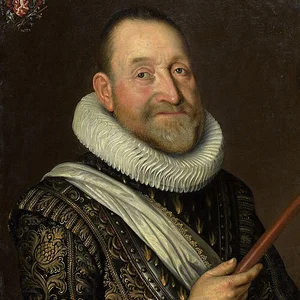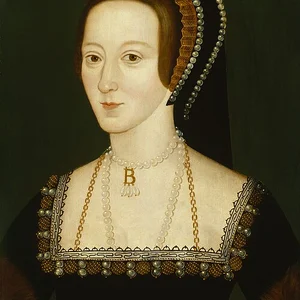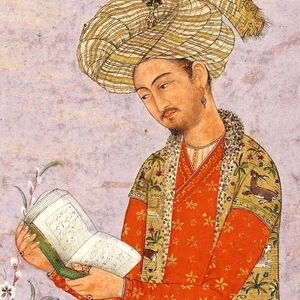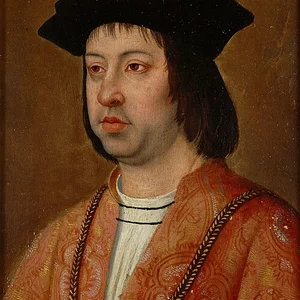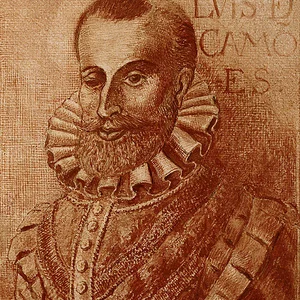

Luís de Camões (c. 1524–1580) is the greatest poet of the Portuguese language. A soldier and adventurer, he lived in Portugal, Africa, India, and Macau. His epic Os Lusíadas (1572) celebrates the Portuguese discoveries and remains a monument of world literature.
Luís de Camões(1524 — 1580)
Luís de Camões
royaume de Portugal
7 min read
Frequently asked questions
Famous Quotes
« Where the land ends and the sea begins.»
« O die, die curioso e impertinente! — O death, curious and impertinent death!»
Key Facts
- c. 1524: born in Lisbon or Coimbra
- 1552: imprisoned after a brawl in Lisbon
- 1553–1569: serves as a soldier in North Africa, India, and Southeast Asia
- 1572: publication of Os Lusíadas, Portugal's national epic
- 1580: dies in Lisbon, the year of the union of the Iberian crowns
Works & Achievements
An epic poem in ten cantos and 1,102 stanzas written in ottava rima, Os Lusíadas recounts Vasco da Gama's voyage to India (1497–1499) and celebrates the history of the Portuguese people. The absolute masterpiece of Portuguese-language literature, it is considered the Lusophone equivalent of Virgil's Aeneid.
A collection of lyric poems including sonnets, elegies, odes, and songs, published posthumously. The Rimas reveal a more intimate Camões — a man in love and tinged with melancholy — who was equally at home with Petrarchan forms and the medieval Portuguese lyric tradition.
One of the three plays attributed to Camões, inspired by an episode from ancient Greek history. It speaks to the breadth of the poet's literary talents, showing that he also tried his hand at comedy in the tradition of Gil Vicente.
A comedy mixing prose and verse, featuring noble characters alongside servants, representative of sixteenth-century Portuguese humanist theatre. The play was most likely performed in Goa before the Portuguese viceregal court.
Anecdotes
During the naval battle of Ceuta in 1547, Camões lost his right eye in combat. Far from breaking his spirit, this wound became a symbol of his life as an adventurer-poet, uniting the pen and the sword in a truly extraordinary existence.
In 1552, Camões was imprisoned in Lisbon after wounding a royal officer in a street brawl during the Corpus Christi festivities. He was pardoned by King John III after several months in prison, on the condition that he serve as a soldier in India — a turn of events that would radically change his life.
During his shipwreck in the Mekong Delta in 1559, Camões is said to have swum to shore holding the manuscript of the Lusiads above the water with outstretched arms, saving his masterwork at the risk of his own life. This heroic image has become legendary in Portugal.
Camões spent seventeen long years in the East — in India, Macau, and Mozambique — before returning to Portugal in 1570. When he finally published Os Lusíadas in 1572, he was so poor that he had to petition for a royal pension just to survive. He died in poverty in 1580, the very year Portugal lost its independence to Spain.
Primary Sources
As armas e os barões assinalados / Que da ocidental praia Lusitana / Por mares nunca de antes navegados / Passaram ainda além da Taprobana.
Amor é fogo que arde sem se ver; / É ferida que dói e não se sente; / É um contentamento descontente; / É dor que desatina sem doer.
Neste reino tão remoto e tão miserável me acho com saúde quebrada e fortuna mais que quebrada, sem ter quem me valha nem a quem recorrer.
Vós, tenro e novo ramo florescente / De uma árvore de Cristo mais amada / Que nenhuma nascida no Ocidente, / Cesário ou de outra qualquer coroa ornada.
Key Places
Capital of the Portuguese kingdom and heart of its maritime empire, Lisbon is the city where Camões was born, imprisoned, and died in poverty. The Tower of Belém, from which navigators set sail, is the symbol of the era he celebrated in his poetry.
A Portuguese enclave in Morocco where Camões served as a soldier and lost his right eye in a naval battle in 1547. This formative military experience fed directly into his epic poetry.
Capital of the Portuguese empire in the East, Goa was the center of Camões's life during his years in Asia. It was here that he was tried and convicted of misconduct before being pardoned.
A Portuguese trading post in the Far East where Camões was appointed administrator of estates around 1556. According to tradition, it was in this city that he completed the writing of Os Lusíadas.
A strategic stopover on the maritime route to India, where Camões stayed on his return from the East and wrote part of his correspondence. The island served as a relay point for Portuguese fleets sailing between Europe and Asia.
Typical Objects

The universal writing tool of the Renaissance, Camões composed his verses on parchment or paper, even during military campaigns. Legend has it that he drafted sonnets during moments of rest between battles.

The weapon of the 16th-century Portuguese infantry, Camões carried it as a soldier of the Crown. It symbolizes his dual identity as poet and warrior, captured in the Portuguese expression «a espada e a pena» (the sword and the pen).

A navigation instrument used by Portuguese sailors to determine latitude at sea. Camões describes seafaring techniques with great precision in Os Lusíadas, reflecting his firsthand familiarity with life aboard ship.

A nautical chart depicting coastlines and maritime routes, indispensable to Portuguese navigators. Camões studied many such charts during his voyages between Portugal, Morocco, India, and Macao.

A stringed instrument widely associated with the lyric poetry of the Portuguese Renaissance. Camões was also a musician, and his poems were often set to music to be sung at court.

Having lost his eye at the Battle of Ceuta in 1547, Camões wore an eye patch for the rest of his life. This distinctive feature appears in virtually all posthumous portraits of the poet.
School Curriculum
Vocabulary & Tags
Key Vocabulary
Daily Life
Morning
In Goa or Macau, Camões rose early, before the oppressive tropical heat set in. He devoted the first hours of the day to writing — rereading and revising his stanzas by the morning light, before administrative or military duties claimed his attention.
Afternoon
Afternoons were often taken up by his duties as a soldier or colonial officer — inspecting troops, settling disputes between merchants, drafting reports for the Crown. In his free moments, he would seek out scholars and humanists passing through the Portuguese trading posts of the East.
Evening
In the evenings, Camões joined his companions in taverns or noble households to recite verse, play the lute, and debate philosophy and poetry. It was often late at night, by candlelight, that he wrote his most intimate sonnets — steeped in longing and impossible love.
Food
In Portugal, his diet consisted of bread, dried pulses (chickpeas, broad beans), salted fish (bacalhau), and local wine. In the East, he adapted to local cuisines — rice, spices, tropical fruits — depending on what provisions were available at the Portuguese trading posts in India and China.
Clothing
As a soldier, Camões wore the dark doublet (gibão) and wool breeches of the Portuguese infantry, along with a morion helmet in combat. On formal occasions, he dressed in more refined court attire, befitting his status as a poet connected to Lisbon's literary circles.
Housing
In Portugal, Camões lived in modest lodgings in Lisbon, often as a guest of patrons or staying in boarding houses. In the East, he occupied quarters reserved for colonial officers in Portuguese fortresses at Goa or the trading posts of Macau — functional but sparse accommodations, far removed from the comforts of home.
Historical Timeline
Period Vocabulary
Visual Style
Style pictural de la Renaissance portugaise à la croisée de la peinture flamande et de l'art manuélin, avec des couleurs chaudes dorées, des bleus océaniques profonds et des décors d'épopée maritime.
Sound Ambience
Ambiance sonore d'un port portugais du XVIe siècle mêlant les bruits de la mer, des navires et d'une foule cosmopolite, ponctuée de musique de luth et d'échos de combats navals.
Liens externes & ressources
Références
Œuvres
Os Lusíadas
1572
Rimas — Sonnets
c. 1550-1580 (publiés en 1595)
El-Rei Seleuco (comédie)
c. 1540
Filodemo (comédie)
c. 1555