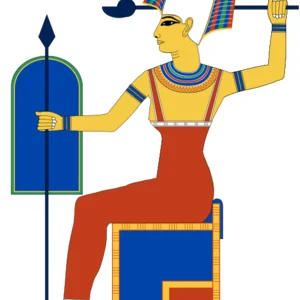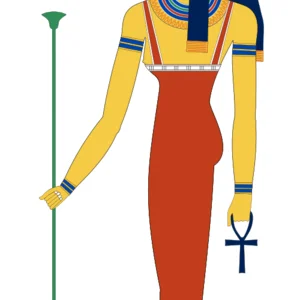

Egyptian goddess of justice, truth, and cosmic order, Maat is a central figure in the religion and moral thought of ancient Egypt. Depicted with an ostrich feather on her head, she embodies the universal principle of balance and harmony that governs the cosmos, society, and the afterlife.
Maat
Maat
8 min read
Frequently asked questions
Famous Quotes
« "I have not committed iniquity. I have not stolen. I have not killed." (From the Negative Confession in the Book of the Dead, spoken before Maat, c. 1550 BCE)»
Key Facts
- Maat is attested as early as the Egyptian Old Kingdom (c. 2700 BCE) in the Pyramid Texts, making her one of the oldest known abstract deities.
- Her name refers both to the goddess herself and to the fundamental philosophical concept of order, truth, and justice that underpins Egyptian civilization.
- In the scene of the 'judgment of the dead' (psychostasia), described in the Book of the Dead (c. 1550 BCE), the heart of the deceased is weighed on a scale against the feather of Maat.
- The pharaoh was considered the guardian of Maat on earth: his primary role was to uphold cosmic and social order in her name.
- Maat is the daughter of Ra, the sun god, reflecting her connection to light, truth, and the divine origin of universal order in Egyptian religious tradition.
Works & Achievements
A collection of funerary spells whose Chapter 125 is entirely devoted to the Judgment of Maat. This foundational text reveals the moral and religious thought of ancient Egypt on divine justice.
The oldest religious texts in the world, carved inside the pyramids of Saqqara. They attest, as early as the Old Kingdom, to the central role of Maat in Egyptian royal and cosmic ideology.
A democratized extension of the Pyramid Texts, painted on the inside of coffins belonging to nobles and wealthy citizens. Maat is invoked here as the guarantor of resurrection.
A wisdom text attributed to the vizier Ptahhotep during the Old Kingdom, considered one of humanity's earliest philosophical works. It presents Maat as the guiding principle of a just and balanced life.
A literary tale from the Middle Kingdom in which a peasant unjustly stripped of his possessions pleads his case nine times before a high royal official. This text offers a concrete illustration of Maat as an ideal of social justice.
At Dendera, Edfu, and Philae, Maat is depicted alongside Greek deities in a religious syncretism. These images bear witness to the exceptional longevity of her cult across more than three millennia.
Anecdotes
During the judgment of the dead, known as the 'weighing of the soul,' the deceased's heart was placed on one side of a scale opposite the feather of Ma'at. If the heart was as light as the feather, the deceased entered the paradise of the Field of Reeds (Aaru). If it was heavier, weighed down by sins committed, the monster Ammit would instantly devour it.
The pharaoh had the sacred mission to 'do Ma'at' — that is, to maintain cosmic order, justice, and harmony on earth. At every religious ceremony, he would symbolically offer a small statuette of Ma'at to the gods to signify that he was properly fulfilling his divine duty.
Ma'at had no temple of her own in the classical sense — she was everywhere. Her principle was inscribed on the walls of every temple in Egypt. She appears in judgment scenes on funerary papyri, painted or carved alongside Thoth, god of writing and wisdom.
Egyptian judges and magistrates sometimes wore a small image of Ma'at around their neck as a symbol of their office. To administer justice was literally to 'speak Ma'at' — an expression meaning to tell the truth and act with fairness.
The Negative Confession, a famous text from the Book of the Dead, lists 42 faults that the deceased had to deny before 42 divine judges, each associated with a province of Egypt. This ritual showed that Ma'at was not merely an abstract goddess, but a very concrete moral code of conduct for ordinary Egyptians.
Primary Sources
"I have not committed iniquity against men. I have not mistreated animals. I have not done evil in the place of justice."
"Maat is great and its effectiveness endures. It has not been disturbed since the time of Osiris."
"The king lives by Maat, he is nourished by Maat, Maat is his bread, Maat is his beer."
"Do not move the boundary stones at the edges of fields, do not shift the surveyor's rope. Do not be greedy for additional land by encroaching on the boundaries of a widow."
Iconic depiction of the Weighing of the Heart scene before Osiris, with Thoth recording the result and Maat symbolized by her feather on the scales.
Key Places
A grand religious complex where Maat was venerated alongside Amun and the great deities of the pantheon. Many scenes depicting the pharaoh offering Maat are carved on its walls.
A mythological subterranean realm where the Weighing of the Heart took place in the presence of Osiris, Thoth, and the 42 divine judges. Maat presided over the scales, her feather serving as the standard of truth.
Site of the oldest pyramids and the earliest Pyramid Texts, in which Maat is mentioned. This place bears witness to the antiquity of her cult as far back as the Old Kingdom.
The village of the craftsmen who built the royal tombs, where a small temple was dedicated to Maat and Hathor. The artisans paid homage to the goddess here before beginning their sacred work.
The holy city of Osiris, god of the dead and supreme judge alongside Maat. This was the site of the great Egyptian funerary mysteries, where divine justice was celebrated with the utmost solemnity.
Liens externes & ressources
Références
Œuvres
Le Livre des Morts (Pert em Heru)
Vers 1550 av. J.-C. (Nouvel Empire)
Les Textes des Pyramides
Vers 2400 av. J.-C.
Les Textes des Sarcophages
Vers 2055–1650 av. J.-C.
L'Enseignement de Ptahhotep
Vers 2400 av. J.-C.
Le Conte de l'Oasien éloquent
Vers 2100 av. J.-C.
Représentations iconographiques dans les temples ptolémaïques
305–30 av. J.-C.