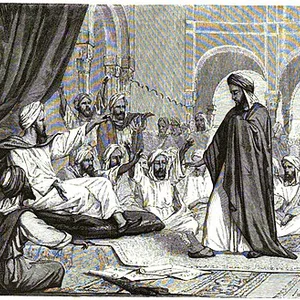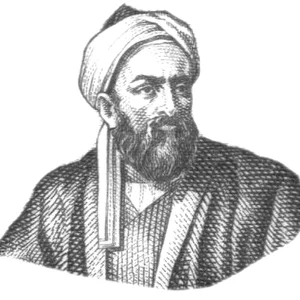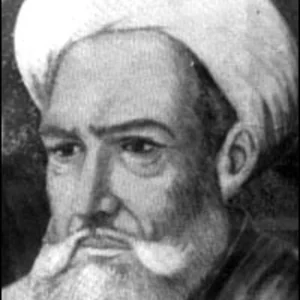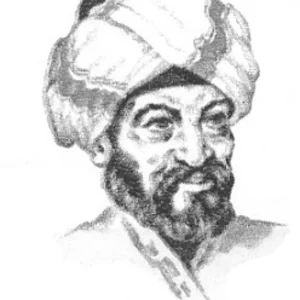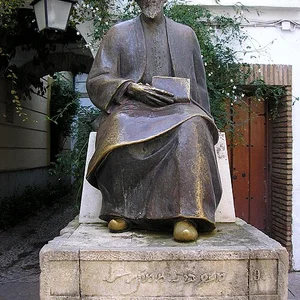

A 12th-century Jewish philosopher, theologian, and physician, Maimonides is one of the greatest figures of medieval Jewish thought. Born in Al-Andalus and settled in Egypt, he synthesized Aristotelian philosophy with rabbinical theology in his major work, the Guide for the Perplexed.
Frequently asked questions
Key Facts
- 1135: Born in Córdoba, Al-Andalus, into a family of jurists and physicians
- 1165: Settled in Cairo and became physician at the court of Sultan Saladin
- 1190: Wrote the Guide for the Perplexed (Moreh Nevukhim), a foundational work reconciling reason and faith
- 1168–1180: Completed the Mishneh Torah, a systematic codification of rabbinical Jewish law
- 1204: Died in Cairo, leaving a major influence on both Christian and Jewish theology
Works & Achievements
Written in Judeo-Arabic, this systematic commentary on the Mishnah made Jewish oral law accessible to a wide audience. It contains the famous Thirteen Principles of Faith, a summary of the doctrinal foundations of Judaism.
A fourteen-volume legal code written in clear Hebrew, covering the entirety of Jewish law in a systematic manner. A masterpiece of rabbinic codification, it remains to this day a fundamental reference in halakhic law.
A major philosophical work written in Judeo-Arabic, it reconciles Aristotelian philosophy (as transmitted by Averroes and Al-Farabi) with Jewish theology. Translated into Hebrew and then into Latin, the book profoundly influenced Thomas Aquinas and the entire medieval scholastic tradition.
A pastoral letter addressed to the Jewish communities of Yemen facing persecution and dangerous messianic movements. It bears witness to Maimonides' moral authority and his international reach.
A response to accusations from those who charged him with neglecting the dogma of bodily resurrection in his Guide. Maimonides clarifies his thinking and defends the compatibility between philosophical reason and traditional faith.
One of his ten medical treatises, written at the request of an Ayyubid prince suffering from respiratory difficulties. He advocates a holistic approach combining healthy lifestyle habits, proper diet, and natural remedies.
An ethical treatise integrated into his Commentary on the Mishnah, inspired by Aristotelian moral philosophy. Maimonides sets out his doctrine of the golden mean and the conditions for the perfection of the human soul.
Anecdotes
When Maimonides was only thirteen years old, Córdoba was conquered by the Almohads, a Berber dynasty that imposed Islam by force. His family, refusing forced conversion, had to flee and wander for several years across Andalusia, the Maghreb, and the Holy Land, before finally settling in Cairo. This experience of uprooting profoundly shaped his thinking on tolerance and the pursuit of truth.
Having become physician to Sultan Saladin and his court in Cairo, Maimonides was so much in demand that he himself described in a letter his overwhelming schedule: he would return home exhausted after an entire day at the palace, only to find his waiting rooms still packed with patients awaiting his consultation until evening. His medical reputation was such that King Richard the Lionheart of England reportedly offered to make him his personal physician, an offer he declined.
Maimonides wrote his major philosophical work, the Guide for the Perplexed, in Judeo-Arabic rather than Hebrew, so that his ideas would reach the widest possible readership of educated people of his time. He deliberately embedded apparent contradictions throughout the text so that only readers capable of genuine reflection could grasp its deeper meaning, thereby filtering superficial minds from sincere thinkers.
At his death in 1204, grief was so great that Jewish and Muslim communities together observed three days of mourning in Egypt and the Holy Land. According to tradition, his body was transported from Cairo to Tiberias, in Galilee, to be buried there. His tomb remains to this day a pilgrimage site visited by believers from all three Abrahamic religions.
Maimonides formulated his famous 'Thirteen Principles of Faith', a summary of the foundations of Judaism that became an essential reference. Yet his works sparked fierce controversy among the rabbis of Europe: some deemed them too philosophical and dangerously close to Greek thought. In the years following his death, Jewish communities in France went so far as to burn his books, only to bitterly regret it afterward.
Primary Sources
The object of this treatise is to enlighten a religious man who has been trained to believe in the truth of our Law, whose soul is upright, and whose intelligence has been sharpened by the philosophical sciences.
I saw the need to compose a work gathering all the oral laws, the ordinances, the customs and the decrees instituted from Moses to the compilation of the Talmud, so that all men might know them clearly.
Know, my brethren, that the great and terrible trial you are enduring has no equivalent in the history of Israel since the time of the Dispersion. Be steadfast and courageous for the name of God.
Change of air is the simplest and most effective remedy for diseases of the lungs. If you wish to heal, flee the smoky cities and their miasmas, and seek the pure air of the heights.
When you were with me, I had decided not to expound these questions to you orally, for fear that they might fall into the hands of unworthy persons. It is now that you are far away that I write you this book.
Key Places
Maimonides' birthplace, Córdoba was in the 12th century one of the greatest intellectual centers of the Mediterranean world, where Jewish, Arab, and Christian cultures coexisted. The Almohad conquest of 1148 brought this golden age to an end and forced his family into exile.
Maimonides' family spent several years in Fez, then a major intellectual metropolis of the Maghreb. It was there that the young Maimonides deepened his knowledge of medicine, astronomy, and Arabo-Greek philosophy.
Maimonides settled permanently in Fustat around 1166 and spent the rest of his life there. It was in this cosmopolitan city, the economic and intellectual capital of Fatimid and then Ayyubid Egypt, that he wrote nearly all of his major works.
According to tradition, Maimonides' body was transported from Egypt to Tiberias, on the shore of the Sea of Galilee, to be buried there. His tomb has since been a major pilgrimage site for Jews from around the world.
Maimonides passed through Alexandria when settling in Egypt and was well acquainted with this city, heir to the great Hellenistic intellectual tradition. His writings reflect a thorough knowledge of Greek texts preserved in the Alexandrian libraries.
Typical Objects

Maimonides worked on hand-copied Torah scrolls and codices written on vellum, often in the square Hebrew script characteristic of the Sephardic tradition. His Mishneh Torah project aimed to make Jewish law accessible without requiring consultation of dozens of disparate volumes.

As a physician practicing Galenic and Arabic medicine, Maimonides used scalpels, cupping glasses, and precision scales to prepare his remedies. He took care to empirically verify the medical prescriptions inherited from Hippocrates and Galen.

In 12th-century Egypt, Arab-manufactured paper had largely replaced papyrus. Maimonides wrote all of his works with a reed pen, dedicating his evenings to writing after long days of medical consultations.

Maimonides' pharmacopoeia included hundreds of plant, animal, and mineral substances described in his medical treatises. His mortar and carefully labelled blown-glass vials were central to his daily practice.

Maimonides often wrote and studied at night by the light of a copper oil lamp, a typical form of lighting in the affluent homes of Fustat in the 12th century. He himself described working after nightfall as the only moment of quiet available to him.

Maimonides, as the spiritual leader of the Jewish community, wore the tallit (prayer shawl) and tefillin (phylacteries) during his daily prayers. He devoted a large portion of the Mishneh Torah to the precise rules governing the use of these ritual objects.
School Curriculum
Vocabulary & Tags
Key Vocabulary
Tags
Daily Life
Morning
Maimonides rose at dawn for the morning prayer (Shacharit) in synagogue with the Jewish community of Fustat. He then devoted the first hours of the day to studying the Torah and drafting his responses to halakhic questions (responsa) that reached him from around the world.
Afternoon
Most of the afternoon was dedicated to his duties as physician at the palace of the Ayyubid sultan, where he consulted members of the court. Upon his return, often exhausted according to his own writings, he would still receive Jewish patients from the neighborhood who waited for his consultation in his hallways.
Evening
The evening, the only truly quiet moment according to his own epistolary accounts, was devoted to writing his great philosophical and legal works. He would sometimes dictate to a secretary or write himself by the light of an oil lamp, continuing until the late hours of the night.
Food
Maimonides scrupulously observed Jewish dietary laws (kashrut) and advocated in his medical treatises for a sober and balanced diet. He recommended consuming fresh vegetables, fruits, poultry rather than red meat, and never eating to complete satiety.
Clothing
Maimonides wore the traditional garment of learned men in medieval Egypt: a long robe (djellaba or kaftan) in wool or linen depending on the season, a white or dark turban, and a dark cloak for ceremonies. As a Jewish scholar, he wore the ritual fringes (tzitzit) beneath his outer garment.
Housing
Maimonides lived in Fustat, the old quarter of Cairo, in a house with an inner courtyard typical of medieval Arab architecture, with rooms organized around a central patio cooled by a fountain. His library, rich in Hebrew, Arabic, and Greek manuscripts, occupied a room dedicated to quiet and study.
Historical Timeline
Period Vocabulary
Visual Style
Un style visuel mêlant la miniature médiévale arabo-andalouse et l'enluminure hébraïque, dominé par des tons chauds d'ocre, de lapis-lazuli et de terracotta. Les arabesques géométriques et les calligraphies hébraïques créent une atmosphère de savoir raffiné entre Orient et Occident.
Sound Ambience
L'ambiance sonore mêle les appels à la prière des minarets du Caire fatimide, l'agitation du marché de Fustat et le calme studieux d'un cabinet de médecin-philosophe travaillant à la lumière d'une lampe à huile. Les sons de la synagogue se mêlent aux bruits du souk animé et au murmure du Nil tout proche.
Liens externes & ressources
Références
Œuvres
Commentaire de la Mishna
1168
Mishné Torah (La Main forte)
1170-1180
Guide des égarés (Dalālat al-Ḥā'irīn)
vers 1190
Lettre au Yémen (Iggeret Téman)
1172
Traité sur la résurrection des morts
1191
Traité de médecine sur l'asthme
vers 1190
Les Huit chapitres (introduction éthique au traité Avot)
vers 1168