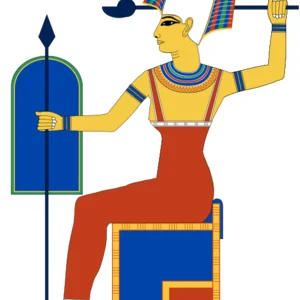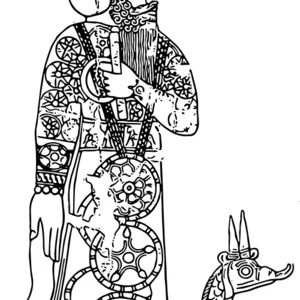

Marduk is the supreme god of the Babylonian pantheon, tutelary deity of the city of Babylon. He embodies creation, justice, and divine sovereignty. His rise to king of the gods is narrated in the creation epic *Enûma Eliš*.
Marduk
Marduk
9 min read
Frequently asked questions
Key Facts
- Tutelary god of Babylon, his veneration reached its peak under Nebuchadnezzar II (6th century BCE)
- The epic *Enûma Eliš* tells how Marduk defeats the goddess Tiamat and creates the world from her body
- His main temple, the Esagil, and the ziggurat Etemenanki (the probable model for the Tower of Babel) were located in Babylon
- Son of the god Ea, he receives the 50 names of the gods, symbolizing his dominion over the entire pantheon
- Under the Neo-Babylonian Empire, he became the equivalent of a national god, legitimizing royal power
Works & Achievements
A foundational mythological text in seven tablets recounting Marduk's victory over Tiamat and the creation of the world from the body of the defeated goddess. It is the central text of Babylonian theology, recited during the New Year festival.
A text in which Marduk speaks in the first person and describes his journeys to foreign lands during the abductions of his statue, foreshadowing the return of prosperity to Babylon. The text served as a theological justification for political crises.
A corpus of liturgical texts sung or recited by the priests of the Esagila during daily and festival rituals. These hymns celebrate the fifty names and attributes of Marduk, forming a poetic theology of remarkable depth.
Marduk decides to create humans so that they may serve the gods and build temples for them. He uses the blood of Kingu, commander of Tiamat's army, to fashion humanity, thereby accounting for the simultaneously divine and servile nature of human beings.
Following the victory over Tiamat, the gods build Babylon and the Esagila in honor of Marduk. This myth legitimizes Babylon's supremacy over all other cities and establishes its status as the center of the divine world.
A vast compilation of astral omens in which Marduk, identified with the planet Jupiter, presides over royal destinies. The text illustrates the fusion between Mardukean theology and Babylonian astronomical science.
Anecdotes
In the Babylonian creation epic, the *Enûma Eliš*, Marduk confronts Tiamat, the dragon-goddess of the primordial waters of chaos. He splits her in two: one half becomes the sky, the other the earth. This victory earns him the title of king of the gods and fifty sacred names that encapsulate all his powers.
The fifty names of Marduk, listed at the end of the *Enûma Eliš*, form a true divine encyclopedia. Each name corresponds to a power or cosmic function: master of magic, judge of the gods, creator of vegetation... Memorizing these names was a required exercise for Babylonian scribes in schools known as the *é-dubba*.
In 1595 BCE, the Hittites sack Babylon and carry off the statue of Marduk. For the Babylonians, this is a religious catastrophe: without his statue, the god is absent and the city is left to its fate. Five centuries later, around 1125 BCE, King Nebuchadnezzar I brings the statue back from Elam; this event is celebrated as a national rebirth and inspires new hymns.
The Babylonian New Year festival, the *Akitu*, lasted twelve days and featured Marduk as its central figure every year. The king would present himself before the god's statue, be stripped of his royal insignia by the high priest, and ritually humiliated before being restored to his position. This ceremony signified that royal power was only legitimate if Marduk granted it.
When Cyrus II of Persia conquers Babylon in 539 BCE, he destroys nothing: on the contrary, he presents himself as Marduk's chosen ruler and has it inscribed on the Cyrus Cylinder that the god himself guided him to the city. This political appropriation shows just how central Marduk was to Babylonian identity, even in the eyes of foreign conquerors.
Primary Sources
When on high the heavens had not yet been named, below the earth had not yet received a name, only Apsû existed, their primordial father, and Tiamat, the mother of all… Then Marduk rose against Tiamat and struck her down.
Lord Marduk, king of the gods of heaven and earth, who determines the fates of gods and men, you whose command is irrevocable and whose word is exalted.
I am Marduk, the great lord. I have left my temple, I have traveled through foreign lands. I have witnessed their rites and their sacrifices. Now I return to my sanctuary.
Marduk, the great lord, guardian of his people, looked with joy upon the good deeds of Cyrus and commanded him to march toward Babylon… He took him by the hand and named him king of all lands.
The Esagila, dwelling of Marduk, lord of the gods: its gate faces the rising sun. The inner chapel, where the divine image resides, measures nine cubits wide and twelve cubits long.
Key Places
The religious and political capital of Babylonian Mesopotamia, Babylon was the holy city of Marduk. All the prestige of the god was tied to the greatness of his city, and its destruction or restoration directly reflected the fate of the god.
The Esagila, whose name means "the house whose head is high," was the great temple of Marduk at the heart of Babylon. This was where his statue resided, where daily rituals were performed, and where the great religious festivals of the year took place.
The ziggurat Etemenanki, whose name means "the house that is the foundation of heaven and earth," was the sacred mountain linking the human world to Marduk's celestial realm. It most likely inspired the biblical myth of the Tower of Babel.
The ancient Sumerian religious capital and seat of the god Enlil, whom Marduk supplanted as king of the gods. The primacy granted to Marduk over Enlil reflected Babylon's rising political dominance over the older Sumerian city-states.
A city near Babylon, Borsippa was home to the temple of Nabu, son of Marduk and god of writing. The two cities were religiously linked and celebrated certain festivals together, with Nabu traveling in procession to join his father in Babylon.
Typical Objects

Marduk's primary symbol, the divine hoe or pickaxe represents his role as creator and agricultural deity. It appears on kudurrus (royal boundary stones) and Babylonian cylinder seals to mark the god's protection.

These mythical tablets contain the order of the world and the fate of all living beings. Marduk seizes them after his victory over Tiamat and becomes their supreme guardian, which establishes his absolute authority over all of creation.

Marduk's sacred animal, the mushussu is a hybrid creature with a serpent's body, lion's paws, and a bird's neck. Its image decorated the Ishtar Gate in Babylon and accompanied the god's statue in the Akitu processions.

Insignia of divine authority passed by Marduk to legitimate kings. When a Babylonian king received kingship, he was expected to receive them symbolically from Marduk's hands during the New Year ritual, affirming the divine source of his power.

Marduk uses an immense net to capture Tiamat during the cosmic battle described in the Enûma Eliš. Stretched across the four winds, this net symbolizes the god's all-encompassing power as he encircles and subdues primordial chaos.

Marduk's statue, made of solid gold according to some sources, was the living heart of his cult. Each day, priests would feed, wash, and dress it; its removal or return triggered national crises or celebrations.
School Curriculum
Vocabulary & Tags
Key Vocabulary
Tags
Daily Life
Morning
At dawn, the priests of the Esagila would open the doors of the sacred chamber and ritually awaken Marduk's statue by reciting hymns. They brought him a first meal of breads, beers, dates, and grilled meats, laid out on a richly adorned offering table.
Afternoon
During the day, the priests conducted oracular consultations on Marduk's behalf: worshippers would come to put their questions to the diviners, who interpreted the divine signs. Scribes copied sacred texts and trained future ritual specialists in the temple's annexe halls.
Evening
In the evening, a second round of offerings was presented to the statue before the sanctuary doors were closed. Musicians and sacred singers performed hymns to appease the god, and at night the statue was believed to rest and commune with the other celestial deities.
Food
The food offerings reflected the wealth of Mesopotamia: barley and spelt beers, breads of various kinds, beef, mutton and poultry, river fish, oils, dates, figs, and pomegranates. These foods, once presented to the statue, were then redistributed among the temple staff.
Clothing
Marduk's statue was dressed in luxurious garments of dyed wool and fine linen, sometimes adorned with gold and precious stones. It wore a multi-horned tiara — the mark of supreme divinity — and was decked with jewellery whose style varied according to the major festivals of the religious calendar.
Housing
Marduk resided in the Esagila, a true divine palace organised around a central courtyard and an inner chapel surrounded by numerous annexe rooms. This complex included storehouses, priests' quarters, workshops, and archives; the adjacent ziggurat Etemenanki served as a symbolic bridge between the divine and the human.
Historical Timeline
Period Vocabulary
Liens externes & ressources
Références
Œuvres
Enûma Eliš (Épopée de la création)
vers 1100 av. J.-C. (version canonique)
Prophétie de Marduk
vers 1100-1000 av. J.-C.
Hymnes et prières à Marduk
IIe-Ier millénaire av. J.-C.
Création de l'humanité (mythe de Kingu)
intégré dans l'Enûma Eliš, tablette VI
Construction mythique de Babylone et de l'Esagila
mythe fondateur, IIe millénaire av. J.-C.
Enuma Anu Enlil (traité d'astrologie babylonienne)
vers 1500-1000 av. J.-C.