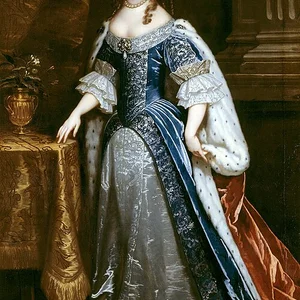

Seventeenth-century English natural philosopher and woman of letters (1623–1673), she developed her own theories on the nature of matter, drawing on atomism while proposing an original vitalist materialism. The first woman to attend a meeting of the Royal Society, in 1667.
Margaret Cavendish(1617 — 1673)
Margaret Cavendish
royaume d'Angleterre
8 min read
Frequently asked questions
Key Facts
- Born in 1623 in Colchester (England), died in 1673
- Published *Poems and Fancies* in 1653, a work blending poetry and atomist theory
- Wrote *Observations upon Experimental Philosophy* in 1666, a critique of experimental method
- Attended a meeting of the Royal Society in 1667 — the first woman to be admitted
- Developed a vitalist materialism: matter is animated by its own reason, in opposition to Descartes
Works & Achievements
Cavendish's first major work, blending poetry with atomist speculation inspired by Lucretius. It is one of the earliest texts to popularize atomic theories in the English language.
The first systematic exposition of her philosophy of nature, developing her theory of vitalist materialism, according to which all matter possesses its own form of perception.
A remarkable autobiography for a woman of her time, offering a valuable account of women's education, the Civil War, and the life of a female intellectual in the seventeenth century.
A rigorous critique of the Royal Society's methods, particularly Robert Hooke's Micrographia. Cavendish argues for the superiority of reason over instrumental observation.
A utopian and philosophical novel considered one of the earliest works of science fiction. A woman becomes empress of a fantastical world, allowing Cavendish to explore her theories in narrative form.
A biography of her husband the Duke of Newcastle, a valuable historical document on the Civil War and the Royalist exile, which also reveals much about Cavendish's own intellectual journey.
A revised and expanded version of her philosophical theories, representing the most complete synthesis of her thought on matter, motion, and universal perception.
Anecdotes
In May 1667, Margaret Cavendish became the first woman to attend a session of the Royal Society in London. Her visit caused such a stir that crowds gathered in the streets to catch a glimpse of the famous "Mad Madge." The society's most eminent members, including Robert Boyle and Robert Hooke, gave her demonstrations of their experiments with the microscope and other instruments.
Margaret Cavendish was renowned across Europe for her spectacular and disconcerting style of dress, blending masculine and feminine elements in entirely invented combinations. At the exiled court of Queen Henrietta Maria in Paris, her outfits drew as much admiration as ridicule. This sartorial extravagance was her assertive way of claiming an identity beyond convention.
In 1653, Margaret Cavendish published her *Poems and Fancies* under her own name, at a time when women who wrote almost always used a male pseudonym or remained anonymous. She justified this boldness in the preface by fully embracing it, making her a pioneer of female intellectual visibility in seventeenth-century England.
Her novel *The Blazing World* (1666) is today considered one of the earliest works of science fiction in world literature. In it, a woman becomes empress of a fantastical world populated by beast-men, and Cavendish inserts herself as a character — creating one of the first examples of autofiction in English literature.
During the years of continental exile with her husband William Cavendish, Margaret met and corresponded with major philosophers such as Descartes, Hobbes, and Gassendi. With no formal education whatsoever, she engaged them in genuine philosophical debates about the nature of matter, sometimes refuting their positions in her own published works.
Primary Sources
My atomes are not those of Epicurus, nor those of Des Cartes, but mine owne: and therefore I desire all my Readers and Friends, not to compare them with those of other Philosophers.
I desire all my Readers and Friends, not to Mistake Me for one that desires Fame; for I dare Declare, that I had rather be unknown, than have an ill Fame.
Art cannot introduce new matter, but only works upon the matter that nature hath given; neither can it go beyond the compass of nature, nor beyond the ability of natural parts.
By this Lady's means, the Emperor came to know the several natures of the inhabitants of that world, their several manners of government, their several sciences, arts and trades.
My father was a gentleman, which title is grounded and given by merit, not by princes; and 'tis the act of time, not favour. And though my brothers and sisters were several in number, yet we were bred virtuously, modestly, civilly, honourably.
Key Places
Birthplace of Margaret Lucas in 1623, born into a prosperous gentry family. The town was besieged and devastated during the Civil War, forcing her family to scatter and Margaret to join the royal court in exile.
City in the Spanish Netherlands where Margaret married William Cavendish in 1645 during their shared exile. The couple lived there for several years and moved in the intellectual circles of European refugees gathered around the court of Henrietta Maria.
City where Margaret lived in exile from 1644 at the court of Henrietta Maria, and where she met Descartes and Hobbes, whose ideas had a lasting influence on her own natural philosophy.
The Cavendishes' main residence after the Restoration of 1660, a vast ducal estate where Margaret wrote the bulk of her mature works and lived until her death in 1673.
The learned institution founded in 1662 that Cavendish visited in May 1667, becoming the first woman to attend one of its sessions. Robert Boyle and Robert Hooke gave her experimental demonstrations that fed into her published critiques.
Typical Objects

The primary tool of her intense intellectual activity, Cavendish wrote millions of words throughout her life, sometimes dictating to secretaries, sometimes in her own hand. Her extraordinary literary productivity was one of the things most remarked upon by her contemporaries.

The works of Descartes, Hobbes, Gassendi, and Boyle circulated in the intellectual circles she frequented during her exile. She studied them carefully to forge her own vitalist materialist theories, often in direct refutation of their positions.

During her visit to the Royal Society in 1667, she was shown experiments with Robert Hooke's microscope. She criticized its limitations in her *Observations*, arguing that the instrument produced illusions rather than revealing the truth of nature.

Margaret Cavendish was famous for her extraordinary costumes, blending masculine and feminine influences with bold necklines and unusual ornaments. Her outfits attracted fascination and commentary from her contemporaries across Europe.

Candlelight was indispensable for long late-night working sessions in her study. Margaret Cavendish was renowned for her dedication to intellectual work, including late into the evening in her apartments at Welbeck Abbey.

She drafted her ideas in handwritten notebooks before developing them into published works. Her husband William Cavendish, himself an author, actively encouraged her and sometimes contributed to revising her texts before they went to press.
School Curriculum
Vocabulary & Tags
Key Vocabulary
Tags
Daily Life
Morning
Margaret often rose late after long evenings of work or reading. Her mornings began with a careful toilette assisted by her ladies-in-waiting, as her elaborate outfits required meticulous preparation. She would then receive letters, welcome visitors, or consult her manuscripts in progress.
Afternoon
Afternoons were devoted to writing, dictating, or revising her texts in her private study, surrounded by books and papers. At Welbeck Abbey, she would sometimes converse with her husband — himself a philosopher and passionate horseman — or join him for walks through the grounds of their vast ducal estate.
Evening
Evenings were often spent in the company of the Duke of Newcastle and their guests over a refined dinner, enlivened by philosophical and literary conversation in which Margaret took an active part. She would then willingly extend her night by reading or writing by candlelight before retiring.
Food
The Cavendish ducal table was richly supplied with roasted meats, game, fish, pastries, and wines. Margaret had known the privations of exile during the Civil War, but after the Restoration, life at Welbeck Abbey was conducted on the scale of a great English aristocratic household, with an abundant kitchen governed by the seasons and the liturgical calendar.
Clothing
Margaret Cavendish was renowned across Europe for her extraordinary and provocative dress, wearing gowns with necklines considered indecent combined with masculine elements such as doublets and cloaks. This deliberate extravagance was for her a form of expression of her singular intellectual identity and her refusal of the conventions imposed on women of her rank.
Housing
After the Restoration of 1660, the Cavendishes resided chiefly at Welbeck Abbey in Nottinghamshire, a vast ducal seat that William was having renovated and enlarged. They also kept a house in London for their stays in the capital. During the years of exile, the couple had lived in rented lodgings in Antwerp and Rotterdam under considerably more modest conditions.
Historical Timeline
Period Vocabulary
Visual Style
Portrait baroque dans la tradition des grands peintres de cour anglais du XVIIe siècle, avec clair-obscur dramatique, costumes extravagants et accessoires philosophiques soulignant l'identité intellectuelle singulière de Cavendish.
Sound Ambience
L'atmosphère sonore d'une grande demeure aristocratique anglaise du XVIIe siècle, entre le crépitement du foyer et le grattement de la plume sur le parchemin, dans le recueillement propice au travail intellectuel.
Liens externes & ressources
Références
Œuvres
Poems and Fancies
1653
Philosophical and Physical Opinions
1655
A True Relation of My Birth, Breeding, and Life
1656
Observations upon Experimental Philosophy
1666
The Description of a New World, Called the Blazing World
1666
The Life of the Thrice Noble Prince William Cavendishe
1667
Grounds of Natural Philosophy
1668