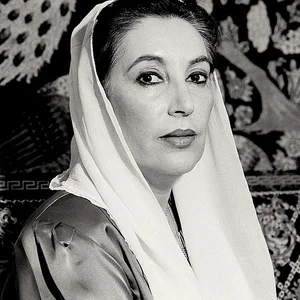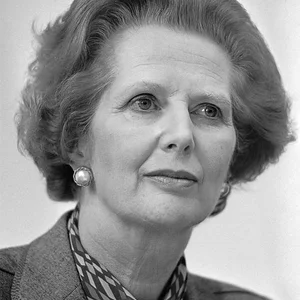

Margaret Thatcher, the first female Prime Minister of the United Kingdom (1979–1990), transformed the British economy through radical free-market policies. Nicknamed the “Iron Lady,” she privatized state-owned enterprises, took on the trade unions, and played a major role in ending the Cold War alongside Reagan and Gorbachev.
Margaret Thatcher(1925 — 2013)
Margaret Thatcher
Royaume-Uni, Royaume-Uni de Grande-Bretagne et d'Irlande
7 min read
Frequently asked questions
Famous Quotes
« There is no such thing as society.»
« The lady's not for turning.»
Key Facts
- First woman elected Prime Minister in Western Europe, in 1979
- Led the Falklands War against Argentina in 1982, which ended in a British victory
- Privatized numerous state-owned enterprises and confronted the miners' unions during the 1984–1985 strike
- Played a key diplomatic role in negotiations leading to the end of the Cold War
- Resigned in 1990 after losing the support of her own party over the poll tax
Works & Achievements
Political memoirs covering her eleven years at Downing Street, detailing her major decisions (Falklands, miners' strike, economic reforms). An essential first-hand account for understanding her policies.
Second volume of her memoirs covering her youth in Grantham, her studies at Oxford, and her rise in politics up to 1979. Sheds light on the ideological and personal foundations of Thatcherism.
Work on international politics setting out her views on NATO, Europe, and globalisation, written after her political retirement. Reveals her growing Euroscepticism.
A series of laws strictly regulating the right to strike and limiting union power, a cornerstone measure of Thatcherism that durably transformed British industrial relations.
A sweeping programme of state-owned enterprise sell-offs (British Telecom, British Gas, British Airways, British Steel) that inspired similar reforms across Western Europe.
Paradoxically, Thatcher signed this treaty creating the European single market, which she supported before becoming increasingly critical of European integration.
Anecdotes
Margaret Thatcher is the daughter of a Grantham grocer, Alfred Roberts, who passed on to her his values of rigour and thrift. She liked to repeat that it was in the family shop that she had learned to manage a budget before managing that of the state.
During the Falklands War in 1982, Thatcher made the controversial decision to send a military fleet 13,000 km away to retake the islands from the Argentinians. This decision, deemed risky by many, earned her a spectacular surge in popularity following the British victory.
Nicknamed 'The Iron Lady' by a Soviet military newspaper in 1976 on account of her staunch anti-communist stance, she embraced the nickname with pride and made it one of her most enduring political emblems.
Thatcher slept only four hours a night according to her aides, which allowed her to work until dawn on her files. She would readily declare that 'people who succeed don't have time to sleep'.
In 1984, she narrowly survived an IRA bomb attack that destroyed the Grand Hotel in Brighton where the Conservative Party's annual conference was being held. Five people died. Thatcher delivered her speech the following morning as planned, refusing to show the slightest sign of weakness.
Primary Sources
I knew that my convictions were not abstract ideas, but practical truths that had been tested in the real difficulties of life.
Today we were unlucky, but remember — we only have to be lucky once; you will have to be lucky always. This attack has failed. All attempts to destroy democracy by terrorism will fail.
We have ceased to be a nation in retreat. We have instead a new-found confidence — born in the economic battles at home and tested and found true 8,000 miles away.
Economics are the method; the object is to change the heart and soul.
You turn if you want to. The lady's not for turning.
Key Places
Thatcher's hometown, where her father Alfred Roberts ran a grocery shop above which she grew up. This provincial, commercial setting profoundly shaped her values of thrift and self-reliance.
The official residence of the British Prime Minister, which Thatcher occupied for eleven and a half years (1979–1990), longer than any other Prime Minister of the 20th century.
The seat of the British Parliament where Thatcher, first as an MP and then as Prime Minister, delivered some of the most memorable debates in contemporary British political history.
South Atlantic archipelago whose military recapture in 1982 following the Argentine invasion became the defining moment of the Thatcher legend.
The site of the IRA bombing in October 1984 that nearly killed Thatcher and a large part of her Cabinet, who had gathered for the annual Conservative Party conference.
Typical Objects

Her black handbag, always present at her public appearances, became such an iconic symbol that the verb 'to handbag' entered the English dictionary to describe her way of intimidating her interlocutors.

Thatcher consistently wore tailored suits in institutional colors (blue, red), designed to project authority and gravitas in what was then a very male-dominated political world.

This secure red briefcase containing classified government files accompanied every Prime Minister; Thatcher would often consult it very late at night or early in the morning.

Thatcher personally revised her speeches up to the last moment, covering her handwritten notes with corrections and emphases; her archives at the Bodleian Library preserve hundreds of them.

In her speeches, Thatcher regularly compared the national economy to that of an ordinary household to justify her austerity policies, a deliberately accessible rhetorical register.

Her privileged relationship with Ronald Reagan rested on frequent telephone exchanges that shaped Western policy throughout the 1980s in the face of the USSR.
School Curriculum
Vocabulary & Tags
Key Vocabulary
Tags
Daily Life
Morning
Thatcher rose around 6:00 AM after only four hours of sleep, a habit she attributed to her training as a diligent student. She would read the morning newspapers and listen to radio news from dawn, annotating articles that required a government response even before breakfast.
Afternoon
Her Tuesday and Thursday afternoons were dominated by Prime Minister's Questions in the Commons, an oratorical exercise she prepared for meticulously with her advisers. The remaining time was devoted to cabinet meetings, meetings with heads of state, and studying economic and diplomatic files.
Evening
Evenings at Downing Street frequently stretched past midnight or later; Thatcher worked in her study while her exhausted staff headed home. She enjoyed hosting official dinners and would sometimes prepare simple dishes herself for close friends and family, a reminder of her modest origins.
Food
Thatcher followed a strict and frugal diet, reflecting her values of economy: eggs, toast and tea in the morning, sandwiches or light meals at lunch. She was known for eating quickly and sparingly, preferring to devote time to work rather than to the table.
Clothing
She wore almost exclusively tailored suits in institutional colours — navy blue, burgundy, grey — made to measure to project authority and controlled femininity. Her black leather handbag and string of pearls were her constant accessories, forming an immediately recognisable silhouette.
Housing
She resided at 10 Downing Street for eleven years, the historic official residence at the heart of Westminster. Outside her official duties, she owned a house on Flood Street, Chelsea, a prosperous London neighbourhood, and spent her retirement at Chester Square, Belgravia.
Historical Timeline
Period Vocabulary
Visual Style
Un style visuel rigoureux et autoritaire associant les codes du pouvoir britannique traditionnel (pierre grise, drapeau Union Jack) au contraste social des années 1980 entre déclin industriel et essor financier.
Sound Ambience
L'univers sonore de Thatcher mêle les joutes oratoires du Parlement de Westminster, les bruits industriels d'une Grande-Bretagne en mutation et les sons feutrés du pouvoir à Downing Street.
Liens externes & ressources
Références
Œuvres
The Downing Street Years
1993
The Path to Power
1995
Statecraft: Strategies for a Changing World
2002
Réforme du marché du travail (Employment Acts 1980-1982-1984)
1980-1984
Privatisations des entreprises nationales
1979-1990
Single European Act (Acte Unique Européen)
1986