
Margherita Luti, known as la Fornarina (“the baker's daughter”), was the model and companion of the painter Raphael in Rome. Her face inspired several of his Madonnas and the famous portrait La Fornarina.
Margherita Luti(1500 — 1522)
Margherita Luti
6 min read
Frequently asked questions
Key Facts
- Active in Rome in the early 16th century (around 1515-1520), at the height of Raphael's Roman career
- Traditionally identified as the daughter of a baker from the Trastevere district, hence her nickname “la Fornarina”
- Presumed model of the painting La Fornarina (around 1518-1519), held at the Galleria Nazionale d'Arte Antica in Rome
- Her face is associated with several Madonnas and with Raphael's La Donna velata
- Companion of Raphael until the painter's death in 1520
Works & Achievements
Portrait for which Margherita is said to have posed, now one of the most famous images of the Renaissance; the bracelet bears Raphael's signature. Held in Rome (Galleria Nazionale d'Arte Antica).
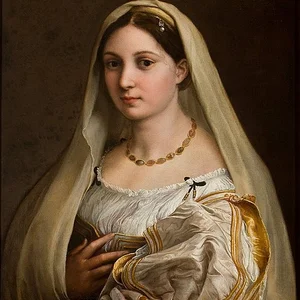
Portrait of a young veiled woman whose features are very close to those of La Fornarina; a masterpiece held at the Pitti Palace in Florence.
Famous Madonna by Raphael whose gentle face is said, according to tradition, to have been inspired by that of his companion. Pitti Palace, Florence.
Large Madonna by Raphael in which some commentators have believed they recognized the idealized features of La Fornarina. Held in Dresden.
Beyond any single work, Margherita's face is said to have shaped an entire type of gentle, ideal female figure in Raphael's painting in Rome.
Anecdotes
She is nicknamed "la Fornarina
meaning "the baker's daughter
because tradition holds that her father ran a bakery in Rome's Trastevere district. This nickname became more famous than her real name, to the point that it was long forgotten that she may have been called Margherita Luti.
On the famous painting La Fornarina, one notices a thin blue bracelet tied around the young woman's arm, bearing the signature "RAPHAEL VRBINAS
(Raphael of Urbino). It is as if the painter had wanted to inscribe his name on the very skin of his model
a sign of the bond that united them.
The biography of Raphael written by Giorgio Vasari recounts that the painter was so smitten with his companion that he could not work without her; for him to complete a commission, the young woman was reportedly even brought to him at the worksite.
Margherita's face is said to have inspired several of Raphael's Madonnas as well as the tender portrait of La Donna Velata (
The Veiled Woman
)
in which one recognizes features very close to those of the Fornarina.
A persistent legend, reported by Vasari, claims that Raphael died prematurely in 1520, at only 37 years old, exhausted by his amorous passion. Historians lean instead toward a fever, but the story of the Fornarina nourished for centuries the myth of the artist who died of love.
Primary Sources
Raphael was a man much given to love and very much attached to women, whom he was forever serving. It is said that he loved one of his mistresses so deeply that he could not apply himself to his work when away from her.
RAPHAEL VRBINAS — the painter's signature inscribed on the blue bracelet painted on the young woman's arm.
A mention of a Margherita, daughter of a Sienese baker established in Rome, identified by some scholars as the Fornarina; a nun at the convent of Sant'Apollonia is recorded under the name of Raphael's widow after 1520.
Key Places
Working-class district of Rome, on the right bank of the Tiber, where tradition places her father's bakery and Margherita's family home.
Capital of the patron popes Julius II and Leo X, artistic center of the Renaissance where Margherita lived her entire life and met Raphael.
Villa of the wealthy banker Agostino Chigi, on the Tiber, where Raphael worked on great frescoes; tradition holds that the Fornarina accompanied him there.
The painter's place of work, where Margherita posed as a model for his portraits and Madonnas.
Roman convent where, according to documents, a “Margherita, widow of Raphael” is said to have withdrawn after the painter's death in 1520.
Typical Objects

A thin blue band of goldsmith's work tied around the arm, bearing the signature "RAPHAEL VRBINAS". In the painting, it serves as a mark of belonging and of love.

A fine transparent fabric laid over the hair or the body, present in La Fornarina as in La Donna Velata. It evokes both modesty and seduction.

A fabric striped with gold and colors wound around the head, fashionable in Renaissance portraits. It gives the sitter an air that is at once exotic and noble.

A large wooden chest in which dough is kneaded, the basic tool of her supposed father's bakery. It is this trade that is said to have given Margherita her nickname of "Fornarina".

Raphael's tools, with which he captured the face of his companion on canvas. They embody the studio where Margherita posed as a model.

Foliage painted in the background of La Fornarina: myrtle is the shrub of Venus, goddess of love, and the quince a symbol of marriage and fertility.
School Curriculum
Vocabulary & Tags
Key Vocabulary
Daily Life
Morning
If we follow the tradition of the baker's daughter, her morning began early, in step with the oven: helping to knead the dough and sell warm bread to the neighbors of Trastevere. Once she became the companion of a famous painter, her mornings might instead be spent getting ready to pose in the studio.
Afternoon
In the afternoon, she would go to the studio or to the sites where Raphael was working, such as the Villa Farnesina. She stayed there for long hours, motionless, while the painter captured her face on the canvas.
Evening
In the evening, Roman life carried on with meals and conversations among artists, patrons, and the painter's friends. Margherita shared the brilliant existence of one of the most admired men in Rome.
Food
People ate bread (everywhere), vegetable soups, pasta, a little meat or fish depending on the day, all washed down with wine cut with water. Fruits such as quince, figs, and grapes rounded out the meals.
Clothing
In the portraits, she wears fine fabrics: a sheer veil, a turban striped with gold, precious textiles that hint at the skin beneath. In the real life of a woman of the people, clothing was simpler: a dress of wool or linen and a head covering over the hair.
Housing
Coming from Trastevere, she most likely lived in a modest house in this working-class neighborhood, above or near the shop. With Raphael, by contrast, she frequented rich residences and villas decorated with frescoes.
Historical Timeline
Period Vocabulary
Liens externes & ressources
Références
Œuvres
La Fornarina (portrait par Raphaël)
vers 1518-1520
La Donna Velata (La Femme voilée)
vers 1512-1516
Madone à la chaise (Madonna della Seggiola)
vers 1513-1514
La Madone Sixtine (visage de la Vierge)
vers 1512-1513