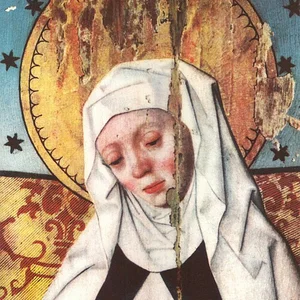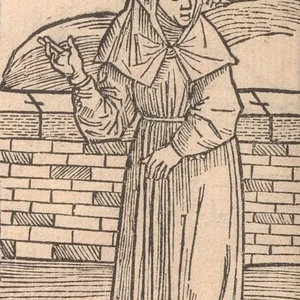

A 14th-century Beguine mystic, Marguerite Porete is the author of The Mirror of Simple Souls, a mystical treatise written in the vernacular. Condemned for heresy by the Inquisition, she was burned alive in Paris in 1310, refusing to recant.
Marguerite Porete(1250 — 1310)
Marguerite Porete
royaume de France
7 min read
Frequently asked questions
Famous Quotes
« The annihilated Soul has neither will nor desire, except what God wills within her.»
Key Facts
- Around 1296: composition of The Mirror of Simple Souls in Old French
- 1306: her book is condemned and publicly burned in Valenciennes by Bishop Guy of Colmieu
- 1308–1310: arrested and tried by the Inquisition in Paris under Guillaume de Paris
- June 1, 1310: burned alive at the Place de Grève in Paris for obstinate heresy
- 19th–20th centuries: rediscovery and attribution of The Mirror to Marguerite Porete after centuries of anonymity
Works & Achievements
A mystical treatise written in Old French, presented as an allegorical dialogue between Love, the Soul, and Reason. It is the only known work by Marguerite Porete and one of the earliest major texts of Christian mysticism written in a European vernacular language.
Anecdotes
Marguerite Porete wrote her Mirror of Simple Souls in Old French, the language of the people, rather than in Latin reserved for the clergy. This bold choice allowed laywomen — often excluded from scholarly education — to read and meditate on her mystical teachings.
Condemned for the first time around 1306, her book was publicly burned in Valenciennes in her presence, and she was forbidden from distributing new copies. Despite this warning, Marguerite continued to circulate her work, which led to her second arrest.
Imprisoned in Paris for nearly eighteen months, Marguerite Porete refused to take an oath before the inquisitors and maintained absolute silence throughout her trial. This deliberate silence — an act of spiritual resistance — was interpreted as an admission of contempt and hastened her death sentence.
On June 1, 1310, at the Place de Grève in Paris, Marguerite was burned alive. Chroniclers report that the onlookers were deeply moved by the serenity and dignity with which she faced the pyre, with some of them shedding tears.
For centuries, the Mirror of Simple Souls was wrongly attributed to other authors, including Ruusbroec. It was not until 1946 that scholar Romana Guarnieri formally identified Marguerite Porete as the author of the work, restoring this woman's rightful place in the history of medieval mysticism.
Primary Sources
The annihilated Soul wants nothing, and wills not to will, for she no longer has a will of her own. She is free from all things, for she desires nothing that is beneath God.
In that same year, a certain beguine, an obstinate heretic, refusing to recant her errors, was burned in Paris before a great crowd of assembled people.
Margareta dicta Porete de Hannonia, quaedam beguina, combusta est Parisius pro haeresi, cum libro suo, quem ipsa composuerat.
The said Marguerite, convicted of heresy, having refused to swear and to answer the inquisitor's questions, is declared a relapsed heretic and handed over to the secular arm.
Key Places
Presumed birthplace of Marguerite Porete, then part of the County of Hainaut. It was here that her book was burned for the first time around 1306, following her initial condemnation.
The site of Marguerite Porete's execution on June 1, 1310. Located on the Right Bank of the Seine, this square was the main place of public punishment in medieval Paris.
The theologians of this institution condemned the theses of the Mirror in 1309, providing the doctrinal basis for the inquisitorial trial against Marguerite.
The beguine community in which Marguerite likely lived. Flemish and Picard beguinages were active centers of independent female spirituality during the 13th and 14th centuries.
Although Marguerite was from Picardy, her work belongs to the tradition of Rhenish mysticism, centered in Strasbourg and Cologne. Theologians such as Meister Eckhart were possibly familiar with her writings.
Typical Objects

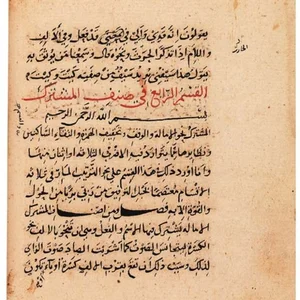
The Mirror of Simple Souls was copied by hand onto parchment and circulated clandestinely among readers. Possessing this manuscript was an act of resistance after its condemnation in 1306.

Beguines wore a habit of grey or brown wool, neither nuns nor ordinary laywomen. This garment symbolized their life of chastity and voluntary devotion, lived outside the official religious orders.

A book of liturgical prayers used for the daily offices, the breviary structured Marguerite's spiritual day. Beguines practiced an intense devotion nourished by sacred texts in both Latin and the vernacular.

Candles accompanied individual and communal prayer in the beguinages. In medieval mysticism, their flame symbolized the soul rising toward God and consuming itself in him.

The writing instruments with which Marguerite composed her mystical treatise. Whether she wrote directly or dictated her work, these tools represent her act of authorship — remarkable for an uncloistered woman in the 13th century.

A symbol of her captivity during the eighteen months of imprisonment before her execution. This period of confinement was for Marguerite a mystical trial, endured in silence and spiritual resignation.
School Curriculum
Vocabulary & Tags
Key Vocabulary
Daily Life
Morning
Marguerite rose before dawn to attend Matins, reciting the psalms together with the other beguines. The morning was devoted to silent prayer and the reading of sacred texts, in her cell with whitewashed stone walls.
Afternoon
In the afternoon, Marguerite wrote and copied her mystical treatise, striving to put into words a spiritual experience that went beyond ordinary categories. She also took part in the collective manual work of the beguinage — sewing, spinning, caring for the sick — which funded the community's independence.
Evening
In the evening, after communal Vespers, Marguerite entered a state of deep contemplation she called the annihilation of self in God. These nocturnal hours, between wakefulness and sleep, were for her the privileged time of mystical union.
Food
The beguines followed a simple, frugal diet: coarse bread, garden vegetables, grain soup, fish on days of abstinence, and meat only rarely. Voluntary table poverty was experienced as spiritual asceticism, with frequent fasting preparing the soul for contemplation.
Clothing
Marguerite wore the characteristic beguine habit: a coarse grey or brown woolen dress, a white veil covering the head, and a rope belt. Neither the luxurious garments of the noblewoman nor the official monastic habit, this clothing represented a third way between the world and the cloister.
Housing
Marguerite lived in an individual cell within the beguinage — a small, plain room furnished with a straw bed, a prie-dieu, a table, and a chest for her manuscripts. The beguinage formed a semi-autonomous, walled district with a garden, a chapel, and a common room, set apart from the noise of the city.
Historical Timeline
Period Vocabulary
Visual Style
Enluminure gothique franco-flamande du XIVe siècle, alliant la sévérité des tons monochromes au rayonnement de l'or symbolisant la lumière divine, avec une figure féminine au visage serein malgré les flammes.
Sound Ambience
Atmosphère d'un béguinage médiéval entre recueillement et tension, mêlant le chant liturgique des femmes, les cloches des offices et le silence pesant de la cellule d'une prisonnière.
Liens externes & ressources
Références
Œuvres
Le Miroir des âmes simples et anéanties
vers 1295-1306