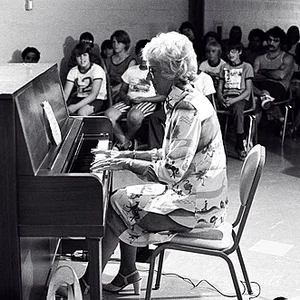

British-American jazz pianist Marian McPartland made her mark on the New York scene from the 1950s onward. She is best known for hosting the radio show “Piano Jazz” for more than thirty years on the American public radio network NPR.
Marian McPartland(1918 — 2013)
Marian McPartland
États-Unis, Royaume-Uni, Royaume-Uni de Grande-Bretagne et d'Irlande
6 min read
Frequently asked questions
Key Facts
- Born Margaret Marian Turner in 1918 in Slough, England
- Settled in the United States after World War II and married cornetist Jimmy McPartland in 1945
- Led her own trio at the New York club Hickory House in the 1950s
- Hosted the show “Marian McPartland's Piano Jazz” on NPR from 1978 to 2011
- Died in 2013 in Port Washington (New York State)
Works & Achievements
Her flagship radio show, blending interviews and improvised duets, which became the longest-running jazz program on American radio.
The record label she founded and ran to release her own music and that of musicians she admired.
One of her best-known compositions, for which lyricist Johnny Mercer wrote the words and which Tony Bennett recorded.
An original ballad that showcases her gift as a composer, beyond performing and improvising.
Trio recordings capturing the excitement of her shows in the clubs of 52nd Street in New York.
A collection of her writings on jazz and her memories, a precious record of an era and its musicians.
Anecdotes
Born into an English family that groomed her for classical piano, Marian Turner abandoned her serious studies in the late 1930s to join a four-piano music-hall act led by Billy Mayerl. Her parents, shocked that she was playing “light” music, took a while to accept this bold choice — which nonetheless launched her career.
During the Second World War, she entertained Allied troops near the front lines with the British organization ENSA, then with the American USO. It was in this way that she met the American cornetist Jimmy McPartland in 1944; they married in February 1945 in Aachen, Germany, while the war was still raging.
The famous jazz critic Leonard Feather reportedly told her she had “three handicaps” to making it in American jazz: she was English, white, and a woman. Marian McPartland spent her entire career disproving that judgment, becoming one of the most respected pianists in the United States.
In the 1950s, her trio was in residence at the Hickory House, a club on New York's famous 52nd Street. She had an ear for spotting talent: her young drummer Joe Morello was “poached” in 1956 by Dave Brubeck's quartet, with which he became a worldwide star.
In 1978, she launched the show “Piano Jazz” on the American public radio network NPR, where she chatted and then improvised duets with a different guest each week. Her very first guest was the pianist Mary Lou Williams. Broadcast for more than thirty years, the show became the longest-running jazz program on American radio.
Primary Sources
The critic reportedly told her that she had “three strikes against her” in jazz: she was English, white, and a woman.
Each episode brings together the host and a guest for a conversation followed by improvised piano duets, a direct testament to her way of teaching and conversing through music.
In it she gathers portraits of the jazz musicians she crossed paths with and recounts her own beginnings, from England to the New York clubs.
Key Places
Town near Windsor where Margaret Marian Turner was born in 1918, into an English middle-class family.
London conservatory where she received a classical musical training before branching off into music hall and jazz.
City where she married Jimmy McPartland in February 1945, while she was entertaining Allied troops at the end of the war.
Jazz club where her trio was in residence during the 1950s, in the heart of New York's “Swing Street.”
Home of the educational broadcaster South Carolina ETV, which produced and distributed her program “Piano Jazz” for NPR.
Long Island community where she lived during her final years and where she died in 2013.
Typical Objects

The instrument of her entire life, which she played with elegance in clubs as well as in the studio of “Piano Jazz.”

A symbol of her second profession: for more than thirty years, she hosted conversations and duets with her guests at the NPR microphone.

Vinyl records released on her own label, Halcyon Records, founded in 1969 to share her music and that of other jazz musicians.

She composed her own pieces, such as “Twilight World,” and jotted down themes and arrangements on manuscript paper.

An honour bestowed by the United Kingdom in 2010, recognition of her career by her country of origin.

On stage and on television, she cultivated a refined appearance, the very image of the sophisticated jazz pianist of the 1950s.
School Curriculum
Vocabulary & Tags
Key Vocabulary
Tags
Daily Life
Morning
Mornings were often quiet and studious: Marian McPartland would sit at the piano to work on her pieces, read through standards, and search for new arrangements. The taping days for *Piano Jazz* began with preparing the tunes she would play with that day's guest.
Afternoon
Afternoons might be devoted to rehearsals with her trio, recording sessions in the studio, or interviews. During the radio broadcasts, she welcomed her guest to talk about their career before improvising together.
Evening
The life of a club pianist was mostly nocturnal: the concerts at the Hickory House and in the New York clubs stretched late into the evening, before a seated audience. She played several jazz sets one after another into the heart of the night.
Food
Like many jazz musicians with irregular schedules, she ate at odd hours, often late after concerts. Mid-twentieth-century American dining (diners, neighborhood restaurants, snacks grabbed between two sets) set the rhythm of her daily life.
Clothing
On stage, she cultivated a polished elegance: dressy gowns and refined outfits matching the sophisticated image of the cocktail and club pianist of the 1950s. On radio and television, she always remained impeccably groomed.
Housing
After settling in the United States, she first lived in New York apartments, close to the clubs where she played. Later, she resided in Port Washington, on Long Island, in a more peaceful setting away from the bustle of Manhattan.